Story
The Sphinxes Behind the Mirror
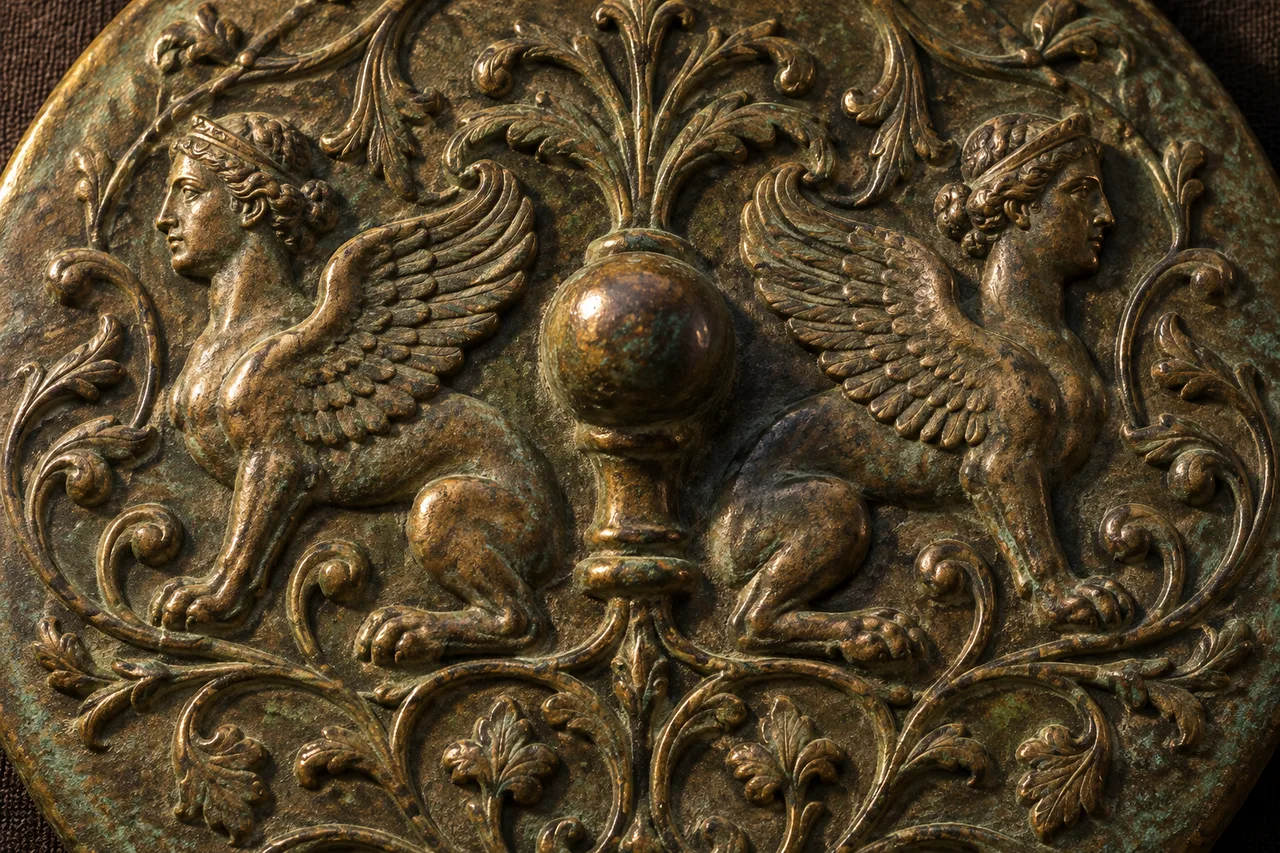
Two faces on the reverse
The eye goes first to the faces. On the reverse of a bronze mirror in the Cleveland Museum of Art, two human-headed, winged lions appear back to back beside a raised central knob, with winding vegetation around them. The museum’s title, Mirror with Addorsed Sphinxes, names their arrangement: “addorsed” means back to back. It is a compact composition with plenty to hold the gaze. Cleveland Museum of Art
The mirror measures 10.6 centimetres across and weighs 160 grams. Cast in bronze and decorated in relief, it is dated to the 1200s and attributed to eastern Anatolia or northern Mesopotamia. These particulars give the object a satisfying physical presence in the imagination: a small circle, a stated weight, decoration rising from its surface. Cleveland Museum of Art
There is a particular pleasure in the way this small space brings together faces, wings, animal bodies and plants. Each detail offers a different point of attention, while the paired creatures give the design its centre of gravity. For someone drawn to the close looking that jewellery invites, the appeal may feel immediate. A modest area of metal can become a whole field of interest.
A resemblance across collections
A second mirror, in LACMA, brings the Cleveland example into a wider conversation. It too is cast bronze and attributed to eastern Anatolia or northern Mesopotamia. LACMA dates it to the early thirteenth century and gives its diameter as 11.43 centimetres, slightly larger than the Cleveland mirror. Together, their measurements make the scale of these objects particularly easy to picture. LACMA
The geographical wording deserves room in the story. Both records retain a choice between two regions. That “or” keeps the precise place of manufacture open, even as the objects acquire a place on our mental map. Their appeal does not depend on attaching a more exact location than the catalogues allow.
A related mirror in Hamburg’s MKG Museum for Applied Arts extends the comparison. The Museum With No Frontiers catalogue identifies it as Iranian, dates it to the twelfth–thirteenth century and places it in the Seljuq period. Also cast in bronze, it measures 10.8 centimetres across. Its centre has a perforated lug handle, a distinct detail alongside the raised knob described on the Cleveland example. Museum With No Frontiers
The same catalogue describes increased production of round cast-bronze mirrors with fully decorated backs during the Seljuq period, and notes comparable examples in several collections. That context gives the resemblance a wider setting, while the different central features and attributions leave each mirror its own identity. Museum With No Frontiers
A mirror asked for answers
The Hamburg mirror gives the story its most intimate words. Its reverse bears two sphinxes with scorpion tails amid floral ornament, while a Kufic inscription runs around the rim. The inscription invokes God, mentions an angel associated with Saturn and describes receiving answers through the mirror about this world and the next. Museum With No Frontiers
A small object suddenly carries an immense request. The words allow us to encounter the idea of a mirror as a place where hidden knowledge might become accessible. The desire expressed in the inscription reaches far beyond the dimensions of the bronze. That tension between a contained surface and an expansive appeal gives this example much of its fascination.
The catalogue suggests that the imagery, combined with the inscriptions, may have given such mirrors a protective role comparable to that of amulets intended to ward off evil. The possibility matters: protection is a scholarly interpretation offered for these objects, with the wording preserving uncertainty. Museum With No Frontiers
The explicit appeal for supernatural assistance belongs to the Hamburg inscription in this comparison. It gives us something concrete to read alongside the creatures. The Cleveland mirror retains its own quieter fascination, with its paired sphinxes and patterned surface. There is room to be absorbed by both while allowing their individual evidence to shape the story.
The pleasure of a small surface
For a reader who loves jewellery, these mirrors offer a familiar kind of attraction: detail concentrated into a form that rewards attention. A face draws the eye; a wing or a winding stem keeps it there. The relationship between a central feature and the decoration around it can be as engaging as any single creature.
Their small scale also gives the story warmth. Exact measurements sit beside questions that remain open, and the Hamburg inscription brings a voiced appeal into view. We can appreciate the arrangement of the ornament while feeling the pull of what it may have meant.
The faces on the reverse are what linger: two sphinxes sharing a circle of bronze, surrounded by vegetation, holding our attention long after the measurements have faded from memory.