Story
The Gold Ewer That Returned to Anatolia
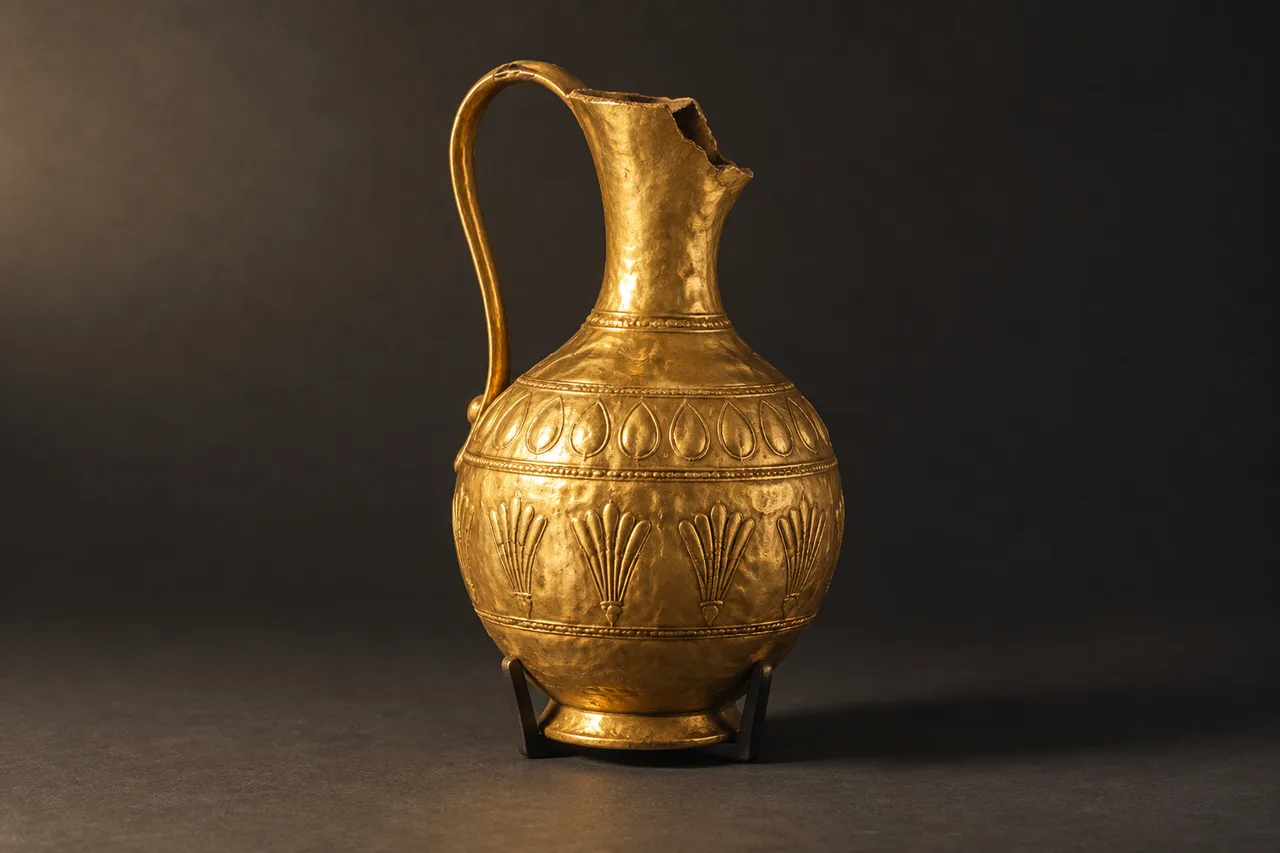
Gold can catch the eye before a shape has fully registered. When metalsmith Adi Toch first encountered the Gilbert Collection’s Hattian ewer in 2015, its colour and embossed surface drew her in. Handling it brought another surprise: the edges looked almost impossibly thin, yet the vessel felt remarkably heavy. Her account gives this ancient object a rare immediacy. We can imagine the difference between what the eye expects and what the hand discovers, without knowing the name of the person who made it. The Goldsmiths’ Company
That encounter offers a way into a story about craftsmanship, collecting and the meaning of return. The ewer’s beauty remained compelling as research changed the understanding of its recent history. A contemporary maker would eventually give that change a form of its own.
A small vessel, closely observed
The V&A dates the ewer to approximately 2500–2000 BCE and attributes it to a Hattian goldsmith working in Anatolia. Its maker shaped gold sheet into a vessel and embossed it with decorative patterns. There is something arresting about holding those two descriptions together: a sheet of metal, and the rounded volume that emerged from it. The finished object makes that transformation visible without revealing its maker’s identity. V&A
Its bulbous body narrows into a slender neck, accompanied by a thin handle. The rounded base cannot stand unsupported. Toch recognised a demanding piece of metalwork in the transition from the broad body to the narrow neck; she also recognised a connection with techniques still used in her own field. The Goldsmiths’ Company reports the alloy as 90% gold, 9% silver and 1% copper. Those proportions give the object a material identity as specific as its silhouette. The Goldsmiths’ Company
For a reader drawn to jewellery, this is an inviting scale of attention: the edge, the curve, the relationship between apparent delicacy and actual weight. The pleasure lies in giving each detail time, allowing a small vessel to occupy the imagination.
An unusual acquisition
Arthur Gilbert purchased the ewer in Los Angeles in 1989. The V&A describes his fascination with its bright gold and accomplished workmanship, an attraction that is easy to understand after reading Toch’s account. An ancient maker’s work had found another admirer, this time a collector whose interests were centred on British and European decorative arts. Anadolu Agency, V&A
The ewer occupied an exceptional position: it was the Gilbert Collection’s only antiquity. The collection was placed on long-term loan at the V&A in 2009, but the ewer was never displayed in its Gilbert gallery. According to The Art Newspaper, that absence initially reflected how different it was from the collection’s European decorative art; it was unrelated to concerns about provenance. This detail matters to the later story, because the return would change the collection without removing a familiar object from its gallery displays. The Art Newspaper
The history behind the beauty
In 2018, the Gilbert Trust appointed provenance curator Jacques Schuhmacher. He began investigating the ewer the following year. Provenance concerns the history of ownership: the people and collections through which an object has passed. Here, that inquiry brought troubling information into view about the dealer who had sold the vessel to Gilbert and his involvement in illicit antiquities. The Art Newspaper
The Trust shared its research with Turkey’s Ministry of Culture. The ministry’s experts established that the ewer had been illegally excavated and exported, and that Gilbert had been deceived about its provenance. In October 2021, the Gilbert Trust donated it to the Museum of Anatolian Civilisations in Ankara. There it went on display alongside objects of the same period, gaining a setting in which its cultural and historical connections could be explored. V&A
For someone who loves precious objects, this turn in the story gives ownership another dimension. Admiration can begin with a surface or a silhouette; understanding asks where the object has been and how it came to be there. The ewer’s journey makes those questions inseparable from its appeal.
A form for letting go
The return also prompted a new commission. In Place to Place, made in 2021, Toch answered the ancient ewer with a gold funnel. Made from a recreation of the ewer’s alloy, the funnel rested on carved, creamy white, translucent chalcedony. Its polished interior was open to view, inviting visitors to look inside and encounter their own reflection. V&A Blog
The ewer’s broken spout helped shape Toch’s thinking: she saw it as a metaphor for lost direction. A funnel offered passage and a renewed direction, while its usual role accompanying another container suggested something absent. In her interpretation, its openness expressed generosity, giving the return a visible presence within the collection. V&A Blog
It is a thoughtful ending to a story that began with the attraction of gold. The funnel allows us to imagine value in the act of passing something onward. The ancient ewer and Toch’s response invite the same sustained attention—to material, to form, and to the histories that make a beautiful object matter.