Story
Gordion’s Bronze Fibulae: Adornment Beside a King
A cloth bag on a table near a dead king’s head contained 145 bronze garment pins, or fibulae. Another 37 lay among the textile remains inside his coffin. These finds, recorded during Rodney Young’s excavation of Gordion’s Tumulus MM in 1957, bring a royal burial into unusually intimate focus. Metal, cloth, a place beside the body: the details are small enough to feel close, even across the centuries. Penn Museum: Tumulus MM
For anyone drawn to jewelry, the pins offer an absorbing meeting of use and beauty. The relationship between clothing and ornament becomes a story worth lingering over, beginning with the expressive shape of the fastening itself.
A royal setting, an uncertain name
Gordion was the capital of ancient Phrygia, at the site of modern Yassıhöyük, southwest of Ankara in Turkey. Within its fortified citadel, elite houses and administrative buildings stood alongside storehouses and workshops. This gives the fibulae a setting beyond the burial chamber: a city where making, storing and governing occupied the same enclosed landscape. Penn Museum: Gordion Archaeological Project
The initials MM mean “Midas Mound,” but the name is more certain than the occupant’s identity. The wooden burial chamber dates to around 740 BCE, while Midas appears in Assyrian records as late as 709 BCE. The chronology points to an earlier king, possibly his father. Nothing found with the burial names the dead man. Even its familiar name opens onto an unresolved question about the person at the center of the tomb. Penn Museum: Tumulus MM
A fastening with sculptural presence
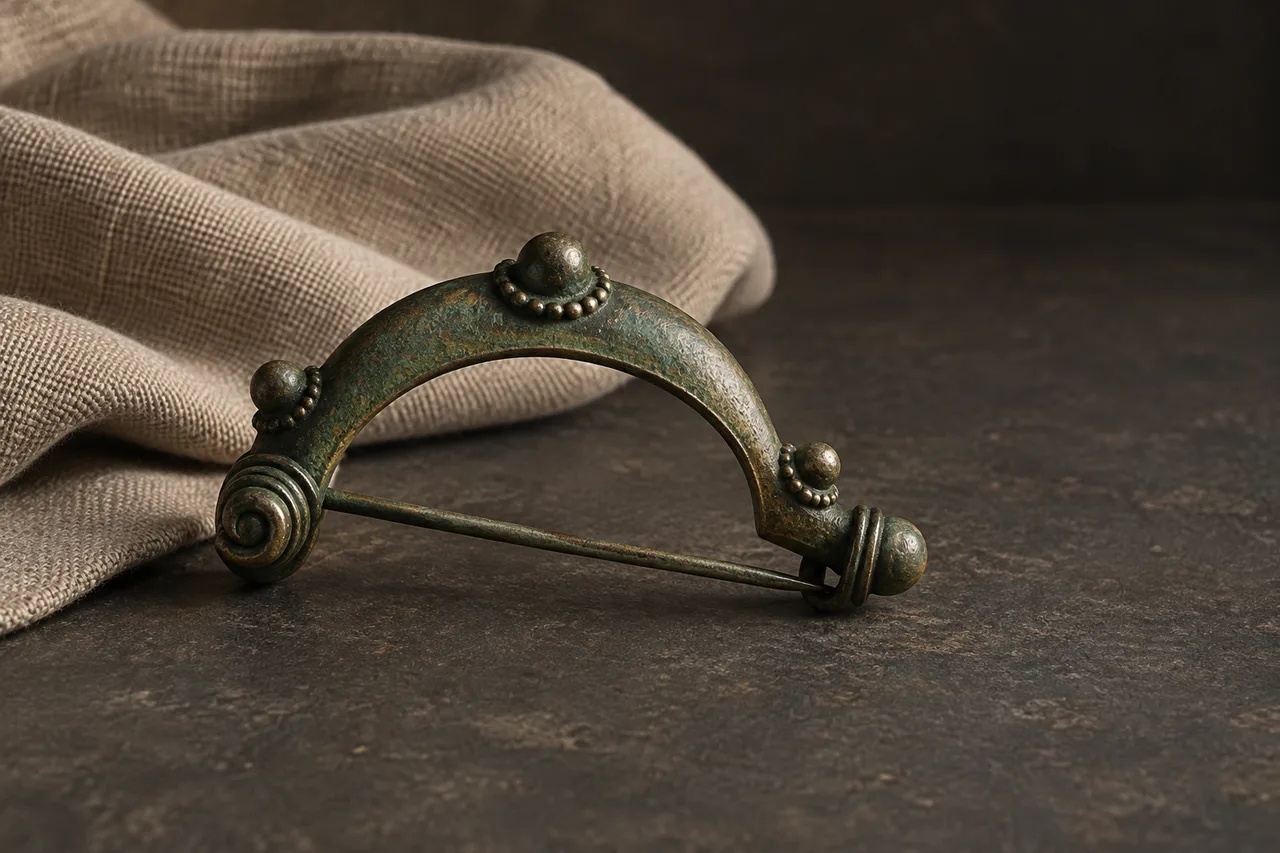
A separate museum example gives a useful sense of scale. The Cleveland Museum of Art’s bronze arched fibula, accession 1999.87.1, dates to 725–675 BCE and measures 6 × 7.5 centimeters. The museum suggests that its two fibulae may have been a matched pair. Those dimensions invite us to consider the object almost as a small sculpture, with a silhouette substantial enough to command attention on its own. Cleveland Museum of Art: Arched Fibulae
Some particularly elaborate Phrygian fibulae have two pins beneath detachable covering plates, or shields. Their decoration includes studs, incised lines and cutouts; most known examples of this construction came from Tumulus MM. Raised accents, fine lines and openings through the metal offer different rhythms to the eye. The distinction between the curved body and its decorated plate gives these fasteners more than one surface to explore. Maya Vassileva: Phrygian Bronzes in the Greek World
There is pleasure here in the balance between an outline and its details. The bow establishes the larger gesture; the ornament interrupts and enriches it. Seen this way, workmanship becomes something we can appreciate through the finished object’s proportions, without needing to reconstruct every action that made it.
The question inside the cloth bag
The royal tomb is only part of the fibula’s setting. Phrygian examples also occur in settlement deposits on Gordion’s City Mound. Archaeologist Maya Vassileva describes them as prestigious dress ornaments and suggests that they may have circulated as gifts among aristocrats. Finds in both the town and its burials place these objects within a wider social world, although they cannot tell us the personal history of every pin. Maya Vassileva
The authors of the Penn Museum account offer one possible explanation for the concentration of fibulae beside this king. Funeral guests may have removed fibulae from their own clothing and left them as parting gifts. The pins might then have been collected into the cloth bag for transport to the tomb. The authors present this as a hypothesis. The find preserves the objects and their locations; the gesture behind them remains uncertain. Penn Museum: Tumulus MM
The possibility gives the bag an emotional presence. A personal ornament could have become a token of farewell. That thought links the pleasure of wearing something with the significance of giving it away. The pins remain tangible; the relationships that may have brought them together stay just beyond reach.
A form beyond Phrygia
One royal image brings an elaborate fibula into view on a wearer. At İvriz, a rock relief depicts the Tabalian king Warpalawa with a double-pin Phrygian fibula and a studded bow. Vassileva links the image to high status and suggests that the fibula could have been a diplomatic gift. Maya Vassileva
Phrygian-type fibulae also reached Greek sanctuaries, including those at Ephesos, Miletos, Samos and Chios, where they were dedicated as offerings. Dedications of Phrygian belts and fibulae peaked in the seventh century BCE and continued into the sixth. Greek makers produced imitations, sometimes difficult to distinguish from imports. Stone casting molds found at Smyrna/Bayraklı and Miletos add evidence for the local making of these forms. Maya Vassileva
For a modern jewelry lover, the appeal can begin with the curve of a bow or the measured repetition of studs. Gordion adds the intimacy of cloth and a royal coffin, and the unanswered question of why so many ornaments were gathered there. A small fastening can hold the eye for its shape, then hold the imagination for everything its surviving form cannot quite disclose.