Story
A Seahorse and Its Double
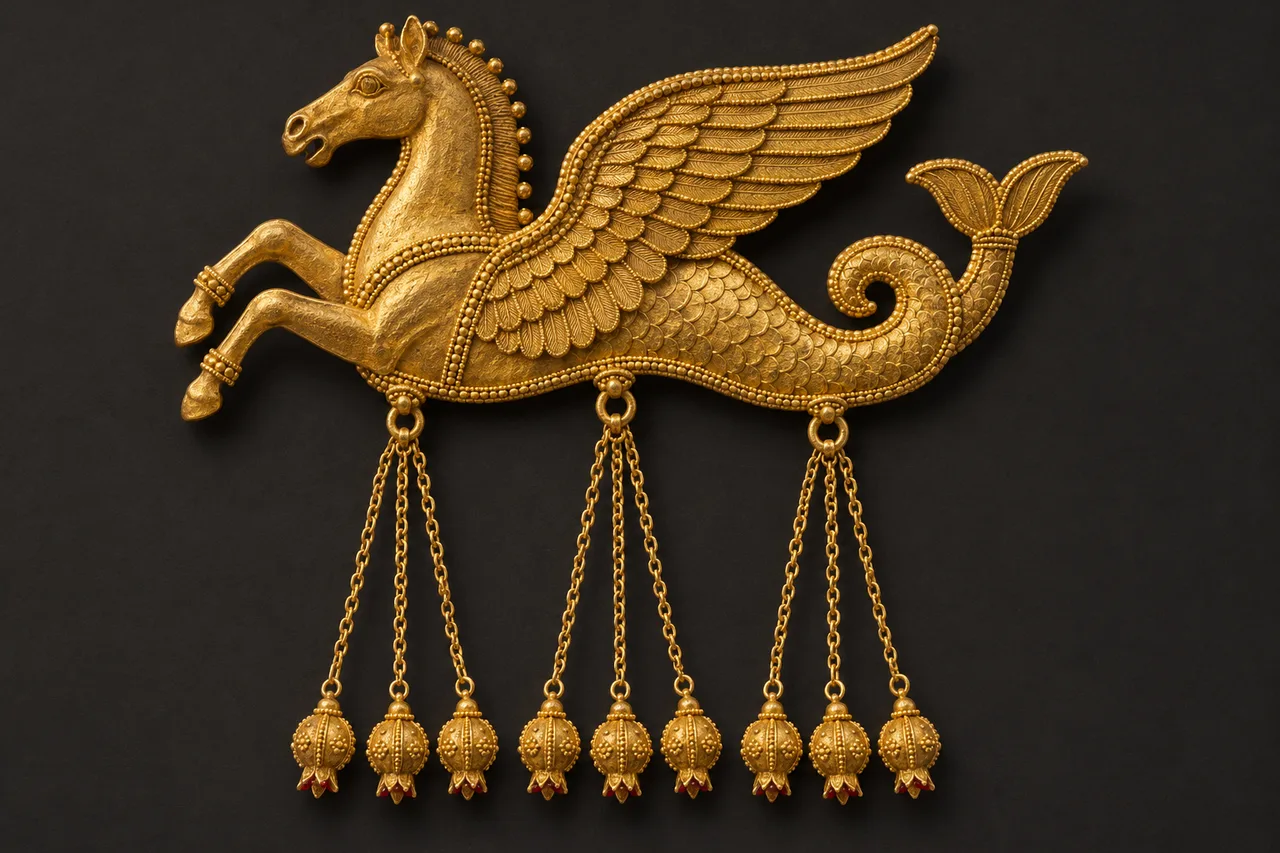
The first surprise is its size. The winged-seahorse brooch weighs 14.3 grams and measures 3.4 centimetres high by 2 centimetres wide. Those figures give an intimate scale to an object whose story crosses borders and centuries. For a jewellery lover, they also make the prospect of looking closely irresistible: how much can such a small piece hold? Aktüel Arkeoloji
This gold creature belongs to the collection known as the Karun Treasure, or Lydian Treasure, described by Uşak Museum. Its beauty is one invitation into that collection; its encounter with a museum double is another. The story brings the pleasures of ornament into unexpectedly close contact with the work of identifying an ancient object. Uşak Museum, TÜBA-AR
A creature surrounded by detail
Beneath the figure, three attachment points each carry three chains. Their ends bear ornaments resembling pomegranates, with small applied granules and points of opaque red glass. Nine chains extend the composition below the creature, giving the eye a succession of small forms to follow. The Jewellery of the Lydian Treasure
There is a particular pleasure in this change of scale within an already tiny object. The eye moves from the creature as a whole to the hanging lines, then pauses at the minute ornaments at their ends. Each close look seems to offer somewhere new to linger. That generosity of detail makes the brooch feel expansive, even with its dimensions firmly in mind.
The company it keeps
Archaeologist İlknur Özgen describes the Lydian Treasure as 363 objects dating to the second half of the sixth century BCE. Jewellery belongs here alongside silver and bronze vessels, ladles, tools used in making jewellery, and fragments of wall painting. The brooch therefore sits within a much wider picture of skilled work and sumptuous possessions. Lydian Treasure
Özgen associates these belongings with local dignitaries. The burial mounds around Güre lie approximately 25 kilometres west of Uşak; their furnishings combine Anatolian, Ionian Greek and Achaemenid Persian features. These details give the little jewel a setting: a region, a privileged social world and objects brought together in burial. Lydian Treasure
The collection’s modern journey was troubled. Objects looted from burial mounds during the 1960s were smuggled out of Turkey, and many were acquired by New York’s Metropolitan Museum of Art. The treasure returned to Turkey in 1993 after six years of litigation in New York. It was displayed in Ankara’s Museum of Anatolian Civilizations before being sent to Uşak. That homecoming supplies the essential background to the brooch’s later disappearance. Lydian Treasure
The double in the case
According to Mahmut Aydın’s research article, the authentic brooch was stolen from Uşak Museum and replaced with a fake at the end of 2005. In October 2012, an object suspected of being the original was found in Hagen, Germany. Recovering a familiar shape was only the beginning of identifying what had been found. TÜBA-AR
One revealing difference lay in the making. Özgen Acar’s account explains that the original was hammered, while the substitute had been cast. Investigators used that distinction in examining the recovered brooch. Its recorded weight and dimensions also matched. Workmanship had become evidence: a feature of the jewel’s physical history could help distinguish it from an imitation. Aktüel Arkeoloji
Aydın’s study, published in 2017, documents portable X-ray fluorescence measurements carried out in Turkey and Germany, followed by statistical evaluation. The study established that the recovered object was authentic and helped secure its return. In Acar’s account, measurements of the recovered brooch’s metal composition differed from those of the museum substitute and modern gold jewellery examined for comparison. TÜBA-AR, Aktüel Arkeoloji
That is the satisfying turn in this detective story. The question of identity reaches into the object itself. The way the gold was worked and the results of scientific comparison give substance to the word “authentic”; the small creature’s appearance belongs to a larger body of evidence.
A second homecoming
On 7 March 2013, Germany’s Federal Foreign Office announced the brooch’s return to Turkey, crediting cooperation between the two countries’ police authorities. This was a second return in the jewel’s modern history, following the treasure’s repatriation in 1993. Federal Foreign Office, Lydian Treasure
Uşak Museum moved into a new building in 2018. Its official description places the winged seahorse in the galleries devoted to the Karun Treasure, giving the brooch its collection context again. Uşak Museum
For someone who loves jewellery, this history can deepen the pleasure of looking. The little ornaments remain delightful, while the workmanship now carries an additional interest. The way this gold was shaped became part of the evidence that brought it home. Beauty and a documented identity meet in the same small creature.