Story
A Rose Garden in Glass: The Beykoz Gülabdan
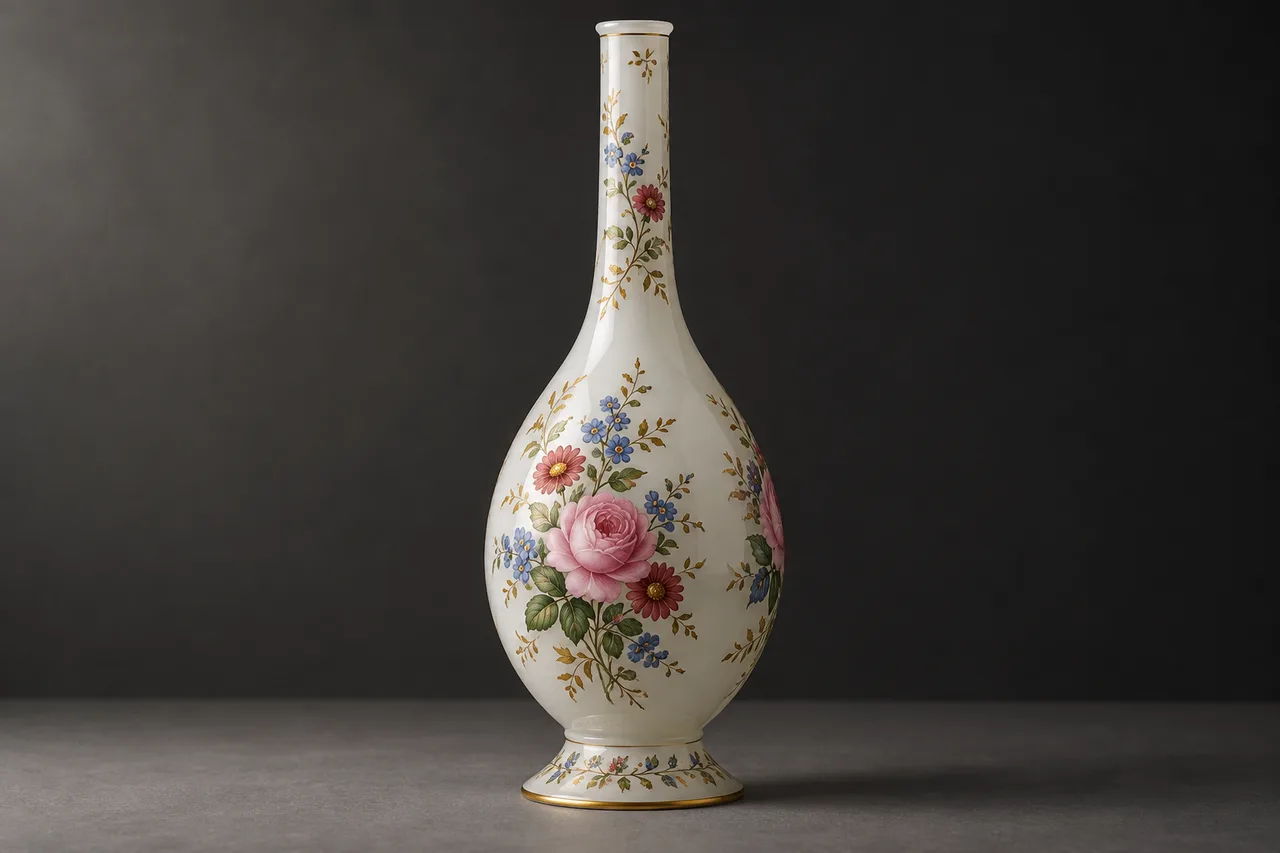
A pink rose, a scattering of blue forget-me-nots, a little gold among the leaves: the decoration of a rosewater bottle at the Corning Museum of Glass rewards a close look. Its slender, pear-shaped body is opaque white, giving the coloured flowers a quiet background. This is a gülabdan, a small flask intended for sprinkling rosewater. The painted roses make an appealing connection between the vessel’s surface and its purpose. Corning Museum of Glass, Museum With No Frontiers
For a reader drawn to jewellery, that combination may feel familiar. A small object can offer several kinds of pleasure at once: the outline seen from a distance, the colour that first attracts attention, then the detail that makes the eye linger. Here, a bouquet takes the place that a cluster of stones might occupy in a jewel.
A bouquet with room to breathe
Corning identifies the bottle, accession 55.1.20, as a Beykoz work made in Istanbul between 1789 and 1858. At 20.6 centimetres tall, it offers a compact setting for an elaborate composition. Two principal bouquets occupy the body, each gathered around a pink rose, with forget-me-nots and flowers resembling daisies around it. Coloured enamels and gilding decorate the white glass. Corning Museum of Glass
The rose gives each bouquet a focus. Around that larger bloom, the smaller flowers suggest the looseness of a garden within the bottle’s contained outline. White, pink, blue and gold invite the eye to move between broad areas of colour and tiny accents. To call it a garden in glass is to describe that visual pleasure: a floral arrangement held within the boundaries of a useful object.
Its proportions are part of the appeal. The body provides room for the bouquets, while the narrow neck draws the gaze upwards. Seen together, these elements offer a balance between abundant decoration and a slender silhouette. For someone who enjoys a finely judged pendant or brooch, that relationship between shape and ornament may be especially engaging.
Beykoz behind the flowers
The place named in Corning’s record also appears in the history of Istanbul glassmaking. Museum With No Frontiers credits Beykoz’s first glass workshop to the Mevlevi dervish Mehmed Dede during Sultan Selim III’s reign, from 1789 to 1807. Its account also records European glassworkers in Beykoz’s workshops and production in coloured, colourless and opal glass. Museum With No Frontiers
That variety becomes tangible in another gülabdan. Ankara’s Ethnography Museum holds a nineteenth-century Beykoz example in green glass, shaped like an ewer and decorated with cut floral work and multicoloured flower motifs. Set beside Corning’s white bottle in the imagination, it offers a different combination of colour, outline and floral decoration within the same kind of vessel. Museum With No Frontiers
Rosewater sprinklers also appear in written accounts of Beykoz production. The Istanbul Encyclopedia reproduces Nureddin Rüşdi Büngül’s account from his 1939 Eski Eserler Ansiklopedisi, which includes these rosewater vessels among Beykoz’s products, alongside such forms as bowls, drinking glasses and bottles. The flowers on the Corning piece thus sit within a wider documented world of glass vessels. Istanbul Encyclopedia
A practical detail beneath the ornament
One of the Corning bottle’s most interesting features is tucked inside its neck. The interior at the top is threaded to receive a screw-in stopper. The museum records blowing, applied work, enamelling, gilding and threading among the techniques used in the object. Corning Museum of Glass
That hidden thread changes the way the decoration reads. The eye has been occupied by roses and gold; the neck brings the bottle’s practical design into view. Its purpose and its ornament can be appreciated together. The fitting of a closure and the arrangement of a bouquet offer two different reasons to admire the same small vessel.
Flowers in a reception room
A related bottle at the Metropolitan Museum of Art offers a setting in which to consider such objects. The Met dates its 22.2-centimetre sprinkler, numbered 91.1.1544, to the late eighteenth–nineteenth century and attributes it to Beykoz with the qualification “probably.” It describes the bottle as typical of objects displayed in open niches in the reception rooms of upper-class Syrian homes during the Ottoman period. The Metropolitan Museum of Art
This context belongs to the Met’s example. Alongside the Corning bottle, it gives the imagination an architectural frame: a small decorated vessel seen within a room, its outline part of a larger arrangement. From that imagined distance, the silhouette matters; closer attention returns us to the flowers.
The attraction for a lover of small luxuries lies in that change of scale. A whole object first, then a bouquet, then a little gilded leaf: the bottle offers successive reasons to pause. Its rose garden remains modest enough to fit around a flask, yet generous enough to occupy the eye.