Story
A Horse That Pours: The Charm of Çanakkale Ceramics
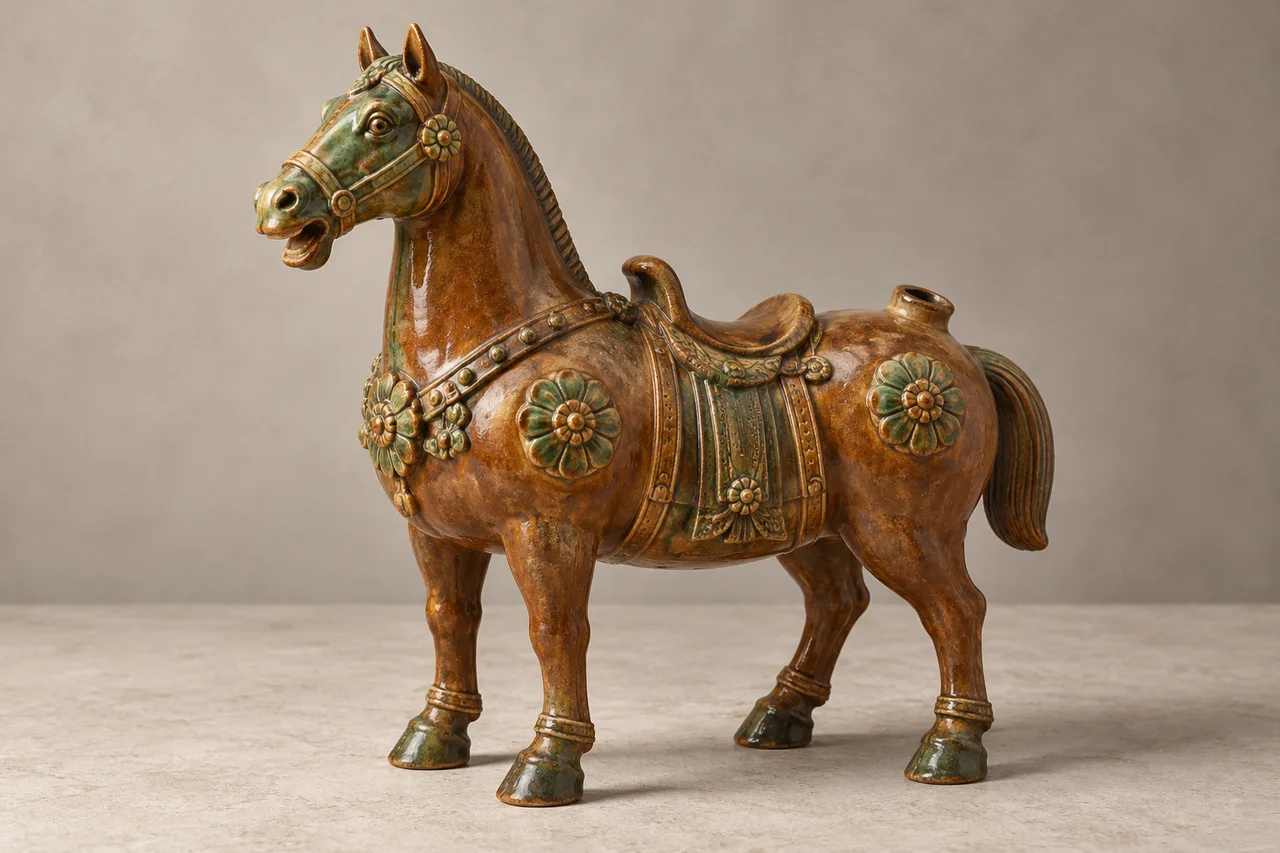
The pleasure begins with a small surprise: a saddled horse, dressed in clay flowers, turns out to be a jug. One example in the Fitzwilliam Museum, catalogued as C.1989-1928, gives that idea a substantial presence. Dated to approximately 1850–1899, it stands 48 centimetres high and measures 55.5 centimetres long. Those dimensions lend a different scale to the charming phrase “horse jug”: this is an animal with room to command our attention. Fitzwilliam catalogue
For anyone who loves jewellery, there is an inviting way into this object. The eye can move from the whole silhouette to a flower, then follow a narrow strap before returning to the face. The enjoyment lies in that movement between a striking shape and details that reward a longer look.
Where the jug reveals itself
The horse’s body is hollow. Its mouth is slightly open, and a circular opening sits on the hindquarters. The museum identifies these two openings as evidence of its function as a pouring vessel; it also records that the interior is unglazed. These are the details that allow us to read the animal as a container. Fitzwilliam catalogue
There is something delightful about holding both readings in mind. “Horse” gives us a face and a bodily presence; “jug” suggests an object made to contain and pour. Together, they make an ordinary function feel unexpectedly theatrical. Even the small opening of the mouth gains a second meaning once the vessel’s purpose is understood. The design keeps offering that quiet moment of recognition.
Flowers, harness and green glaze
The catalogue describes moulded earthenware with separately applied decoration and incised details. Clay rosettes occupy the chest, shoulders and rear, while rolled strips of clay form elements of the harness. The saddle is a broad rectangle of clay, and the rosettes on the chest and shoulders are accompanied by three radiating leaves. Brown glaze covers the exterior, with green tinges especially noticeable around the face. The decoration therefore has both colour and physical relief: the flowers and straps project from the animal’s body. Fitzwilliam catalogue
The comparison with jewellery is a way of looking. A rosette can hold the attention like a brooch; a narrow harness strip can lead the eye towards another ornament. Seen this way, the horse seems dressed for an occasion. That impression belongs to our encounter with it, while the pleasure comes from the relationship between the rounded animal and its carefully articulated adornment.
A smaller horse offers a useful comparison. Christie’s catalogued a Çanakkale horse ewer from the nineteenth century just 22.3 centimetres high, with pale green splashes over a dark green glaze. It brings the same idea of an animal serving as a vessel into a much more compact scale. Set beside the Fitzwilliam measurements in the imagination, it also shifts the colour story from brown with green accents to green upon green. Christie’s catalogue
The contrast makes each object easier to picture. One has the presence suggested by a length of more than half a metre; the other invites us to imagine the horse form condensed. Size and colour become part of the character we respond to, alongside the initial surprise of a vessel given an animal’s body.
A pottery city and a journey overseas
Çanakkale lies on the Dardanelles Strait in northwestern Turkey. Pottery is embedded in its name: çanak means a ceramic bowl, and kale means a fortress. The name gives a simple point of connection between the place and the material of these horses. MoCA/NY
Tuğba Diri Apaydın’s study traces historical Çanakkale ceramic production from the late seventeenth to the early twentieth century. These horses from the nineteenth century belong within that longer history of making. The pottery also travelled: exports carried Çanakkale wares through the eastern Mediterranean and as far as western Europe. Diri Apaydın’s study, Kathimerini
For the large Fitzwilliam horse, a particular collecting episode comes into focus. On 27 October 1911, J. W. L. Glaisher bought it in Chester for £4 10s.; it subsequently entered his bequest to the museum. That purchase supplies a town, a day and a sum of money—one purchase we can place exactly within the wider history of pottery moving overseas. Fitzwilliam catalogue
The company this horse keeps
The horse belongs to a wider family of animal vessels. Diri Apaydın’s study, published in 2021, examined thirteen Çanakkale ceramics in animal forms across seven British museum collections, including the Fitzwilliam, British Museum and Victoria and Albert Museum. The forms discussed in the study include horses, lions, camels and jugs with duck heads. Diri Apaydın’s study
That wider company makes the individual horse more engaging. It can be approached through a museum record, through the story of a pottery city, or simply through the pleasure of its appearance. For someone considering what draws them to a crafted object, this horse offers a memorable encounter: the first glance meets an animal, the next discovers a vessel, and another settles on a flower.