Story
A Goddess Small Enough to Wear
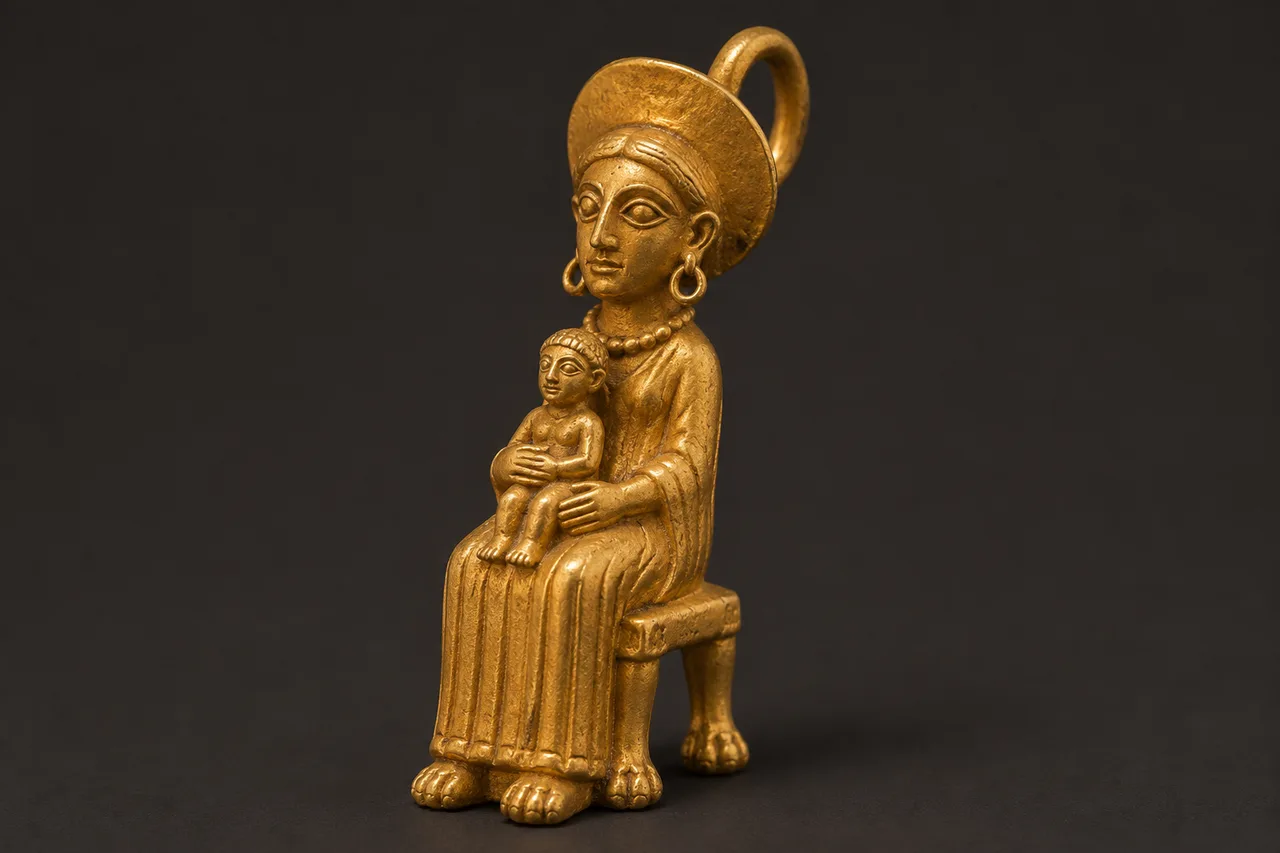
A goddess holds a child in her lap, and an entire scene fits into a piece of jewellery. In the Metropolitan Museum of Art’s collection, this gold pendant brings a divine figure within the dimensions of something wearable. The museum attributes it to Central Anatolia and dates it to approximately the fourteenth–thirteenth centuries BCE. Its subject is intimate; its identity remains open to interpretation. The Met’s object record.
Researcher H. Kübra Ensert reports a height of 4.3 centimetres and a weight of 23.2 grams, with the child measuring just 1.5 centimetres. Those figures give the eye something useful to work with: the smaller figure, so central to the composition, occupies very little physical space. There is a particular pleasure in discovering how much attention such a small object can hold. Ensert’s research abstract.
A jewel within a jewel
The seated goddess wears looped earrings and a necklace. Her disk-like headdress and the lion paws of her backless seat frame the small scene. These details make the pendant rewarding to consider as jewellery: the figure is herself adorned, so ornament appears within ornament. The museum’s description gives us a miniature ensemble whose interest extends from the head to the feet of the seat. The Met’s object record.
Its setting in history is much larger. The Hittites dominated much of Anatolia and neighbouring regions between about 1650 and 1200 BCE, according to the Met’s historical overview. The pendant belongs within that span. Against such a broad historical backdrop, its scale offers a welcome point of entry: a seated figure, a child, a few concentrated details. The Met’s historical overview.
For a present-day viewer, the attraction may begin with that change of scale. History becomes easier to approach when there is something particular to look at. The child draws attention towards the lap, while the headdress and animal-shaped feet invite the gaze to travel outward again. This is a visual response to the composition, without requiring a settled name for either figure.
Two figures brought together
The construction adds another layer of interest. The Met identifies the goddess as gold cast by the lost-wax process, while the child was cast separately in solid gold and attached. The apparent unity of the scene therefore brings together distinct cast elements. That small figure on the lap is also a separate piece of metalwork. The Met’s object record.
The V&A describes lost-wax casting as a process in which molten metal takes the place of wax inside a mould, which is broken open to release the casting. It is a brief explanation with an evocative consequence: the form survives in metal after the wax has gone and the mould has been opened. The V&A’s guide to metalworking.
Here, the separately cast child makes the making of the object especially compelling. What reads as a single encounter between two figures also records an act of assembly. For a reader interested in craftsmanship, that knowledge changes the experience of looking: the meeting of the figures becomes part of both the subject and the construction.
Names held lightly
The headdress offers a possible clue to the goddess’s identity. The Met suggests that its disk-like form may represent the sun and that the figure may therefore be the sun goddess of Arinna. The suggestion remains tentative. The Met’s interpretation.
Ensert takes the inquiry further, arguing that the headdress alone is insufficient and giving weight to the lion features of the seat. She proposes that the child could be Zintuhi, drawing a connection with a prayer of Queen Puduhepa in which Zintuhi is described as an ornament at the breast of her grandparents. In Ensert’s account, Puduhepa also promises Zintuhi a large ornament if she fulfils the queen’s request. An ornament thus becomes part of the appeal to a deity. The connection between this text and the pendant remains a scholarly interpretation. Ensert’s research abstract.
That possibility gives the little scene a different emotional register: the child might belong to a divine relationship spanning generations. Yet the pendant remains engaging while those names are unresolved. Its closeness is available to the viewer; a precise account of who is holding whom remains a matter of interpretation.
A divine presence at pendant scale
A second jewel offers a useful comparison. The Louvre’s AO 9647 is a cast-gold Hittite deity pendant, 3.8 centimetres high, dated to 1400–1200 BCE and recorded as discovered at Yozgat in 1894. It depicts a standing god with a horned headdress and a weapon held against his torso. Beside the seated pair, it presents another way of concentrating a divine image into a small gold form. The Louvre’s catalogue.
Behind the Met goddess’s headdress projects a suspension loop. The museum suggests that the pendant was probably intended to be worn around the neck as an amulet. That possibility brings the discussion back to the body and to the personal scale of jewellery. The Met’s object record.
For someone drawn to meaningful ornaments, the loop may be the most affecting detail of all. It allows us to imagine the distance between a divine image and its wearer becoming very small. Gold, careful construction and uncertain names meet in an object whose appeal can begin simply with looking closely.