Story
A Case Within a Case: London Watches for Ottoman Buyers
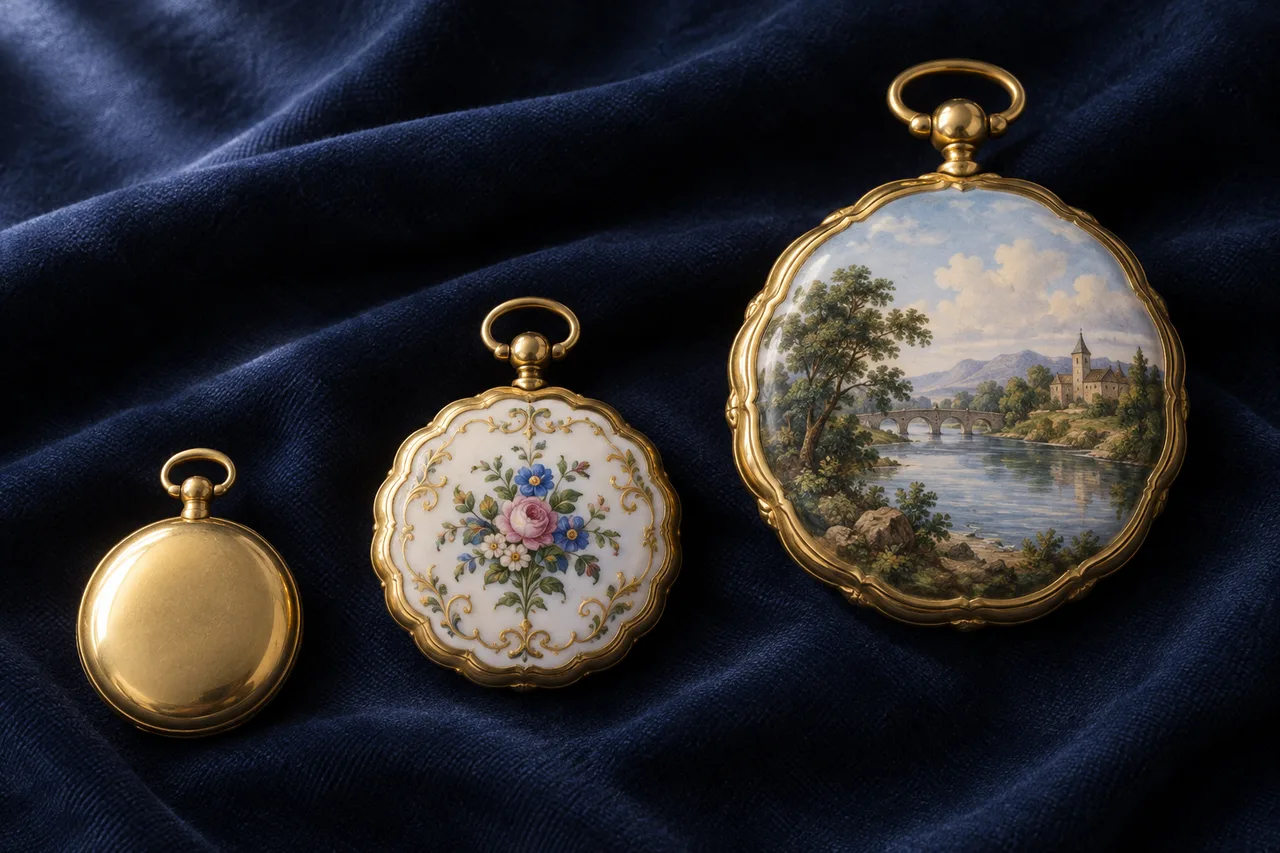
The pleasure begins with the promise of another layer. An ornamented watch case encloses a second surface, and the eye has somewhere new to linger. The Metropolitan Museum describes watches for the Turkish market as commonly having two, sometimes three, outer cases, with leather, shagreen or silver filigree protecting delicate inner cases. That practical arrangement offers a wonderfully intimate way to encounter precious materials: one small object, several discoveries. The Met: Repeating watch
London and its Ottoman customers
London’s substantial export trade in clocks and watches for Turkey developed in the 1680s. By 1786, according to the Metropolitan Museum, English watches had become the dominant watch imports into Turkish lands. Behind the gold and enamel lies an established commercial relationship, one that gives these small objects a much wider setting. London Museum: Watch, The Met: Repeating watch
A watch dated 1780 in London Museum brings that relationship into focus. Catalogued as C1478 and attributed to Markwick, Markham, Story, it was made in London for export to Turkey. Its enamel dial carries Turkish numerals, and the museum specifically connects its elaborate outer decoration with the tastes of wealthy Turkish clients. The intended audience is present in both the face of the watch and its ornament. London Museum: Watch
One case within another
This 1780 watch has three cases in total. Coloured enamel forms patterns around the outer case’s border. The gold middle case has a border resembling twisted rope, also decorated in coloured enamel; the gold inner case has a winding hole in its back. Each layer gives the gaze a different detail to follow, from a band of colour to the small opening that serves the mechanism. London Museum: Watch
The rope-like border is especially appealing to a reader drawn to jewellery. Its interest lies in the meeting of line, colour and gold, all gathered around an edge. Even the boundary of a case becomes something worth looking at closely. The arrangement invites a slower kind of attention, with the middle layer enjoying a decorative presence of its own.
An Isaac Rogers watch in the British Museum, made in London for the Turkish market and dated 1795, offers another combination of surfaces. Its three cases incorporate silver and shagreen, and the outer case measures 73.20 millimetres across. Inside the middle case survives a cream-coloured printed watch-paper with a serrated edge. Alongside metal and shagreen, this modest piece of paper gives the object an unexpectedly quiet point of interest. British Museum: Isaac Rogers watch
That surviving paper changes the mood of the encounter. A serrated edge has its own visual rhythm; a cream surface offers a pause among more elaborate materials. Here, a small interior detail can hold the attention as firmly as an ornamental border.
Silver that sparkles and rings
In the Metropolitan Museum’s gold-and-enamel repeating watch, probably dating to around 1770, the movement is attributed to Francis Perigal or Francis Perigal Jr. The sculpted silver hands carry small diamonds. Tiny openings concealed within the case decoration allow the repeating mechanism’s bell to be heard. Ornament and sound share the same small enclosure. The Met: Repeating watch
The hands make a particularly satisfying meeting point for jewellery and watchmaking. Their sculpted shapes and diamond details give the time display a decorative focus. The concealed openings add another pleasure to the thought of the object: its case has an audible dimension, as well as a visible one.
A larger example in the V&A collection extends that connection. Made by Markwick & Markham in London and dated 1750–1775, it was probably intended for Turkey. This clock-watch stands 12 centimetres high and strikes the hours and quarters on a silver bell. The museum explains that large watches of this form could hang from a hook in a room and serve as clocks while travelling. Its scale gives a different sense of how such an object could occupy a person’s surroundings. V&A: Markwick & Markham watch
A river held in gold
A watch by Markwick Markham & Perigal in the Clockmakers’ Museum collection, hallmarked 1813, brings the story to a painted landscape. Its three cases combine gold and enamel: the inner case is plain gold, while the middle and outer cases have scalloped edges. The outer back carries an enamelled river scene. Science Museum Group: Triple-cased enamel watch
The scalloped outline gives the little scene a gently moving frame. Beside the plain gold of the inner case, the landscape feels like a further reward for looking. For a jewellery lover, this is the lasting charm of these watches: pleasure distributed across an entire object, through its borders, its hidden layers and the small picture waiting on its back.