Story
Two Halves of a Golden Crescent
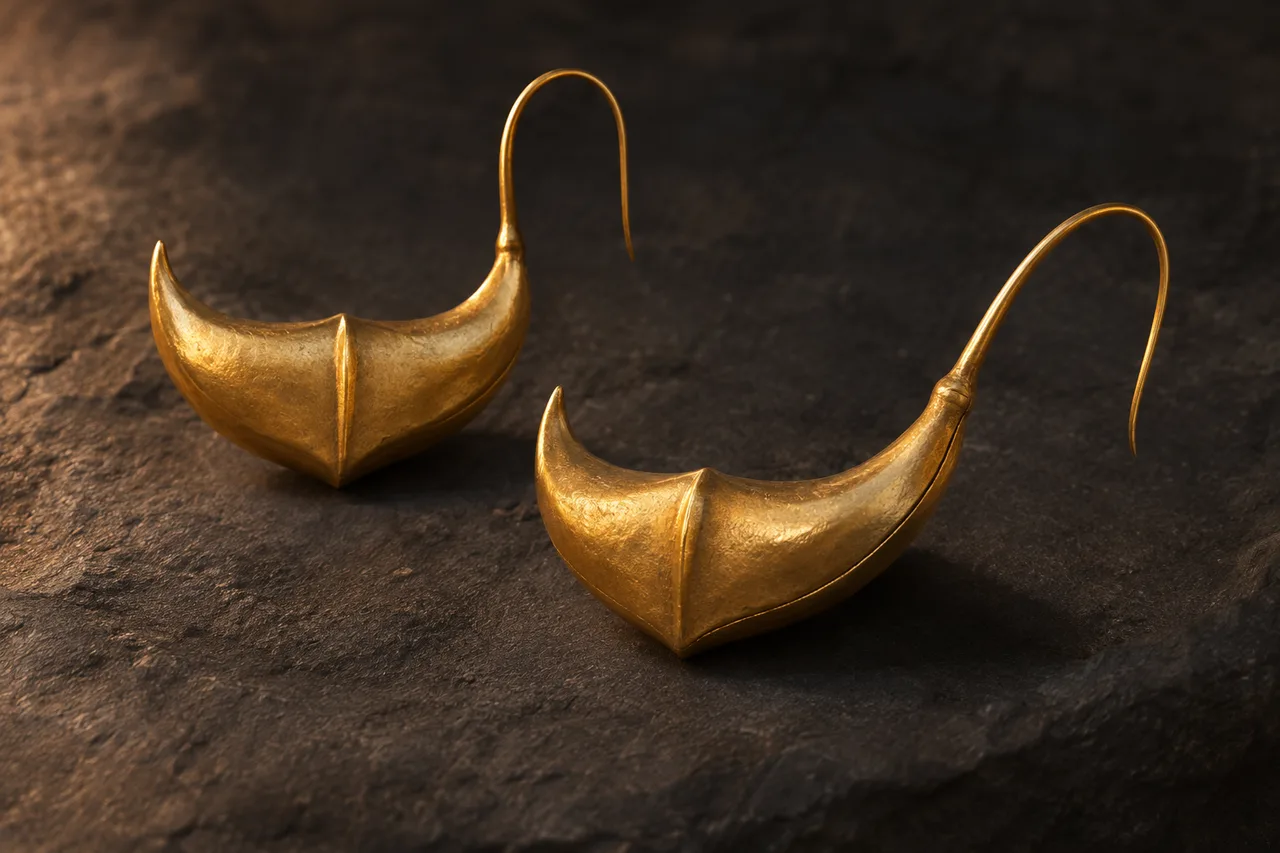
The eye follows the curve first: a swelling gold crescent, its ends turning upward. Then a smaller detail comes into focus. A seam runs around the edge, marking the meeting of two halves. In the boat-shaped earrings from Toptepe Tumulus, that quiet line is part of the fascination. It lets the finished jewel retain a visible trace of its construction. The pair dates to the late sixth or early fifth century BCE and is listed in the Uşak Archaeological Museum under inventory number 1.89.96. Toptepe catalogue
For a reader who loves jewellery, this is an inviting place to begin. There is an immediately appealing silhouette, followed by the pleasure of discovering how much character can fit into a very small object.
Where the two halves meet
The catalogue describes crescents with pointed bases and curved, pointed corners. One corner extends into a long, fine hook that passes through a pierced ear. A vertical ridge runs down the centre of each side. Sometimes called “leech-shaped,” the earrings carry descriptive names that bring their rounded bodies and tapering ends into focus. Each was made in two halves, joined along the edge. Toptepe catalogue
The measurements make those curves easier to imagine. Both earrings are 1.3 centimetres high; their lengths are 2 and 2.2 centimetres, and their weights are 4 and 3.6 grams. The small differences in length and weight give each earring a distinct place in the record. Beside an image or description, those figures offer something tangible: a clearer sense of how small the crescents are. Measurements
The same entry connects the gold earrings with a shaping form, four examples of which were found among the Lydian Treasure objects. That detail adds depth to the little seam. A finished crescent can be appreciated as a continuous outline, while its edge keeps the joining of separate parts in view. Here, the construction itself supplies something interesting to look at, alongside the rounded body, central ridge, and slender hook. Construction and forms
Gold in Lydia’s wider world
Sardis, the capital of Lydia, provides the broader setting. In her study of Lydian jewellery, Yıldız Akyay Meriçboyu connects gold from the Pactolus stream, which ran through Sardis, with the city’s wealth and the development of its jewellery production. Workshops supplied wealthy patrons with jewellery, gold and silver tableware, and everyday accessories. Necklaces, brooches, pins, and ornaments sewn onto clothing belonged to this varied world of adornment. Lydian Jewelry
The Toptepe pair is catalogued as Late Lydian, of the Persian period. Meriçboyu explains that Sardis remained an important city under Persian rule, became a satrapal capital, and continued as a centre of jewellery production. Together, these accounts place the earrings within a regional craft tradition that continued across political change. Dating, Persian-period context
The form also had a life in bronze. The Toptepe entry records bronze examples from Lydian houses destroyed in the middle of the sixth century BCE. Sardis yielded casting moulds for similar earrings, probably intended for bronze. The crescent thus appears across different materials, giving the gold pair a wider family of comparisons. Its outline becomes more interesting when seen as a shape that goldsmiths and other metalworkers returned to. Bronze parallels
One crescent, several personalities
Another small gold earring comes from the Artemis sanctuary at Ephesus. Its catalogue describes a swelling crescent body with a wire extending from one end to pass through the ear. It measures 1.25 centimetres wide and 1.4 centimetres high, and weighs 2.6 grams. These details bring another small interpretation of the boat form into view, with its own proportions and recorded weight. Ephesus earring
A later pair in the British Museum gives the name “boat-shaped” a more theatrical presence. Dated to 420–400 BCE and made in Athens, the earrings have tightly packed filigree on the fronts and backs of the boats. Each contains a siren, a creature with a bird’s body and a female head. Four cockleshell pendants hang beneath each boat on chains. The boats are attached to large, two-tiered rosettes with traces of enamel. Each earring stands 5.6 centimetres high. British Museum account
The shared name accommodates strikingly different visual experiences. At Ephesus, a swelling crescent provides the main description; in the Athenian pair, the boat becomes the setting for a figure and dangling shells. Returning to Toptepe after these comparisons, the eye has a different appreciation of the curve, the ridge, and the meeting edge.
For someone drawn to jewellery today, that may be the enduring pleasure of this pair: the way a small object rewards sustained attention. The measurements give its beauty a scale. The hook gives the crescent a delicate extension. And the seam offers a final, absorbing detail—the place where two halves became one earring.