Story
Silver in a Slippery Hand
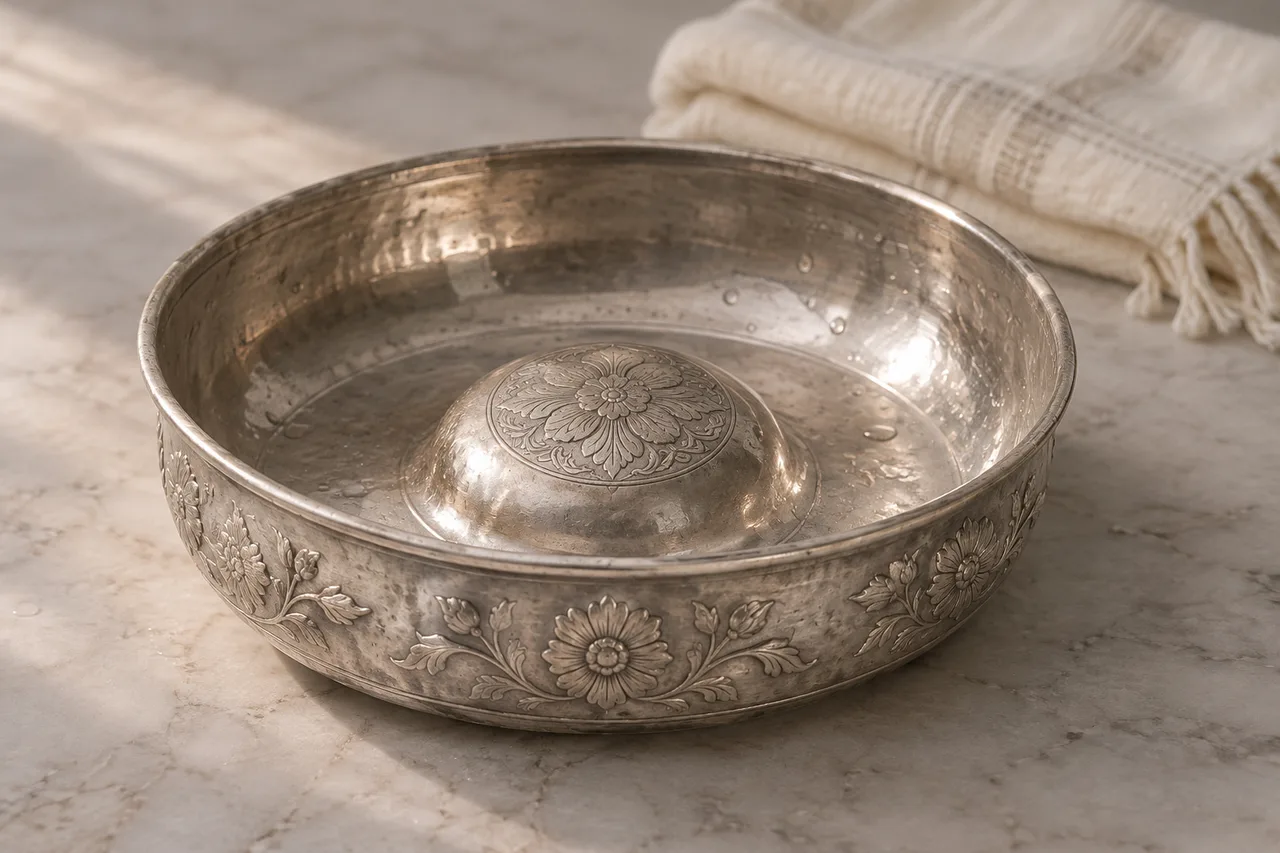
The hamam tası, or Turkish bath bowl, had a straightforward purpose: to scoop up water and pour it over the body. Traditional examples were made in brass, copper and silver. That last material offers a particularly inviting point of entry for anyone who loves silver jewelry: here, a familiar attraction belongs to an object made for bathing. CVAR’s introduction to the tas
There is something absorbing about considering ornament at this scale of everyday life. A bowl asks us to think about the space within it, the water it carried and its contact with a hand. Its decoration gains another dimension when we remember the action for which it was intended.
A centre that helped the hand
Bath bowls were made both with and without a raised central boss, known as a göbek. Ebru Subaşı’s study describes both forms; the Yaşayan Tarih Müzesi explains how a central protrusion or corresponding hollow helped prevent a bowl from slipping from a wet, slippery hand. The prominent centre therefore belongs to the practical story of the vessel. Arış study, Yaşayan Tarih Müzesi catalogue
With that detail in mind, the shape becomes especially engaging. What first catches the eye also brings the hand into the picture. Looking at the centre means considering the bather’s grip, and looking at the surrounding bowl means remembering its capacity to hold water. The pleasure is in seeing those purposes together, in one small object.
The museum’s nineteenth-century metal example measures 19 centimetres across and 7 centimetres deep. It bears the inscription transcribed as “Tas-i Mahsus-i Hamam.” The catalogue also records worn tinning and dents, bringing the material condition of a surviving bowl into view. Museum object record
Flowers across the silver
A group of six silver bowls catalogued by Christie’s as Ottoman Turkish, from the early nineteenth century, ranges from 22 to 26.5 centimetres in diameter. Their raised centres carry floral and radiating relief patterns, described as repoussé. Palmettes, floral sprays, medallions and cusped arches decorate the exteriors. Christie’s group of six bowls
The ornament gives the eye several places to settle: the middle, the surrounding surface, the outside of the vessel. For a reader drawn to decorated silver, that movement is part of the attraction. The bowl can be considered as a whole shape and as a gathering of smaller details, with the raised centre holding the composition together.
The wider vocabulary described in the Arış study includes geometric, figural and plant motifs, worked in relief or engraving. On bowls with a boss, decoration is generally concentrated on that feature; examples without one may have a decorated interior or remain plain. These distinctions allow room for several kinds of visual character within the same useful form. Arış on bath-bowl decoration
An owner’s name
One silver bowl makes the connection with personal ownership especially direct. Christie’s dates it to AH 1262, or 1845–46 CE, and gives its diameter as 19.7 centimetres. Its raised central roundel is engraved with flowers, its sides with floral swags. It carries the owner’s name, Fatima Khanum, and Abdülmecid’s tughra mark. Christie’s dated bowl
That name changes the way the object can be encountered. Alongside a date, a measurement and a description of flowers, there is a named owner. The brief catalogue entry leaves her life outside the frame. The inscription itself gives us enough to pause over: the bowl was identified with someone, and that personal connection remains part of how we see it.
The appeal lies in the intimacy of that small detail. An inscription can draw attention away from the overall design for a moment, giving a small detail unusual emotional weight. Here, a name shares the silver surface with floral ornament.
Company in a bridal bundle
A different perspective comes from Subaşı’s 2018 study of wedding traditions in Sivas. In the documented bridal bath bundle, the bowl appears alongside a comb, soap container and jewelry box. The bride’s family generally prepared the bundle, sometimes with gifts contributed by the groom’s mother. The choice of silver, copper or other metals reflected the family’s economic circumstances and social standing. Subaşı’s study of Sivas bridal customs
In the pre-wedding kına hamamı, or henna bath, described in the study, each guest customarily poured a bowl of water over the bride’s head. The gesture places the vessel within a shared occasion, giving the familiar act of pouring a ceremonial role. Arış on the henna bath
This account gives the bowl a specific local setting among possessions gathered for a wedding-related occasion. The jewelry box is a particularly suggestive companion for readers of silver jewelry: it places the bath bowl within a group of personal things, each with its own use and presence.
The raised centre, the flowers and the inscribed name invite attention at different distances. Together they make the bowl rewarding to contemplate. There is the shape first, then the detail, and finally the thought of silver held in a slippery hand.