Story
Silver at the Waist: The Ottoman Divit
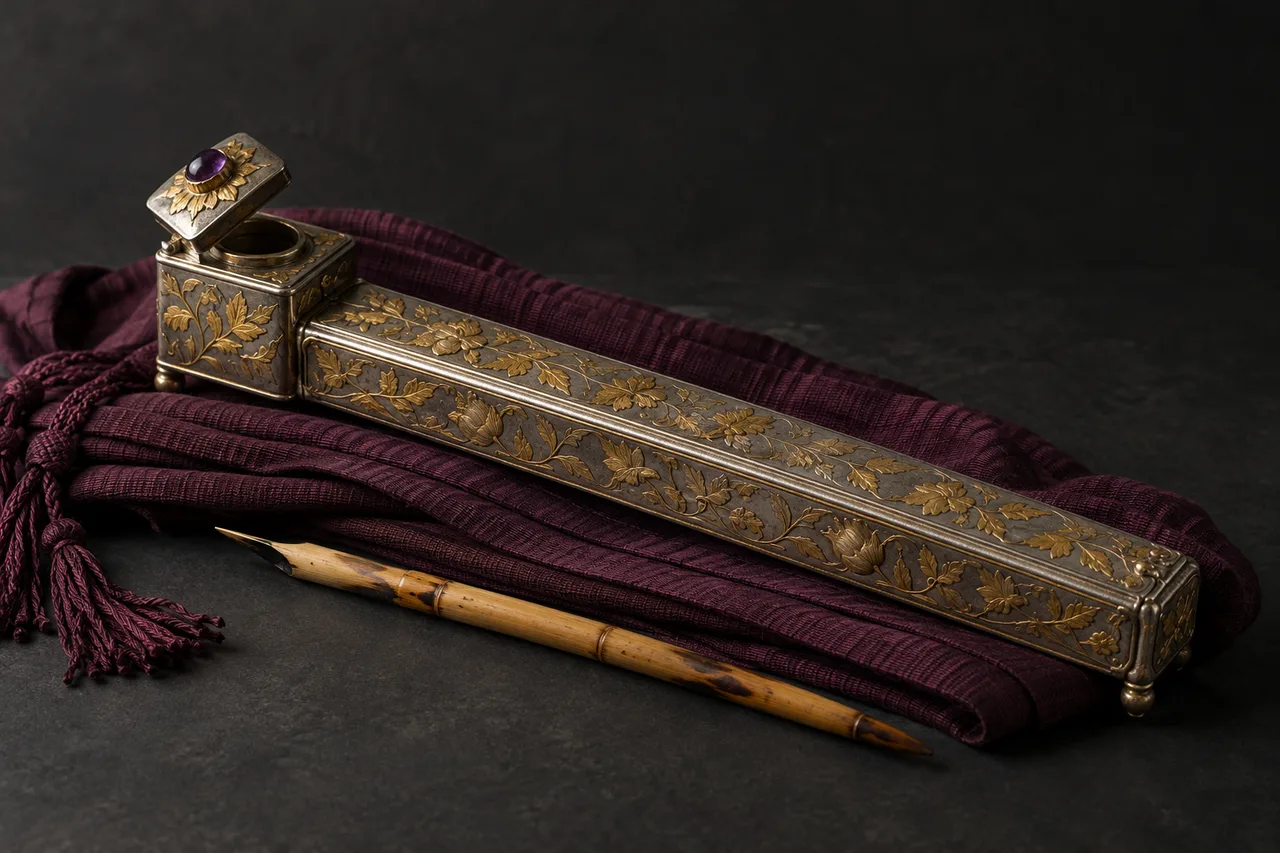
An Ottoman divit brings the pleasures of looking at silver into the world of writing. Its defining shape joins a long, narrow pen case to a projecting inkwell; tucked into a sash, the whole object could travel with its wearer. Silver and gem-set examples give this practical arrangement the richness that draws us towards jewellery: an inviting surface, ornament to follow and small details that reward a second look. TDV İslâm Ansiklopedisi
For a reader accustomed to admiring a ring or a pendant, the appeal is immediate. Here, precious materials surround the tools of a written page. Two surviving divits, one in Bucharest and another in Istanbul, let us see how much attention such a compact writing kit could command.
A place in the sash
As M. Uğur Derman explains, the divit’s elongated compartment held reed pens and tools, including a penknife and a maktaʿ, a support used when cutting a pen. A fabric lining protected the contents from the metal interior. These details make the case feel closely fitted to its purpose: a narrow home for slender, easily damaged things. TDV İslâm Ansiklopedisi
Its relationship with clothing was equally precise. A scribe or calligrapher could place the divit diagonally in a waist sash, leaving the projecting inkwell above it. That projection kept the case from slipping down. The phrase “wearable luxury” acquires a very concrete meaning here: the shape of the writing kit helped it stay where it was worn. TDV İslâm Ansiklopedisi
There is something satisfying about that union of shape and use. Knowing why the inkwell stands proud of the case changes the silhouette we see. The small projection becomes the point where an elegant object meets the practical fact of carrying it.
An amethyst above the ink
The National Museum of Art of Romania holds a Turkish divit dated to 1703–1730. Measuring 34.5 centimetres long and 7 centimetres wide, it combines cast, chiselled, engraved and gilded silver. Vegetal decoration follows the sides and ends of the pen case and the edges of the inkwell. An amethyst is set into the inkwell’s hinged lid. Discover Islamic Art
The gemstone gives the eye a place to rest, while the long case offers a different pleasure: ornament unfolding across an extended surface. Seen through a jewellery lover’s eyes, the lid becomes a particularly intimate detail. A stone has been given a place within the everyday equipment of writing.
The catalogue also records traces of textile, identified as liqa, inside the inkwell. That modest survival brings our attention back to the interior. Alongside the amethyst and worked silver, a remnant of soft material remains part of the object’s story. The precious exterior and the small trace within deserve to be considered together. Discover Islamic Art
Flowers, a ruby and a royal possibility
At Istanbul’s Sadberk Hanım Museum, a nineteenth-century silver divit presents another combination of metal and colour. It is 32.2 centimetres long, with gilded repoussé leaves and flowers decorating parts of the case and inkwell. A ruby sits in a silver mount on the inkwell lid. The floral relief gives the ornament a raised presence; the stone concentrates colour in one small setting. Sadberk Hanım Museum
Writing also enters the decoration. An inscription on the front of the pen case leads the museum to suggest that the divit may have been made for Sultan Mustafa IV. On the back, the Al-Fatiha surah appears in a calligraphic composition. The possible royal association remains tentative, while the inscriptions themselves add another layer of interest to an object made to carry writing tools. Sadberk Hanım Museum
Names and marks in the silver
Derman notes that many surviving divits retain their makers’ names, stamped or engraved. Silver examples also received a sah mark and the reigning sultan’s tughra, or monogram, as guarantees of metal fineness. Such marks invite a different kind of attention from the decorative flowers: they concern who made an object and how its silver was assured. TDV İslâm Ansiklopedisi
On the Bucharest divit, Ahmed III’s tughra appears beneath the inkwell and on the back of the pen case; the catalogue uses it to establish the date. The upper surface carries the maker’s stamp, “‘amal Muhammad.” Here, the record offers both a ruler’s monogram and a maker’s name. Discover Islamic Art
These objects also have a place in Istanbul’s working geography. Derman records that divit makers worked in an Üsküdar neighbourhood formerly called Divitçiler and kept shops in the Kâğıtçılar Çarşısı at Vezneciler, in Beyazıt. He links the waist divit’s loss of favour to the disappearance of sashes from men’s dress after the Tanzimat reforms: the case was too large for a pocket. TDV İslâm Ansiklopedisi
That change leaves a poignant detail in the design. The projecting inkwell still makes sense when we picture its place in a sash. Silver, gemstone and ornament draw us close; the shape lets us imagine the object finding its place against a wearer’s waist.