Story
Rubies on Porcelain: A Ming Bowl at the Ottoman Court
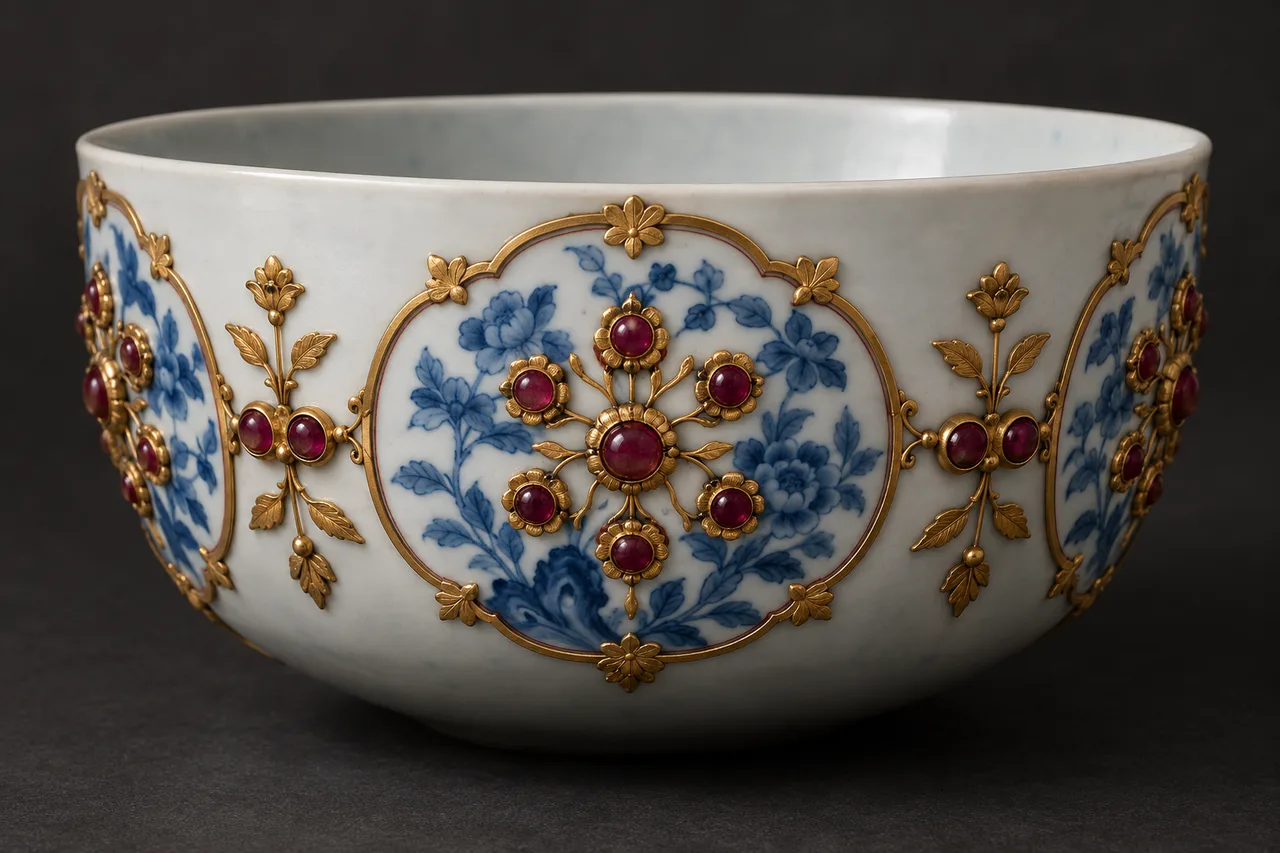
Six centimeters high and twelve across the rim: the bowl has an intimate scale for something carrying so much ornament. Blue painted roundels, gold leaves and rubies share its curved exterior. Made at Jingdezhen in China during the Ming dynasty, it received its gold and gemstones from Ottoman court artisans in the late sixteenth century. The materials invite a jewelry lover’s attention, while the bowl itself opens a story that reaches beyond anything worn on the body. Shanghai Museum
Its appeal begins with that unexpected meeting. The familiar curve of a small vessel becomes a place to linger over petals, branching lines and groups of red stones. Seen together, they offer the pleasure of a jewel on the scale of an object made for the table.
Gold follows the painted circles
The Shanghai Museum catalogue assigns the porcelain to the Wanli period, 1573–1620, and dates the Ottoman embellishment to approximately 1570–1600. On the outside, four circular motifs have red outlines and blue interiors. The added goldwork takes its shape from these existing painted areas, surrounding them with petal-shaped frames whose contours broadly follow the original roundels. Shanghai Museum
Within each framed roundel, seven rubies sit in gold settings accompanied by petal-shaped pieces of gold. Curving wire and gold sheet form the connecting stems and leaves. Further rubies, with their own floral goldwork, occupy spaces between the roundels. The decoration therefore continues around the bowl, carrying the eye from one concentrated group of stones to the next. Shanghai Museum
For today’s viewer, the relationship between the painted circles and their golden borders is especially satisfying. The blue remains part of the composition, giving the red stones and golden foliage a distinct setting. Each material has room to be noticed. The porcelain’s painted design and the jeweler’s branching ornament can be read together, with the same curve belonging to both.
There is a particular intimacy to this arrangement. At the bowl’s small scale, a leaf or a bend in the wire becomes a substantial visual event. Looking closely offers a succession of details: a ruby, its surrounding petals, a line reaching toward another stone, then the blue beneath. The pleasure lies in those relationships as much as in the individual materials.
A shared language of court craftsmanship
The bowl belongs to a wider history of jeweled porcelain at the Ottoman palace. In her study for the National Palaces journal, Kübra Erdoğan identifies goldsmiths, engravers, inlay workers and coppersmiths among the Ehl-i Hiref palace craft divisions involved in decorating porcelain. Her account places this jeweled embellishment between the second half of the sixteenth century and the middle of the seventeenth. Kübra Erdoğan, National Palaces journal
Erdoğan describes rubies and emeralds used on sheets of gold and silver to enrich porcelain. This gives the featured bowl a broader setting: its gold and rubies belong to a courtly practice that brought several kinds of skilled metalwork into contact with ceramic objects. The craft divisions named in the study describe that practice collectively; the bowl’s individual makers remain unnamed in its museum account. National Palaces journal, Shanghai Museum
For readers drawn to jewelry, this meeting of materials offers a rewarding change of perspective. Attention moves outward from the gemstone to the object around it. The bowl’s shape, the spacing of its painted motifs and the sweep of the gold branches all contribute to the effect. Its richness can be appreciated through the way the parts relate, without needing a name attached to the hand that arranged them.
A place at court, a journey beyond it
Porcelain also belonged to the working life of the palace. Türkiye’s Ministry of Culture and Tourism describes porcelain tableware used for the sultan’s meals and receptions for foreign ambassadors. Its account of the Surname-i Vehbi, which records the circumcision festivities of 1720, notes jeweled porcelain vessels among the objects depicted in the miniatures, alongside censers, coffee cups and silver basins and ewers. These images give the wider world of jeweled porcelain a ceremonial setting. Türkiye Ministry of Culture and Tourism
The featured bowl’s own documented journey takes a clear turn in 1877, when Sultan Abdülhamid II presented it to the British ambassador in Constantinople. In 1904, George Salting donated it to the British Museum, where its registration number is 1904,0714.1. Those two moments connect its history as a court treasure with its place in a museum collection. Shanghai Museum
The eye can return from that journey to a single blue roundel. A painted circle, a gold border and a gathering of rubies hold different acts of making within one small space. For someone who loves jewelry, that is an enduring invitation: to find delight in the careful conversation between a stone, its setting and the surface that receives them.