Story
Ottoman Tombak: Gold on Copper
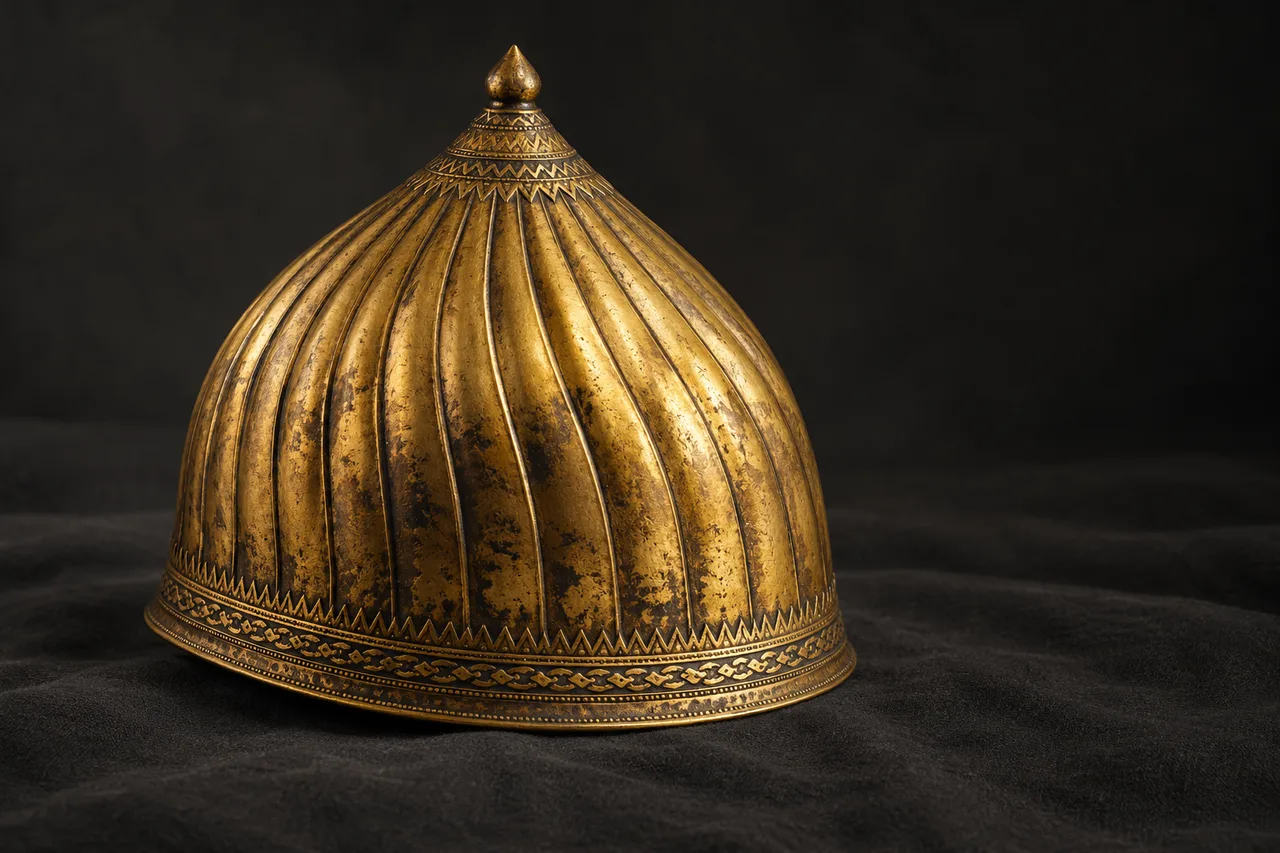
A golden surface is an invitation to look closer. On a helmet, that invitation has an unusual force: the eye encounters the outline of armour, then begins to notice details that might equally hold the attention of a jewellery lover. Broad folds sit beside minute ornament. A name appears at the rim. The pleasure lies in the movement between the whole object and its smallest marks.
An Ottoman tombak helmet catalogued by Sotheby’s offers just such an encounter. Dated broadly to the late sixteenth or seventeenth century, it belongs to the world of gilded copper: gold gives the surface its precious character, while copper supplies the underlying metal. 2
A dome with a measured rhythm
The catalogue describes a domed helmet with thirty overlapping vertical pleats. Around the rim and peak run bands of stippled zigzags and stylised chains. The composition brings together two scales of ornament: the emphatic rhythm of the dome and the close, almost intimate detail of its borders. Its appeal is easy to approach through that contrast, without imagining a particular ceremony or wearer’s costume. 2
There are quieter survivals, too. The bar for the sliding nasal, some gilded copper rivets and traces of cloth lining remained when the helmet was catalogued. These details bring the interior into the story. Beside the splendid exterior sits the evidence of a lined object with fittings, something more physically particular than an uninterrupted golden silhouette. The catalogue records those remnants without supplying a complete picture of the original lining. 2
What the golden surface means
Museum With No Frontiers explains tombak gilding through a later object: an ewer and basin set dated 1870. Its account describes a historical gold–mercury amalgam whose heating allowed the mercury to evaporate, leaving gold attached to the surface. This is the material meaning behind the golden appearance: actual gold forms the gilding. The later set also carries the term into a different kind of object, away from the helmet’s martial outline. 1
For a reader drawn to jewellery, that relationship between surface and supporting metal is part of the fascination. The pleasure of the helmet need not depend on imagining it as solid gold. Its copper form and gilded finish can be appreciated together, with the broad pleats and narrow borders giving the eye different kinds of detail to follow.
The name needs a little care. The Fitzwilliam Museum’s glossary uses tombac for a brass generally containing 85–88 per cent copper and 12–15 per cent zinc; it also lists tombak as an alternative term. Those percentages describe the glossary’s alloy. They are not measured proportions for this helmet, which Sotheby’s discusses as gilded copper. A familiar word can therefore carry different material meanings in different records. 3 2
A name at the rim
The inscription brings a person into view. In the catalogue’s translation, the helmet was made for emir ‘Uthman, son of emir ‘Ali, addressed with an elevated honorific. The entry gives us this named recipient without a biography. His presence is concentrated in the words around the rim: a small, personal centre within the larger display of metal and ornament. 2
A second inscription helps place the wider group in time. Sotheby’s points to a comparable helmet in the Benaki Museum in Athens bearing the date 1007 AH, corresponding to 1598–99 CE. The auction helmet keeps its broader dating, while the Athens example offers a precise point of comparison. One inscription names a person; the other gives a year. Each brings a different kind of specificity to the elaborate metalwork. 2
Splendour between parade and battle
Ceremony is an appealing setting for such an object, and the catalogue gives that reading scholarly support. It quotes James Allan’s view that copper’s softness and the gilded decoration suggest parade equipment. The wording matters: it presents an interpretation of purpose, allowing the material itself to shape the question. 2
The same note also cites tombak armour in the Baden-Baden collections, within the Karlsruher Türkenbeute, as evidence of its use at the siege of Vienna in 1683. The broader history thus reaches the battlefield, although that evidence does not establish the experiences of this individual helmet. The relationship between splendour and martial use remains more interesting than a single, tidy label would suggest. 2
What stays with the eye is the meeting of those different scales: a commanding dome, a delicate border, a named recipient, the surviving trace of cloth inside. For readers who love precious surfaces, the helmet offers a rich object of attention. Its gold invites the first glance; the folds, fittings and inscription give that glance somewhere to linger.