Story
Nazarköy: The Village Named for a Glass Eye
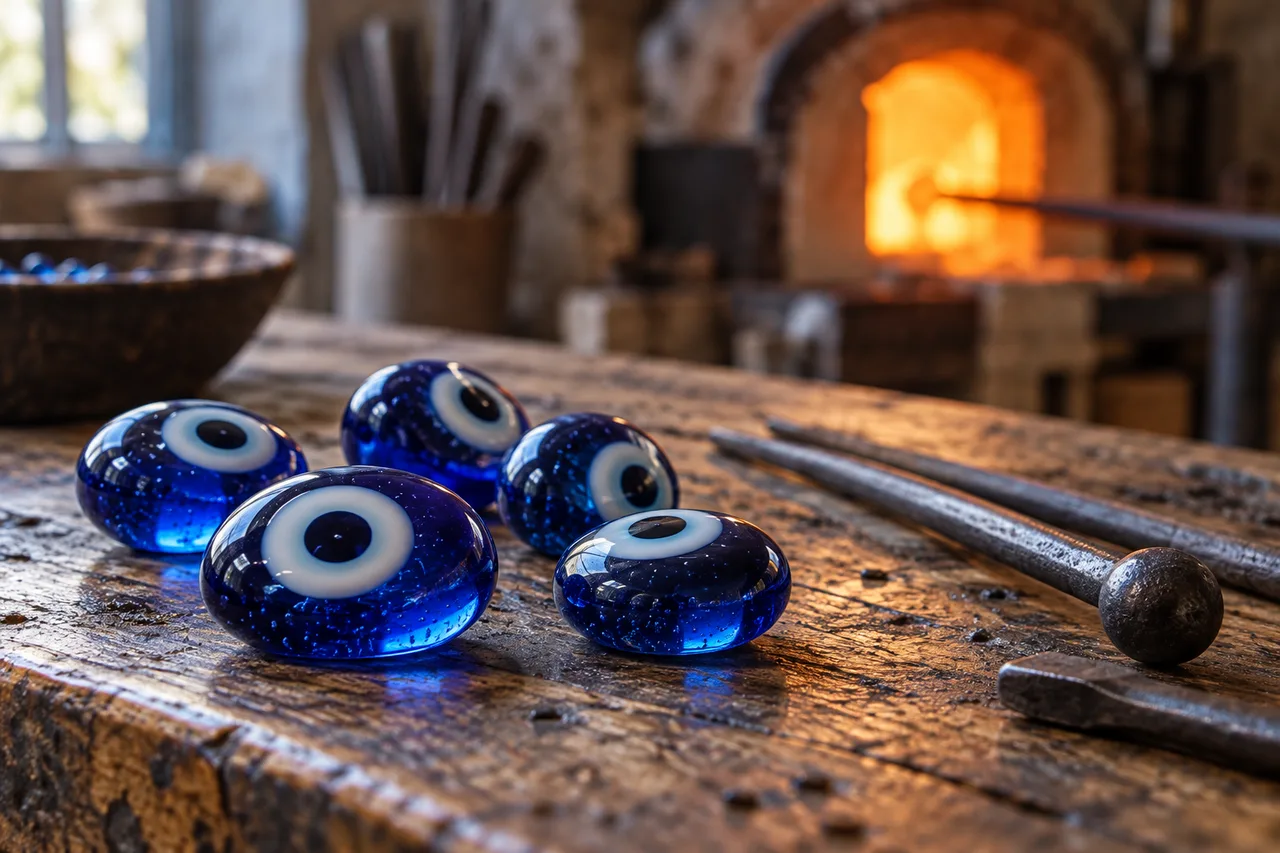
In 2007, Kurudere, in İzmir’s Kemalpaşa district, became Nazarköy. The new name recognised the eye beads made there, giving a craft a place in the community’s very name. For anyone drawn to a glass eye ornament, this is a compelling beginning: an object small enough to hold has helped define a place. Visit İzmir
The nazar boncuğu carries a protective meaning through the belief that its eye guards against the evil eye. It also has a life as decoration and a souvenir. Those meanings can sit comfortably together: someone may value the symbolism, enjoy the ornament or feel attached to the place behind it. Visit İzmir
The fire behind the glass
Visit İzmir describes traditional production in wood-fired furnaces, where glass is melted and beads are fashioned individually with simple tools. It identifies Nazarköy and Görece, in İzmir’s Menderes district, as centres where the craft passes between masters and apprentices. The bead’s local story thus belongs to a wider geography of work and learning around İzmir. Visit İzmir
That account changes the scale of the finished object. An ornament can draw attention to its eye motif; its making draws attention to a furnace, tools and the person who works with them. There is pleasure in holding both views together. The glass remains something to admire, while its origin gives that admiration a more particular focus.
A memory shared by beadmaker Uğur Karataş adds another material detail. In an interview published on 21 January 2025, he recalled that beads had once been made from recycled bottle glass, and that children in his family helped clean the bottles. The recollection places an earlier material practice within family life, giving the glass a history that reaches back into his childhood. Hürriyet Daily News
Knowledge with several teachers
Karataş spoke as a third-generation craftsman who began learning at eleven. His first beads were saraç, round forms without eyes. Other relatives taught him to add the eye and to work with moulds. His father and grandfather were also part of the family’s beadmaking tradition. In his account, different relatives contributed different parts of his knowledge. Hürriyet Daily News
This gives the phrase “inherited skill” a human scale. Knowledge arrives through particular relationships: one person knows something that another is ready to learn. The finished eye can be understood as the meeting point of those lessons, even when the people who passed them on are invisible to its eventual owner.
Research by Petek Ersoy İnci, published in 2020, describes transmission through master–apprentice relationships alongside changes in motifs, colours and techniques. The study also includes the views of five women who trained through the Bir Usta Bin Usta programme between September and December 2018. Their experiences add another route of learning to the craft’s story. Continuity, in this account, has room for changing designs and new participants. Petek Ersoy İnci, 2020
A livelihood behind the village name
The affectionate account of learning meets a harder question in Karataş’s interview: whether the work can support the people who do it. In January 2025, he reported three active workshops in Nazarköy, recalling eighteen during the period from 1942 to 2005. He attributed serious losses to imported plastic and acrylic imitations and said many craftspeople had left beadmaking for factory work. These figures capture the situation he described at the beginning of 2025. Hürriyet Daily News
Karataş connected the prospect of a new generation entering the craft with its economic value. He spoke of his love for the work and his wish to pass it on, while describing the difficulty of maintaining a workforce. Seen through his testimony, the future of the bead depends partly on whether learning the skill can lead to a viable livelihood. Hürriyet Daily News
For a prospective buyer, this adds weight to the distinction between materials and origins. The eye motif may be the first attraction. Knowing who made the object, where and from what gives its appeal further substance. A village name on its own cannot convey all the relationships and working lives gathered behind the glass.
What remains in the bead
Karataş also described small traces of making: slight bubbles in the eyes of his beads and a rust-like mark inside their holes, which he linked to the iron rods used in production. These are details he offered when explaining his own handmade work. They give the eye another point of interest, somewhere for attention to linger beyond the design itself. Hürriyet Daily News
The appeal of a Nazarköy bead can hold several things at once: a protective symbol, the pleasure of glass and an attachment to the work behind it. The village’s renaming makes that connection unusually tangible. An ornament carries a place into view; the story of that place gives the ornament something more to hold.