Story
Jewels Beneath the Boot: Ottoman Stirrups
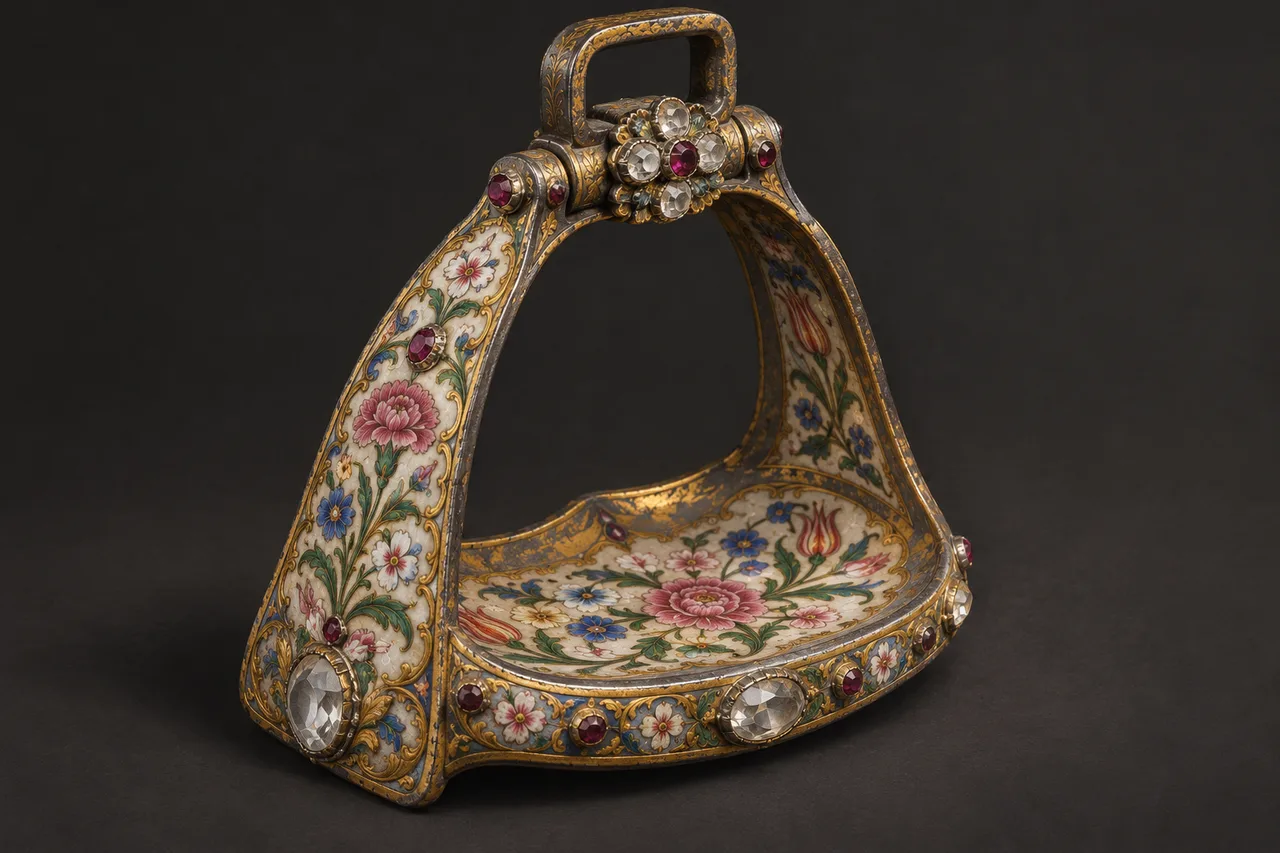
A stirrup offers an unexpected place to begin a story about jewelry. Its broad opening and waiting footplate invite us to picture a boot; its decoration asks for the closer attention we might give a brooch. In the Ottoman examples preserved in Vienna and Dresden, those two ways of looking meet. Engraved iron, gemstones and worked silver give riding equipment a place in the history of precious objects. Museum With No Frontiers, Badisches Landesmuseum.
A shape made for the boot
An Ottoman pair in the Kunsthistorisches Museum collection brings that meeting into focus. Dated to the late seventeenth–eighteenth century, it combines engraved iron with jade, glass and gilding. The catalogue tentatively identifies its origin as Turkey. Even this short list of materials is enough to invite a lingering look: the engraved surface, the stone and the glass each become part of the same ornamented object. Museum With No Frontiers.
The long, broad, curved footplates were particularly suited to the heel-less boots worn by Ottoman riders. Their sharp edges could also serve as spurs. These details give the decorative surface a physical context: the curve accommodated footwear, while an edge had a further riding function. For a jewelry lover, the appeal lies partly in this closeness between adornment and use. The boot belongs in the picture as surely as the jade. Museum With No Frontiers.
Flowers around the footplate
In Vienna’s Imperial Carriage Museum, stirrup G 257 offers another combination of form and ornament. Dated approximately 1710–1720 and probably made in Istanbul, it has a concave base and curved, trapezoidal sides. Its recorded materials include iron, silver, gold, enamel, rock crystal and rubies; floral designs in enamel and gemstones decorate the sides. The curved outline gives those flowers an architectural frame, with the footplate anchoring the whole composition. G 257 scholarly catalogue.
The pleasure of considering such an object is in moving between its overall silhouette and its smaller details. The catalogue also records small cracks in the silver setting and areas where the gilding has worn away. Those observations bring the surface into sharper focus. Alongside the flowers and stones, the worn gilding becomes another detail that rewards attention; the object holds our interest even where its finish is incomplete. G 257 scholarly catalogue.
The weight of a gift
G 257 also has a possible place in a particular diplomatic exchange. The scholarly catalogue identifies it as probably belonging to ceremonial horse equipment sent by Sultan Ahmed III to Emperor Charles VI. It connects the gift with ambassador Ibrahim Pasha’s audience in Vienna on 7 September 1719. The qualification matters: the documented exchange supplies a setting for the stirrup, while its membership in that gift remains probable. G 257 scholarly catalogue.
A pair in Dresden’s Armory, inventory L 0316, gives the story a more literal weight. These solid-silver Ottoman stirrups date to 1703–1714 and weigh 1,727 grams together. Their silver was chased, cut, engraved and polished, and they bear the stamped tuğra of Sultan Ahmed III. For a reader accustomed to thinking about silver through rings or bracelets, the total weight brings a different sense of scale to the material. Badisches Landesmuseum.
The Dresden pair survives from a gift sent by the Crimean Tatar khan Qaplan Girai to Augustus the Strong in 1714. The recorded gift included a horse and four saddles with stirrups. That larger ensemble helps explain how a single pair can carry such a substantial story: it belonged to an exchange in which the animal and its equipment were presented together. In this context, we can read the decorated stirrups as one element of a carefully furnished gift. Badisches Landesmuseum.
Forms that traveled
These objects also sit within a wider exchange of riding fashions. The Metropolitan Museum of Art describes broad stirrups of the genette type as widely used in the Ottoman Empire in the late sixteenth century. European princes and nobles riding Arabian horses imported from the empire commonly used Ottoman-style equipment, either imported or made and decorated in Europe. Shape and ornament could therefore travel by different routes. The Met: Pair of Stirrups.
A nineteenth-century Turkish set at the Met, 36.25.535a–c, offers a later example of mixed influences. The stirrups and ring bit combine copper alloy, gold and iron. The museum identifies the broad curved footplates and flaring sides as Turkish features, while describing the pierced decoration as European-inspired. In this set, a familiar outline accommodates another decorative vocabulary. The Met: Pair of Stirrups and Ring Bit.
For a reader who loves jewelry, a stirrup opens a generous field of attention. There is pleasure in the relationship between a curve and its ornament, in the balance of a broad form and a small detail. An object imagined beneath a boot can hold the eye with the intimacy of something held in the palm.