Story
Jewelry for Coffee: The Ottoman Zarf
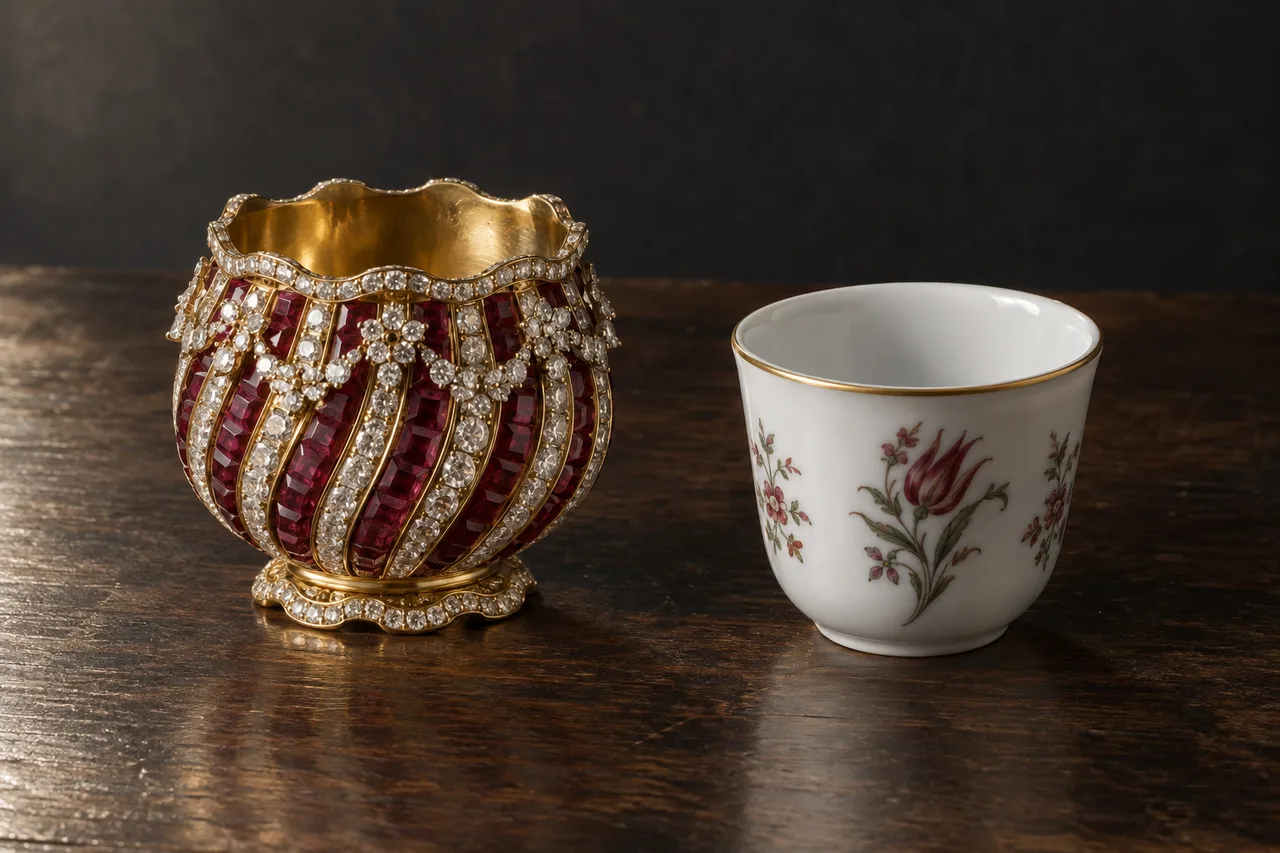
At 4.8 centimeters high, the Louvre’s ruby zarf is a small setting for an extravagant idea: coffee accompanied by gold, rubies and diamonds. The object is a holder for a Turkish coffee cup, and it once belonged to the collection of Sultan Abdülhamid II. The Louvre dates it to the nineteenth century. Louvre, OA 8031
Coffee gives the piece a familiar point of entry. Its scale belongs to a cup; its visual language belongs to jewelry. The pleasure lies in that meeting, with an easily understood purpose supporting an elaborate display. A cup needs a place to sit, and here that place has acquired a presence of its own.
Forty ribs, five garlands
The gold holder, catalogued as OA 8031, is five centimeters across and stands on a low foot. Twenty twisting ribs of fitted rubies alternate with twenty ribs of rose-cut diamonds. Above them sit five floral garlands of brilliant-cut diamonds. Both the foot and the rim have undulating edges, also set with rose-cut diamonds. Louvre, OA 8031
Those details give the little vessel a strong sense of movement. Red bands and diamond bands turn around the body; the floral garlands introduce a looser pattern above. The repeated curves at the top and bottom make the edges part of the decoration, too. Visually, the holder has something of a miniature jewel with a base, a body and a crown.
Even as a list, the numbers are striking. Forty jeweled ribs and five garlands occupy a form less than five centimeters high. The alternating colors, individual curves and decorated borders each offer something to notice within that small silhouette. Louvre, OA 8031
The same idea, in green
Another holder in the Louvre, OA 8032, offers a close comparison. It is gold, stands five centimeters high and measures 5.2 centimeters across. Here sixteen twisting ribs of fitted emeralds alternate with sixteen rose-cut diamond ribs. Five floral garlands of brilliant-cut diamonds return above them. The wavy borders of the rim and foot are also set with rose-cut diamonds. Louvre, OA 8032
With fewer ribs and green stones, the broad arrangement takes on another rhythm. The emeralds change the mood, while the diamond garlands keep the resemblance clear. Seen together, the two designs invite attention to more than the choice of gemstone. Their character also comes from repetition, proportion and the care given to the outline. The low foot and decorated rim frame each jeweled body, giving all those details a distinct beginning and end.
A ruby shaped for its place
A zarf in Qatar’s Museum of Islamic Art gives the eye a different route. Dated 1800–1899 and measuring 5.5 centimeters in diameter, its openwork gold body widens to a cusped rim above a splayed foot. Table-cut rubies and rose-cut diamonds form scrolling foliage. Smaller diamonds are set into the scroll itself, which ends in a cluster of three large diamonds. Qatar Museums
The museum records a particularly revealing detail: the rubies were cut specifically to fill the spaces remaining within the design. Their outlines were therefore integral to the composition. Alongside the Louvre’s repeated ribs, this suggests another way to appreciate the ornament: through the close fit between a curling gold form and the stone occupying its opening. The relationship between the elements becomes as interesting as the materials themselves. Qatar Museums
Qatar Museums links the time and expense involved in making the holder to the wealth of its patron. It also records the growing popularity of jeweled objects at the nineteenth-century Ottoman court. Incense burners, rose-water bottles and cigarette cases were among the similarly decorated possessions that adorned wealthy Ottoman homes. The zarf belongs, in this account, to a broader taste for bringing precious decoration to familiar objects. Qatar Museums
The museum also notes that comparable objects were believed to have been made in Europe for export. It considers its own zarf probably the work of a royal workshop in Istanbul, where European craftsmen were also employed at the time. Qatar Museums
From a royal collection to the Louvre
The ruby and emerald zarfs share a documented connection to Abdülhamid II’s collection. At the 1911 sale of his jewels at the Hôtel Drouot in Paris, the ruby holder appeared as lot 198 and sold for 12,600 francs. The emerald example, lot 202, brought 19,000 francs. Both later belonged to Georges Heine and entered the Louvre through his 1929 bequest. Louvre, OA 8031; Louvre, OA 8032
The catalogues offer two very different measures of these objects: centimeters describe their intimate scale, while the sale prices preserve a moment in their histories as collected treasures. The figures sit alongside the more immediate pleasures of a red rib following a diamond one, or a carefully decorated border completing the form.
For a reader drawn to jewelry, the attraction is close at hand. A zarf gives the support for a coffee cup a character worth contemplating in its own right. Gold supplies the body; fitted stones, repeated curves and flowers give it expression. Coffee provides a familiar setting for an extraordinarily concentrated work of ornament.