Story
Gardens at the Waist: The Many Lives of Ottoman Buckles
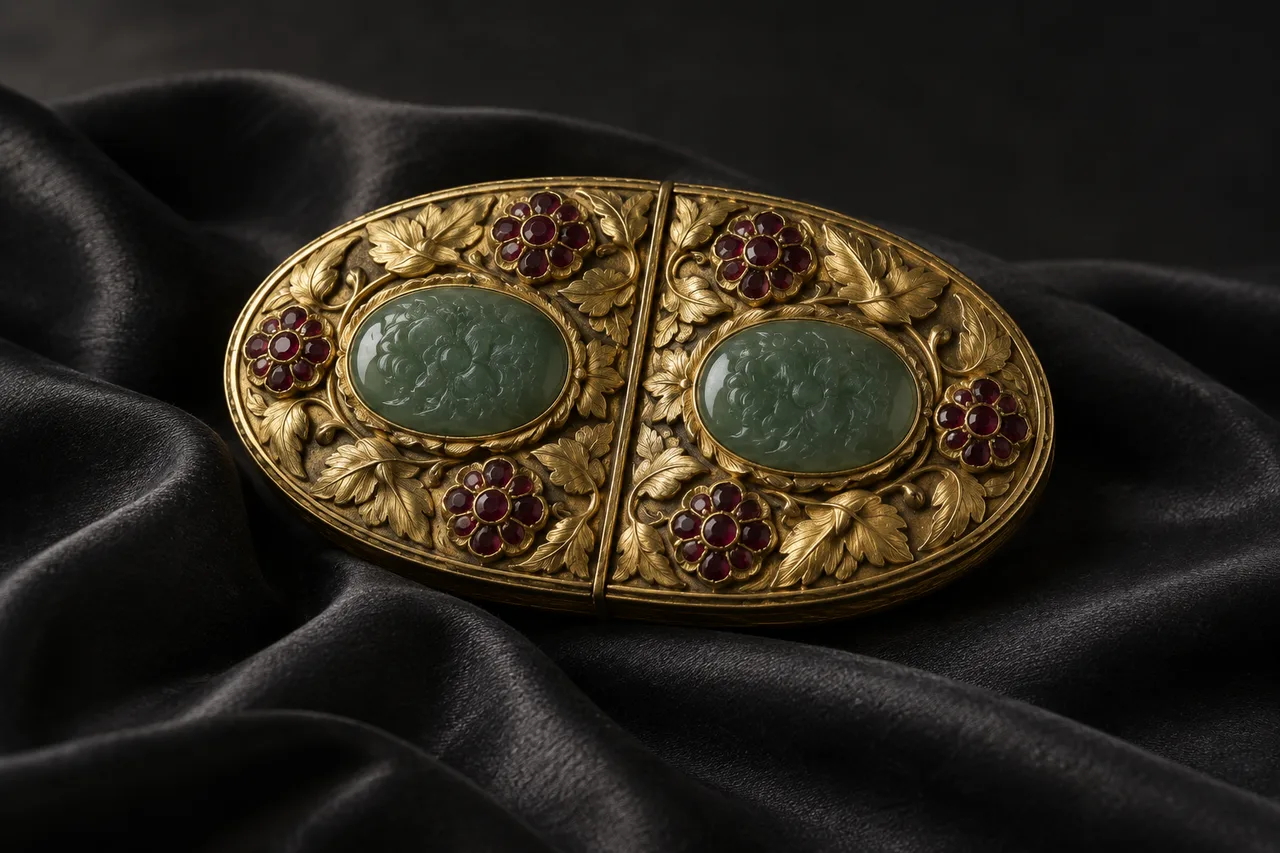
A flower of gold, a red stone at its heart, a stem winding across jade: the details of an Ottoman buckle invite the eye to linger. On an example in the Sadberk Hanım Museum, flowers and curving leaves cover an oval surface made in two sections. Catalogued as an Istanbul work of the late sixteenth century, it brings the scale of a garden into the intimate space of an accessory. Sadberk Hanım Museum
The buckle offers a starting point for a story that moves between flowers, clothing, and possessions. Across the museum objects gathered here, decoration shares space with a fastening mechanism, while the pleasure of a jewel sits alongside its value as wealth.
Flowers on the surface, a fastening behind
The Sadberk Hanım buckle measures 18.8 by 6.9 centimetres. A sheet of gold covers silver, and jade plaques carry flat-cut spinels in flower-shaped gold settings. Inlaid gold stems with curving leaves connect the flowers; further raised leaves and spinels surround the plaques. The eye can follow these links from stone to stone, reading the ornament as a continuous composition. Sadberk Hanım Museum
Behind this elaborate face is a plainly useful arrangement. A sliding pin joins the two sections, and loops allow the belt to pass through. That small piece of engineering gives the flowers their place in a wearable object. Front and back hold different kinds of interest: one rewards attention with ornament, the other explains how the buckle does its job. Sadberk Hanım Museum
Another Istanbul buckle, dated about 1600 and held by Frankfurt’s Museum Angewandte Kunst, brings gold together with nephrite jade and rubies. Its catalogue records chasing, engraving, soldering, repoussé, and inlay. These names give a sense of the varied work contained in a single accessory. The comparison also sharpens the identity of each object: the Frankfurt record names rubies, while the Sadberk Hanım record identifies spinels. Their individual materials are part of the pleasure of looking closely. Museum Angewandte Kunst, Sadberk Hanım Museum
A jewel within an outfit
A late-seventeenth-century Turkish buckle at LACMA introduces a different combination: gilt steel with jade, turquoise, and coral. Its large, three-lobed form shows how elaborate ornament could be carried on a steel foundation. Gold, silver, and steel each have a place among these particular museum examples; their surfaces cannot be understood from a general impression of richness alone. LACMA, Sadberk Hanım Museum, Museum Angewandte Kunst
LACMA places such substantial buckles within the indoor dress of wealthy Ottoman women. They finished an ensemble that could include a transparent silk shift, a fitted long-sleeved waistcoat, loose trousers, a matching caftan, and a head covering. The supporting belt visibly expressed status and wealth and could also display a finely embroidered handkerchief. That detail brings the accessory into the space of dressing: fabric, embroidery, and jewellery all meet at the waist. LACMA
Wealth worn close
The connection with a woman’s possessions becomes clearer in the trousseau inventories discussed by LACMA. Belts appear frequently in surviving Ottoman lists from the seventeenth and eighteenth centuries. Their worth was recorded according to the weight of their metals and the quality of gems, pearls, or other stones. An accessory could therefore be appreciated as ornament and accounted for with considerable precision. LACMA
LACMA also notes that women could turn these valuables into cash in times of financial need or have them melted down for their metals. This possibility lends another meaning to the flower-covered surface: beauty could hold resources that might one day be needed. LACMA
Belts had a ceremonial life, too. Museum With No Frontiers records their role as Ottoman palace awards for promotion or notable professional achievement, presented in a ceremony of girding on a belt. Here the accessory marked a recognised change in standing. Discover Islamic Art
A pomegranate, and a possibility
At the Canellopoulos Museum, a buckle 6.5 centimetres high offers a more compact floral composition. Dated from the second half of the seventeenth century to the early eighteenth, it is associated in the catalogue with Constantinopolitan goldsmiths. Its central section resembles a pomegranate and carries a six-petalled enamel flower. One garnet occupies the centre; eight more surround the leaves in a double row. Canellopoulos Museum
The museum connects this type of belt with women’s dress and suggests that the pomegranate probably referred to fertility. The connection is suggestive, while remaining an interpretation rather than a certainty. Canellopoulos Museum
There is much to enjoy in that small, concentrated arrangement without settling every question it raises. A flower, a fastening, a carefully recorded value: together, these details make the buckles feel worth lingering over. Their ornament offers an immediate pleasure; the museum records give that pleasure depth.