Story
Dragons at the Threshold: Cizre’s Bronze Guardians
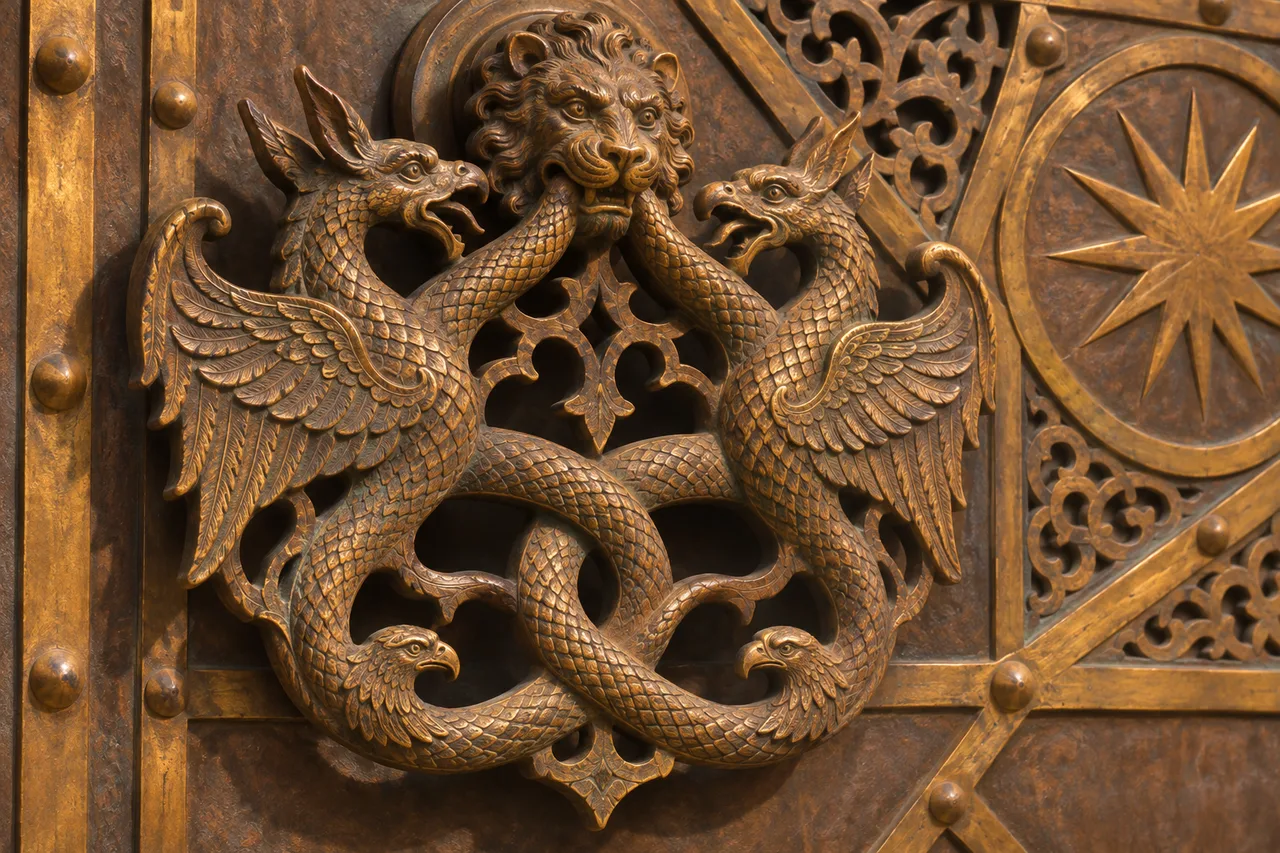
A gathering of creatures
The first impression is of a knot; the next, of creatures emerging from it. Two winged dragons curl symmetrically around a lion’s head on a bronze door knocker from the Great Mosque, or Ulu Cami, in Cizre, southeastern Turkey. The Istanbul museum catalogue dates the door and its knocker to the beginning of the thirteenth century. Even within that monumental setting, the animals invite the kind of close attention a piece of jewellery rewards. Istanbul catalogue
The details gradually separate themselves: pointed ears, almond eyes, scales across the looping bodies. The tails end in eagle heads, adding another animal to the composition. Cast and engraved in bronze, the Istanbul knocker measures 27.5 centimetres high, 24 centimetres wide and 3 centimetres deep. Those dimensions give a sense of its compactness; the changing direction of every curve makes it feel visually expansive. Istanbul catalogue
There is particular pleasure in the balance between symmetry and discovery. The overall shape is easy to grasp, yet a single glance cannot settle every detail. A tail becomes a head; a body becomes a knot. The ornament keeps offering another place for the eye to pause.
The door around the dragons
Each door leaf measures three metres high and 112 centimetres wide. The catalogue lists walnut and poplar beneath bronze cladding, with brass strips and plates secured by iron nails. Against this larger assembly of wood and metal, the knocker was one concentrated passage of animal ornament. Its intricate silhouette belonged to an equally elaborate surface. Istanbul catalogue
Three medallions occupy each leaf, with a star with twelve points at the centre of each. Openwork plates bearing arabesques and palmettes fill the intervening spaces. Partial medallions at the edges suggest, in the catalogue’s interpretation, a pattern extending into infinity. Traces of pigment also suggest that red and blue once formed a background to the openwork. The surviving metal therefore hints at a composition in which colour helped the ornament stand out. Istanbul catalogue
Above this patterned field runs an inscription in cast bronze letters. Some letters are missing, but the surviving text names Mahmud Sanjar Shah, the atabeg of Cizre, who ruled from 1208 to 1241. The named ruler and the animals share the same architectural setting: one expressed through writing, the others through bodies, wings and faces. Istanbul catalogue
Fierceness with a purpose
The David Collection interprets the dragons as figures intended to ward off evil. A related knocker in Berlin’s Museum of Islamic Art is explained in similar terms: dragons at the doorway were understood as protection against evil and unwanted visitors. In these museum readings, the creatures’ fierce appearance has a reassuring purpose at the boundary between outside and inside. David Collection Berlin catalogue
The Istanbul catalogue adds another layer, reading the door’s dragon and lion motifs as expressions of divine and sovereign power. Together with its interpretation of the geometric pattern as infinity, this gives the doorway several overlapping meanings. Ornament could speak of protection, authority and a world beyond the threshold, while remaining immediately compelling as a composition of lines and forms. Istanbul catalogue
A comparison supplied by the David Collection places these animals within a wider setting. The engineer al-Jazari installed similar handles at the palace in nearby Diyarbakır, and paired dragons appeared on doors, over gateways and on everyday metal objects in the Jazira region. That connection gives the Cizre fittings company: a recurring image could belong both to architecture and to objects seen at closer range. David Collection
A doorway divided between collections
The door leaves and the knocker now in Istanbul were transferred from Mardin Museum to Istanbul’s Museum of Turkish and Islamic Arts in 1976. In Copenhagen, the David Collection identifies its bronze handle, inventory number 38/1973, as coming from the same mosque. At 27.5 centimetres high and 24.5 centimetres wide, it closely matches the Istanbul knocker’s scale. Istanbul catalogue David Collection
The Copenhagen example has lost its fastening pin with a lion’s head. Qantara’s record explains that the lion’s head originally capped the pin securing the fitting to the door. This small missing component matters to the appearance as well as the attachment: the animal at the centre belonged to both the imagery and the construction. Qantara
Their surfaces offer another distinction. The David Collection describes the restored Istanbul example as having a golden shine, while its own retains an old patina. A comparable bronze knocker in Berlin has a separately recorded collection history: acquired from an art dealer in Tbilisi, it entered the museum in 1912 as a gift from A. Francke. David Collection Berlin catalogue
Seen closely, the Cizre dragons offer the intimate pleasure of jewellery within the scale of architecture. Their engraved bodies, little terminal heads and central lion make the eye move between the whole and its smallest parts. The doorway may be encountered through separate museum records, yet the turning line of a dragon still holds the attention.