Story
Angels Above the Lamp: Kütahya’s Ceramic Hanging Eggs
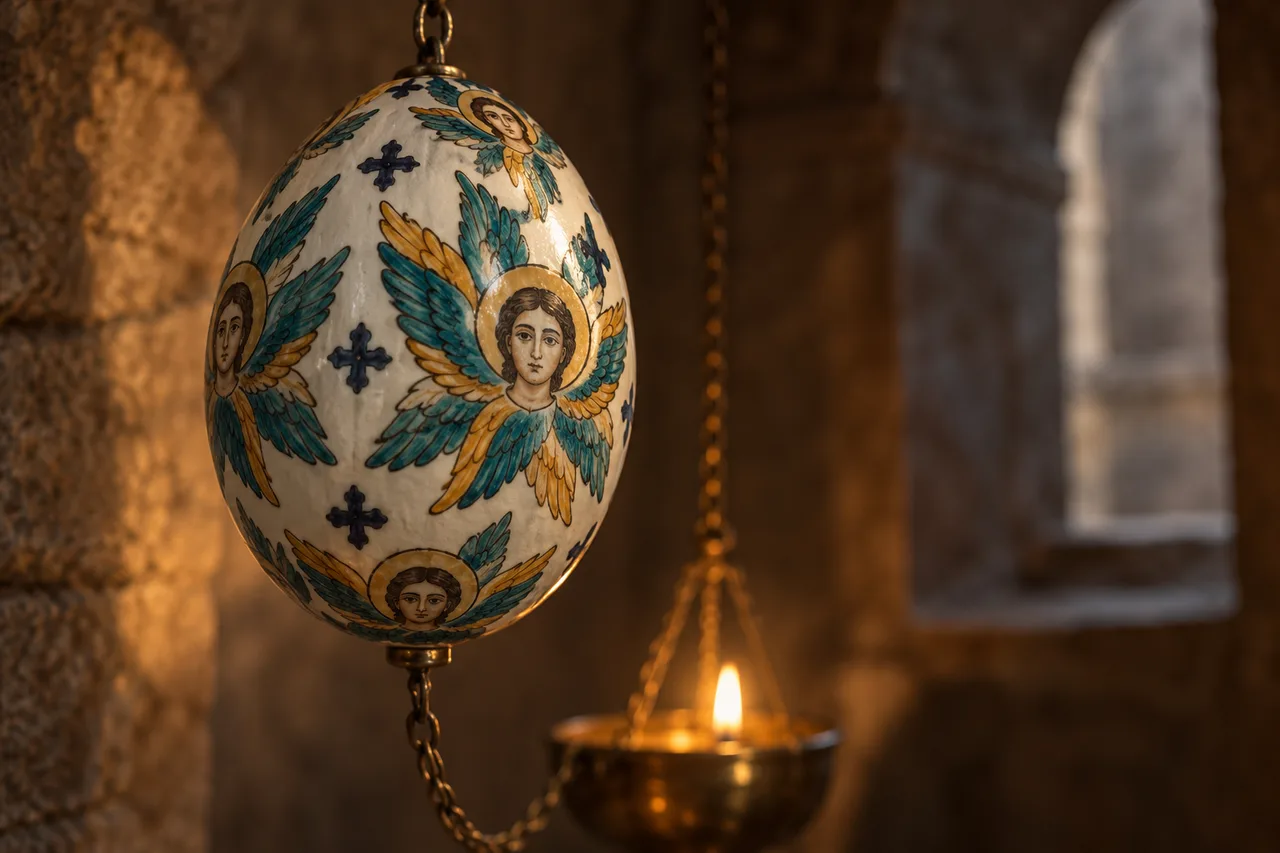
Six wings gather around a painted face on the curve of a ceramic egg. On one eighteenth-century Kütahya ornament shown in the Yerevan Biennial Art Foundation’s Angels of Protection, haloed seraphim have turquoise and yellow wings. These are details that invite the lingering attention usually given to a pendant: the face, the outline, the meeting of two colors. Made by Armenian potters, such eggs hung above oil lamps, and some were carried by Armenian pilgrims to Jerusalem as church offerings. A rounded, painted object opens onto a story of devotion and travel. Angels of Protection
A city of painted ceramics
Kütahya held a leading place in Ottoman ceramic production. Pera Museum describes it as the empire’s most important center after İznik, supported by rich local clay deposits. The museum characterizes its ceramics as an urban art, with a range embracing both architectural decoration and objects for everyday use. That breadth gives the hanging eggs a setting within a city’s varied production. Pera Museum
Armenian, Turkish, and Greek makers practiced glazed ceramics there. Armenian potters produced coffee cups, saucers, jugs, rose-water sprinklers, and inkpots alongside objects for religious settings. By the seventeenth century, the characteristic cobalt blue and white decoration had been enriched with yellow, green, and a thick red. Painting beneath a transparent glaze gave this ceramic world its colored surfaces. The eggs belong within that broader vocabulary of forms and uses, where a vessel for the table and an ornament for a church could both offer a surface for painted invention. Angels of Protection
Six wings and a remembered name
Seraphim, the six-winged angels, were a common motif on the hanging eggs made by Armenian potters, often accompanied by Jerusalem crosses. Their arrangement rewards a turning gaze: a face draws attention, wings carry it outward, and a cross marks another point on the curved surface. The decoration gives the eye several places to pause. Angels of Protection
An eighteenth-century egg in the Alex and Marie Manoogian Museum, accession L1990.14, brings a particular name into this imagery. It depicts the enthroned Virgin Mary holding the Christ Child, surrounded by seraphim of different sizes and small brownish-black crosses. Dark outlines define the faces. Its Armenian inscription commemorates Apraham of Kütahya and names the Holy Mother of God. Manoogian Museum
The name changes the scale of our attention. Beside the sacred figures is a person remembered in writing. Color and pattern now share the surface with an act of commemoration. For someone who loves the intimate character of an inscribed object, that meeting can be as absorbing as the painted angels themselves.
The question above the lamp
The eggs were pierced at both ends and suspended on the chains of hanging oil lamps. Some also served as decoration without lamps. The form appeared in Armenian and Greek churches as well as mosques; the exhibition describes undecorated eggs used in mosques with white, yellow, cobalt blue, or turquoise glaze. A shared shape could therefore carry different treatments of its surface. Angels of Protection
Their position on the chain has prompted a practical interpretation. Fresno State’s Armenian Studies resource reports that some experts considered the eggs barriers against mice trying to descend toward the fat in the lamps. The smooth surface, in this explanation, would cause the animals to slip. This is a proposed function, and the uncertainty belongs with the story. Fresno State
The possibility adds an unexpectedly domestic concern to the ornament’s devotional setting: keeping the lamp’s contents beyond a hungry animal’s reach. If that interpretation is right, beauty and useful work occupied the same short stretch of chain. The painted guardians would have had a practical companion in the slippery ceramic surface.
An offering in Jerusalem
Inscriptions on some hangings identify donors and destinations, recording offerings brought by Armenian pilgrims to churches in Jerusalem. The foundation’s exhibition documents eighteenth-century eggs at the Cathedral of Saint James and the Church of the Holy Sepulchre. These surviving settings and inscriptions connect the form with particular places and acts of giving. Angels of Protection
The egg’s shape also leaves room for interpretation. The exhibition raises possible associations with fertility, the creation of the world, Easter, and the Resurrection as open questions. Those possibilities remain part of the discussion surrounding the objects. Angels of Protection
For a reader drawn to jewelry, the pleasure here is the closeness of the encounter: a face held within wings, a dark cross, a name preserved on a curved surface. The inscription commemorating Apraham gives that attention a personal focus. Color and pattern hold the eye; beside them, one person’s name has a lasting place.