Story
A Name in Gold and Crystal: Abdülhamid II’s Three-Faced Seal
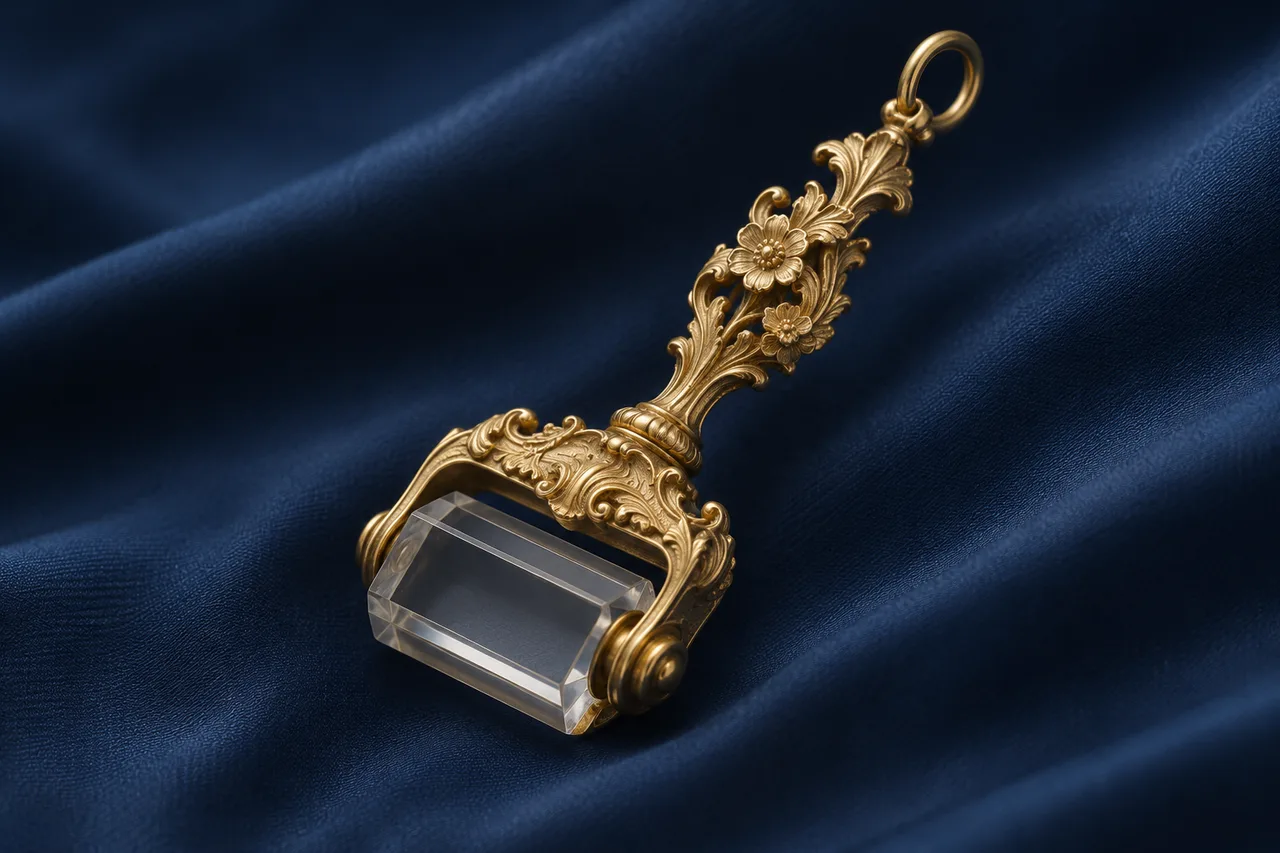
A name can be carried as well as written. In a seal belonging to Sultan Abdülhamid II, rock crystal and gold give that idea a particularly graceful form. The object measures just 3.81 centimetres high; LACMA, which holds it under accession number M.2002.1.561, identifies its owner as the sultan who ruled from 1876 to 1909. Its scale invites close attention, while its combination of materials gives a document tool the presence of a jewel. LACMA
The attraction deepens when movement enters the picture. A pivot allows the crystal to turn between three engraved faces. A small mechanism brings a new inscription into position, making the relationship between ornament and purpose unusually tangible. Here, the beauty of the object includes what it can do. LACMA
A jewel with a moving centre
The gold handle takes the form of rococo foliage and blossoms. LACMA compares these motifs with the decoration of contemporary Ottoman palaces, including Dolmabahçe. That comparison offers a pleasing change of scale: a decorative language associated with palace interiors appears within an object less than four centimetres high. The leaves and flowers frame the crystal while giving the eye somewhere to linger before it reaches the writing. LACMA
At the top, a small link suggests another part of the seal’s life. The museum interprets it as evidence that the object was probably worn on a chain, suspended from the waistband or neck. The proposed arrangement brings the seal close to the body and helps explain its appeal as an adornment even between uses. LACMA
Each crystal face carries a different formulation of the sultan’s name in nastaʿliq script. The pivot gives these three inscriptions a shared setting. According to LACMA, seals with multiple faces were frequently used by Ottoman royalty and palace officials in the second half of the nineteenth century. LACMA
More than one way to name a ruler
The name on a seal belongs to a rich vocabulary of personal and official identity. The TDV İslâm Ansiklopedisi explains that Ottoman sultans possessed personal seals alongside imperial seals bearing the tuğra, the royal monogram. A ruler’s seals could thus express different aspects of his identity through their inscriptions. TDV, “Mühür”
A separate three-faced seal of Abdülhamid II, recorded in Topkapı’s collection as 47/57, makes this variety especially vivid. Two faces bear initials in Arabic letters; the third carries the Latin letters A H. Seen together through their catalogue descriptions, the two examples suggest how much variation the compact format could accommodate: a name written in different formulations, or initials arranged in different alphabets. TDV, “Mühür”; LACMA
There is something intimate about that concentration on a name. For a jewelry-minded reader, the inscriptions offer another point of connection with the object: identity becomes part of its design, as essential to its character as the frame or the turning crystal.
The trust behind the engraving
The engraved surface and its impression had a precise relationship. Letters were cut in reverse so that they would read correctly when stamped. The TDV account of hakkâklık, the art of engraving, also describes calligraphy as an essential part of a seal engraver’s training. The miniature inscription brought together the composition of writing and the demands of a resistant material. TDV, “Hakkâklık”
Its account distinguishes tools according to the material being worked: steel tools for softer metals such as gold, silver, and brass, and diamond tools for harder stones including agate, bloodstone, and turquoise. TDV, “Hakkâklık”
Trust also had a place beside skill. Engravers worked together near Istanbul’s Beyazıt Mosque, in the market formerly known as Hakkâklar Çarşısı and now called Sahaflar Çarşısı. They kept registers of impressions, recording the seals they made before handing them to their owners. When a lost seal was replaced, the record helped ensure that its successor differed from it, a safeguard against forgery. TDV, “Hakkâklık”
Those registers give the beautiful object a social dimension. A finely composed name belonged to a system in which a recognisable impression mattered. The engraving carried responsibility as well as visual pleasure.
Beyond the royal gold
A wider material range appears in Raziye Çiğdem Önal’s study of forty seals in Trabzon Museum. Most of the examples date to the later nineteenth and early twentieth centuries; silver and brass are the most common materials in this group, and circular and oval forms predominate. The findings describe this particular collection, offering a useful comparison with the royal gold and crystal. Önal, Trabzon Museum study
Returning to Abdülhamid’s seal after that comparison, the pleasure lies in the meeting of its elements. The gold foliage gives the name a decorative setting; the crystal carries the writing; the pivot makes the three faces available in turn. The engravers’ books add something less visible to that small assembly: the responsibility attached to a recognisable mark.