Story
A Hunt in Bronze: The Many Lives of an Urartian Belt
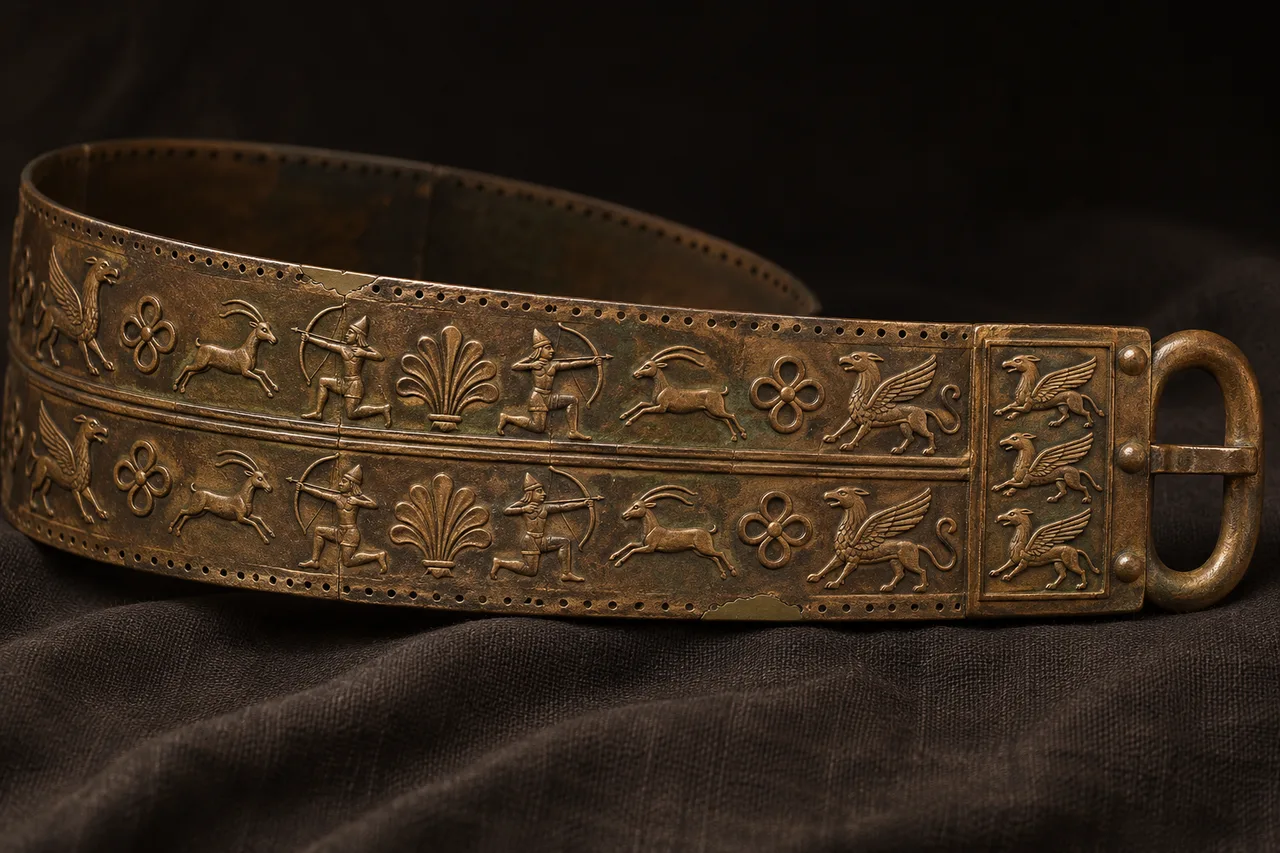
The hunt is already in motion. Goats run, archers bend their knees to shoot, and creatures with bird and animal bodies share the bronze landscape. On an eighth-century BCE belt at Istanbul’s Rezan Has Museum, this activity unfolds in two ordered rows. The museum classifies the belt as medium-sized; within that modest format, its decoration offers an absorbing succession of encounters. The eye can follow the action and then return to the small ornaments between the figures. Museum object record
Another story lies among these lively images. The museum identifies repairs made during the belt’s period of use, as well as a reconstruction from six surviving fragments. Both belong to its biography, bringing questions of damage, continued use and survival into the pleasure of looking. Museum object record
A kingdom on a strip of metal
Urartu’s heartland lay between lakes Van, Urmia and Sevan. Its capital, Tuşpa, was established at Van Kalesi, in present-day Turkey. In its account of Urartian bronzework, Encyclopaedia Iranica places belts and shields among objects formed from thin metal plates, alongside a separate category of cast objects. Urartu in Iran
A study published in Anatolica in 2020 describes Urartian belt plates measuring 70–120 centimetres long and 5.5–17 centimetres wide, with decoration made through embossing, stamping and engraving. These are comparative dimensions for Urartian belts, not measurements of this particular object. The study also distinguishes narrow, medium and wide belts. That range helps place the museum’s medium-sized example within a broader family of objects. Anatolica XLVI
The proportions alone suggest an appealing compositional challenge: a long, limited surface carrying many small events. Here, the interest comes from the relationship between a single figure and the rhythm of the whole.
The hunt and its pauses
Double embossed bands divide the featured belt’s decoration into two horizontal rows. In both, figures proceed from the centre towards the ends. Running goats, archers with bent knees, and mythological creatures fill the hunting scene. The arrangement lets the action spread in two directions, giving the centre a different role from the rectangular panel at the right end. Museum object record
Palmettes and loop-shaped rosettes occupy spaces between the figures. Inward-facing palmette rosettes also mark the upper and lower boundaries of the rows. They can be enjoyed as visual pauses: recurring forms that hold the lively figures within an ordered pattern. The hunt supplies movement; the ornament supplies a measured rhythm around it. Museum object record
At the right end, three mythological creatures appear one above another inside a rectangular panel. A loop-shaped buckle is riveted to that end, while small, closely spaced holes follow the outer border. These details bring the scene back to the physical object. Alongside the goats and archers are an edge, a fastening and the junction between decorated surface and practical form. Museum object record
Two histories of repair
The ancient repairs bring human attention into the belt’s history. The museum dates these marks to its period of use. In that small fact is a sequence of making, use and renewed attention. The circumstances of the repair remain outside the brief account, but the intervention itself is absorbing. A repair can hold the eye as firmly as an elaborate figure: someone responded to damage, leaving another trace on the metal. Museum object record
The reconstruction tells a different part of the story. Six fragments were joined, and the spaces between them were filled. The object presented as a continuous belt therefore includes both surviving pieces and completed gaps. The ancient repairs belong to the belt’s life in use; the joining and filling belong to the recovery of its overall shape. Two different episodes meet within the biography of a single object. Museum object record
There is an intimacy in that distinction. The hunting figures give the surface its energy, while the repairs draw attention to the belt itself as something that passed through use, damage and renewed intervention.
Another hunt, another belt
Rezan Has Museum also describes a separate Wide Belt with Hunting Scene, dated to the seventh century BCE, with lion and bull hunts. Its date, width category and animals distinguish it from the eighth-century belt with running goats considered here. The comparison opens another view of hunting imagery while preserving the particular character of each object. Urartian Belts
For a reader drawn to adornment, the pleasure of this belt lies in how much remains to notice after the first impression. An archer’s pose leads to a rosette; the repeating border leads to the riveted loop. Then the repair marks change the mood again. Beside the miniature action is the quieter presence of a damaged object that someone once repaired.