Story
A Gilded Perch for a Turban
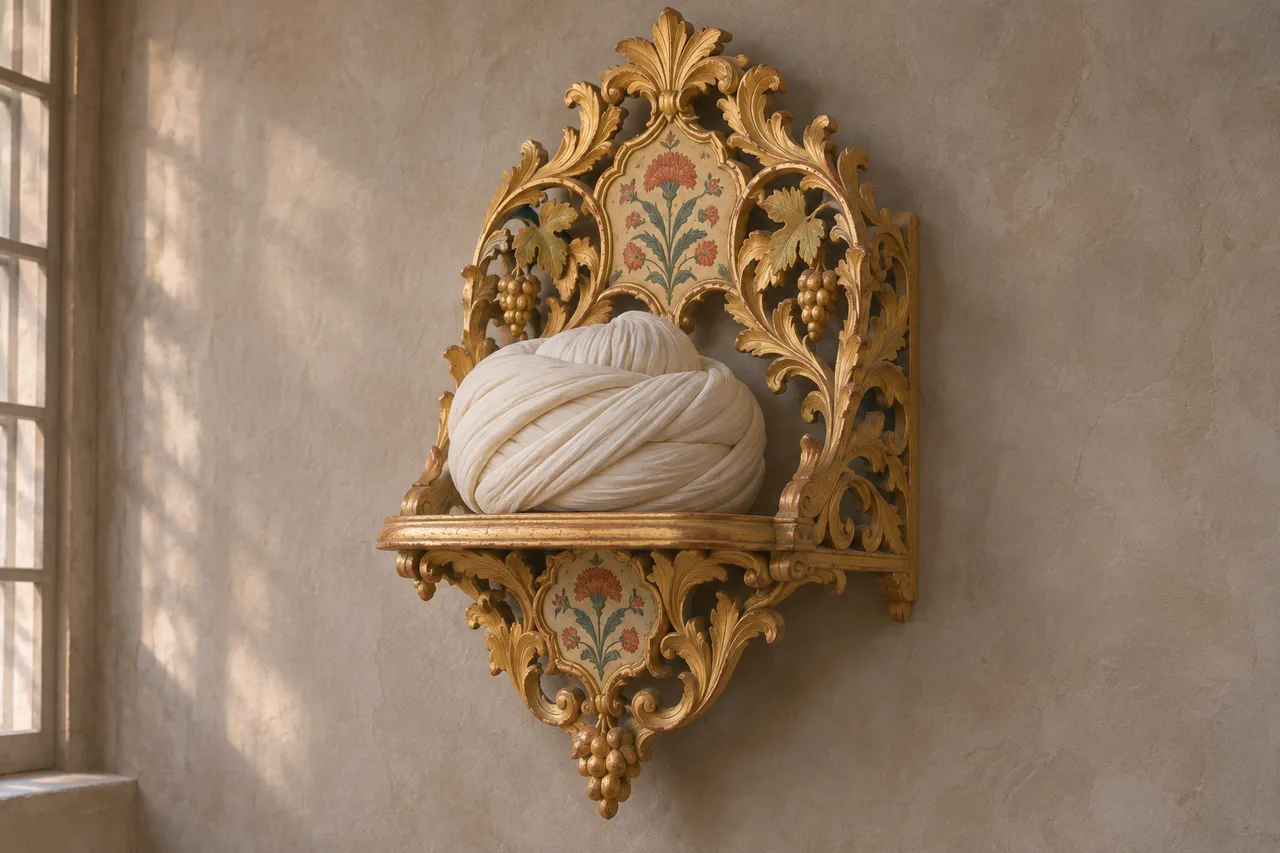
A head covering can command attention even after its wearer has left the picture. That is the quiet fascination of the Ottoman kavukluk: an object devoted to the interval between wearings, when a turban needed somewhere to rest. Getty’s Art & Architecture Thesaurus identifies kavukluk as the Turkish term for a turban stand. The function is easy to grasp; the care lavished on the examples considered here invites a much longer look. Getty
For readers who love jewellery, there is an immediate attraction in this meeting of a personal possession and an ornamental setting. Gilding, carved foliage and patterned inlay give the eye plenty to explore. Yet the most absorbing detail may be the space reserved for something else: the shelf or support that gives all this decoration its purpose.
A resting place for rank
In the Ottoman court and among the elite, elaborate turbans indicated rank and position. Their winding followed precise clothing regulations, and the stands held them between wearings, according to Getty. A turban’s arrangement therefore carried information about the person entitled to wear it. Getty
This connection changes the way a support can be understood. The headwear resting on it belonged to a regulated language of appearance. Thinking of the stand alongside the turban brings a practical concern into focus: an elaborate form had to have a place when it was no longer being worn.
There is something engagingly intimate about that pause. A courtly object becomes easier to approach through an ordinary need, the wish to put a valued possession down. The kavukluk offers a view of courtly dress through the furnishing that accommodated its absence from the body.
Carving with room to breathe
A kavukluk in the Los Angeles County Museum of Art makes that furnishing’s decorative ambition tangible. Made in Turkey in the middle to late eighteenth century, it is carved and gilded wood, measuring 111.76 × 35.56 × 30.48 centimetres. Its maker is listed as unknown. The ornament includes pierced acanthus scrolls, grape clusters, painted floral panels and a projecting shelf. LACMA
At more than a metre high, this is a substantial presence. The dimensions encourage us to imagine the whole object before settling into its details. Then the attention can move between the open spaces of the pierced carving, the rounded suggestion of grapes and the flowers contained within painted panels.
Those different treatments of plant forms give the eye different pleasures. Carved leaves make their effect through shape and depth; painted flowers offer another kind of surface to contemplate. The shelf supplies a visual pause amid the ornament, a place where the object’s practical role becomes legible.
For a jewellery reader, the attraction may lie in that movement between overall shape and close detail. Here, the museum’s simple material description—carved and gilded wood—also matters. It allows the glow of the finish and the structure beneath it to be appreciated together, as parts of one object.
A travelling place of its own
Sotheby’s observes that most surviving turban stands are wall brackets, while describing a rare portable example from eighteenth-century Turkey. Its wooden body is a domed cylinder, painted red, with gilded arabesques on the lower section and a five-sided base bearing calligraphy. The accompanying wooden case is eight-sided. Sotheby’s
That change of outline, from cylindrical support to angular base and enclosing case, is already visually satisfying. The case adds mother-of-pearl, tortoiseshell and ivory inlay, arranged in symmetrical floral designs and interlocking geometric patterns. Green cloth lines the interior. Sotheby’s
The sequence of surfaces gives the portable ensemble a particular intimacy: patterned exterior, cloth-lined interior, then the support itself. Each layer brings the viewer closer to the headwear for which the object was intended. Sotheby’s explains that the stand would have supported the wrapped cloth and the silk cap around which it was wound, protecting the fabric and helping the cap keep its shape. Sotheby’s
Protection becomes part of the object’s visual interest. The green lining is as memorable as the inlaid exterior because it makes the relationship between container and contents easy to picture. Even without a turban in place, the ensemble suggests the volume it was made to receive.
Words beneath the turban
The portable stand also carries an affectionate turn of phrase. Sotheby’s translates the inscription on its base as “Like the turban, your place is on top of my head.” The line draws the object’s function into a declaration of regard: the highest place becomes a place for someone cherished. Sotheby’s
That small verbal flourish offers another way into the kavukluk. Alongside the rank communicated by a turban, there is room to consider tenderness, wit and the pleasure of a beautifully appointed possession. The words give the practical support a more personal voice.
A carved leaf catches attention; a shelf explains the shape; a line of writing changes the mood. Together, these details make a turban stand rewarding to linger over. The resting place has a presence of its own, while keeping its most generous gesture for the thing it was made to hold.