Story
A Fistful of Silver: The Mystery of a Hittite Hand
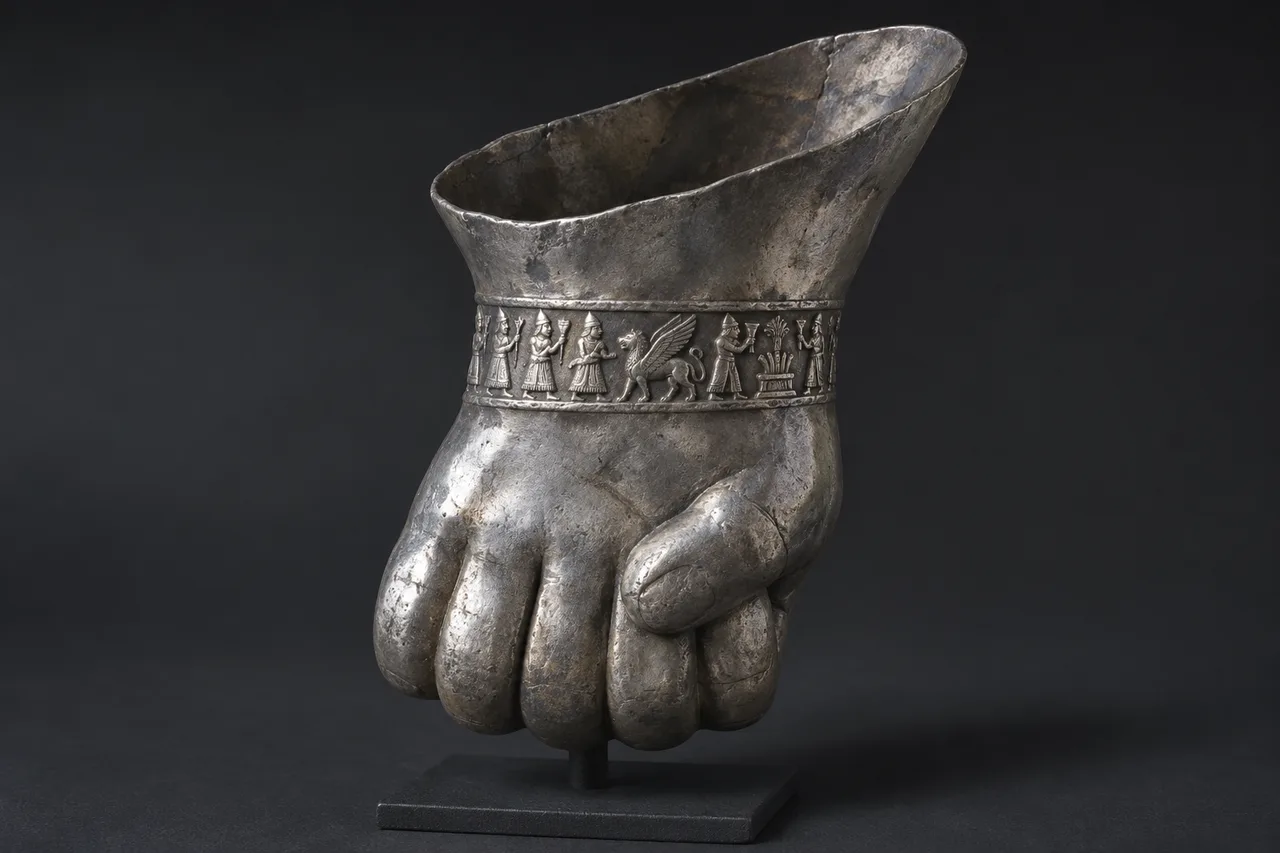
A closed hand is an immediately familiar shape. In silver, with a hollow opening above the wrist, it becomes something harder to place. The Museum of Fine Arts, Boston identifies this object as a Hittite drinking vessel from Anatolia, made in the fourteenth century BCE. Even with that label, the fist holds something back: its original purpose has become the subject of debate. Museum of Fine Arts, Archaeology.
For anyone drawn to finely worked silver, the attraction begins before the mystery. There is the concentrated shape of the hand, then the invitation to look more closely at its wrist. The eye moves between a gesture it recognizes and a small world it needs time to read.
One sheet, an intricate form
In his 2025 study, Clement Hazan describes the fist and its flared cup as having been hammered from a single sheet of almost pure silver. Its height changes across the form: 16.3 centimetres on the thumb side and 12.5 on the little-finger side. Those measurements give the apparently simple silhouette an unexpected asymmetry. Hazan’s study.
Knowing that hand and cup were formed from one sheet changes the pleasure of looking. The broad shape and the small details belong to the same piece of metal. For a reader who enjoys the close attention a decorated bracelet invites, there is a familiar satisfaction here: the whole object catches the eye, while its surface keeps it occupied.
Its modern history adds another dimension. The fist reached the Boston museum on loan in 1977, heavily corroded and assembled from many fragments. Güterbock and Kendall’s chapter preview. Monika Schuol records that restoration and cleaning were completed in June 1990; Hans Gustav Güterbock and Timothy Kendall published their study in 1995. The recognizable hand therefore also carries a history of recovery and examination. Schuol’s study.
A ceremony around the wrist
The wrist holds the most concentrated decoration: a frieze just 2.8 centimetres high, worked in repoussé and chasing. Hazan describes a storm god holding a bull’s reins, an offering table, and seven worshippers led by a king. Hieroglyphic signs beside the royal figure identify him as Tudhaliya, “Great King”; three musicians appear among the attendants. Hazan’s study.
At that scale, the procession offers a different kind of encounter from the fist’s bold outline. A hand can be recognized almost at once; a ceremony unfolds figure by figure. The musicians give the silent relief a suggestion of sound, while the king’s name makes one participant more than an anonymous silhouette.
This is where the object becomes especially absorbing for a lover of ornament. The decorated wrist can be appreciated as a composition, with its sequence of figures and gestures. It also raises questions about what the larger hand represents. The pleasure of the silverwork and the difficulty of interpreting it occupy the same narrow band.
The case for a vessel
Schuol records attachment points for a missing handle at the lip and below the wrist, on the little-finger side. Her study also discusses Hittite monthly festival instructions in which a king and queen drink from a fist-shaped vessel while worshipping Karmahili, accompanied by a large lyre and singers. Together, the physical traces and the written parallel give substance to the vessel interpretation. Schuol’s study.
The distinction between a type of object and this particular example matters. The festival text documents ritual use of a fist-shaped vessel; it does not identify the Boston fist as the vessel used in that ceremony. The correspondence is compelling precisely when it retains that limit. It brings the unusual shape into a recognizable ritual setting without supplying a complete biography.
The possibility of a missing body
In 2023, archaeologist Jorrit Kelder proposed another reading: the fist might have belonged to a life-size statue of the Hittite weather god Tarhuna. As reported in Archaeology, he questioned how conveniently its shape would allow drinking or pouring. He also suggested that a torn section at the rim might mark where a nail secured the silver to a wooden arm. That proposed attachment remains a hypothesis. Archaeology’s account.
Hazan’s 2025 interpretation asks a related question about the imagery. He proposes identifying the depicted storm god as Teššub of Aleppo and reads the hand’s covering as a fingerless gauntlet, possibly a boxing glove or protective armour. These are interpretations of the representation; they do not establish Kelder’s proposed wooden body. Hazan’s study.
The uncertainty leaves the viewer with several ways to imagine the object’s original presence: lifted as a vessel, attached to a figure, or evoking a protected divine hand. None needs to become a certainty for the silver to reward attention. Its strongest invitation remains wonderfully concrete: a clenched hand, a decorated wrist, and a miniature procession that makes a familiar gesture strange again.