Story
Woven in Silver: The Ancient Art of Anatolian Telkari
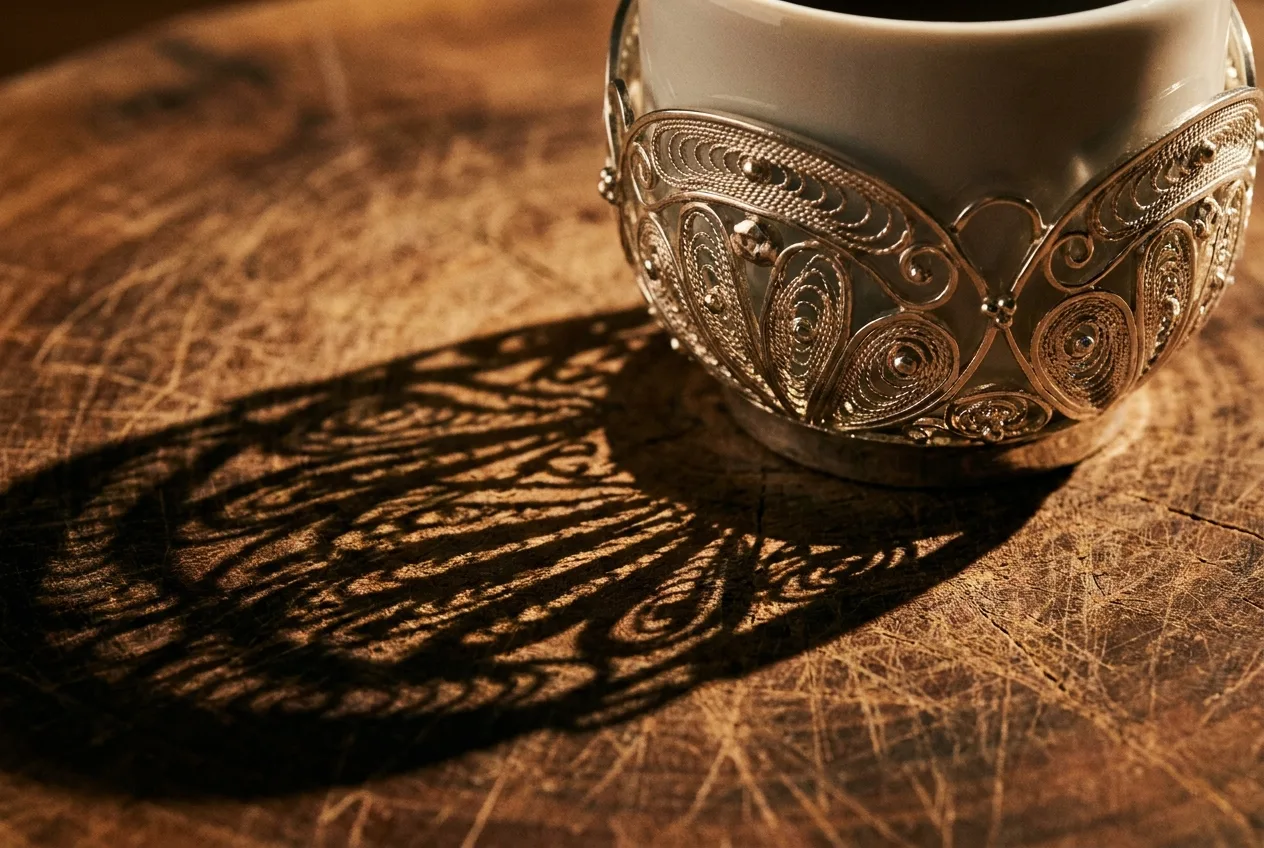
There is a striking, almost poetic paradox at the very heart of Telkari. To look at a finished piece—perhaps an impossibly intricate, lace-like holder for a traditional handleless Turkish coffee cup—is to see something that appears almost weightless, as fragile and fleeting as a winter frost clinging to a windowpane. The eye naturally assumes that something so delicate must have been born of equally delicate origins. Yet, the creation of this “silver lace” is a gripping story of intense heat, brute physical strength, and a millennia-old legacy preserved with profound dedication by the Syriac community in the sun-baked district of Midyat, Mardin.
The Deep Roots of the Silver Thread
The word itself tells a fascinating story of cross-cultural weaving and linguistic heritage. “Telkari” marries the Arabic and Persian word tel, meaning fine metal thread or wire, with kâri or kâr, meaning work or weaving. It is an exceptionally apt name for a craft that has been traced back to the very cradle of human civilization.
Archaeological excavations and historical records reveal that early filigree techniques were born in the heart of Mesopotamia around 3,000 BCE and made their appearance in the fertile lands of Anatolia by 2,500 BCE. For centuries, this mesmerizing art form has been safeguarded and passed down through generations of Syriac artisans. It has survived the rise and fall of great empires, outlasting technological revolutions to remain a vital, living tradition in the modern era.
The Raw Strength Behind the Fragility
The journey of a Telkari piece, from raw earth to finished artifact, is one of dramatic and uncompromising transformation. It begins not with gentle, quiet weaving, but with the deafening roar of the furnace. High-purity silver is melted in specialized crucibles at a blistering 950 degrees Celsius. This glowing, molten metal is poured into molds to form initial thin rods, which are then ruthlessly pulled through steel plates dotted with gradually tapering holes.
As the silver wire grows thinner, the physical resistance of the metal increases exponentially. Historically, when the silver became too stubborn and hard to be pulled by hand with pliers alone, the masters resorted to an extraordinary display of physical commitment. An artisan would tie the end of the wire to a thick, incredibly durable belt made of water buffalo hide, worn firmly around his waist. Leaning back against the unyielding metal, he would use the entire weight, leverage, and power of his body to force the silver through the die. Through this grueling, back-breaking process, the silver wire is drawn down to a mind-boggling thinness of 40 microns, with some threads reaching an ethereal, almost invisible 25 microns.
Constructing the Silver Cage
Despite its gossamer, web-like appearance, a Telkari object is architecturally sound and robust. Every piece is meticulously built upon a sturdy outer structural frame known as a muntaç, which is crafted first using a double thickness of wire. This robust boundary serves as the foundation for the intricate infill motifs that give the piece its signature lace effect.
One of the most captivating applications of this craft is known as “Cage Telkari.” This specific three-dimensional method involves joining shaped silver threads by painstakingly welding them together to create hollow, voluminous decorative objects. The master completes these meticulously assembled pieces resting on a flattened, heavily compressed walnut slab. This wooden surface is intentionally flamed beforehand to burn off the oils used during the metal drawing process. To finalize the piece and bring out the depth of the woven metal, the artisan might employ a chemical oxidation process. This intentionally ages the millimetric wire motifs, granting the silver a rich, dark antique patina that highlights every shadow and curve of the silver lace.
A Legacy Protected for the Future
Today, the survival of Telkari is a powerful testament to the resilience of the Midyat craftsmen who refuse to let their ancestral art fade into the obscurity of mass production. Recognizing the immense cultural and historical weight of this tradition, Turkey officially granted Telkari a geographical indication in August 2021, cementing its deep, historical ties to the region.
The celebration of this craft reached a new and triumphant milestone on December 10, 2023, with the grand opening of the Mardin Telkari Museum in Midyat’s Akçakaya Neighborhood. Standing as Turkey’s only thematic museum dedicated exclusively to this mesmerizing silverwork, it offers a permanent, educational home for the legacy of the Syriac masters. Here, the story of Telkari continues to be told—not merely as relics of a forgotten past, but as a continuing narrative of human ingenuity, where heavy water buffalo belts and 950-degree flames give birth to the most delicate silver lace the world has ever seen.