Story
Twelve Points of Devotion: The Bektaşi Teslim Taşı
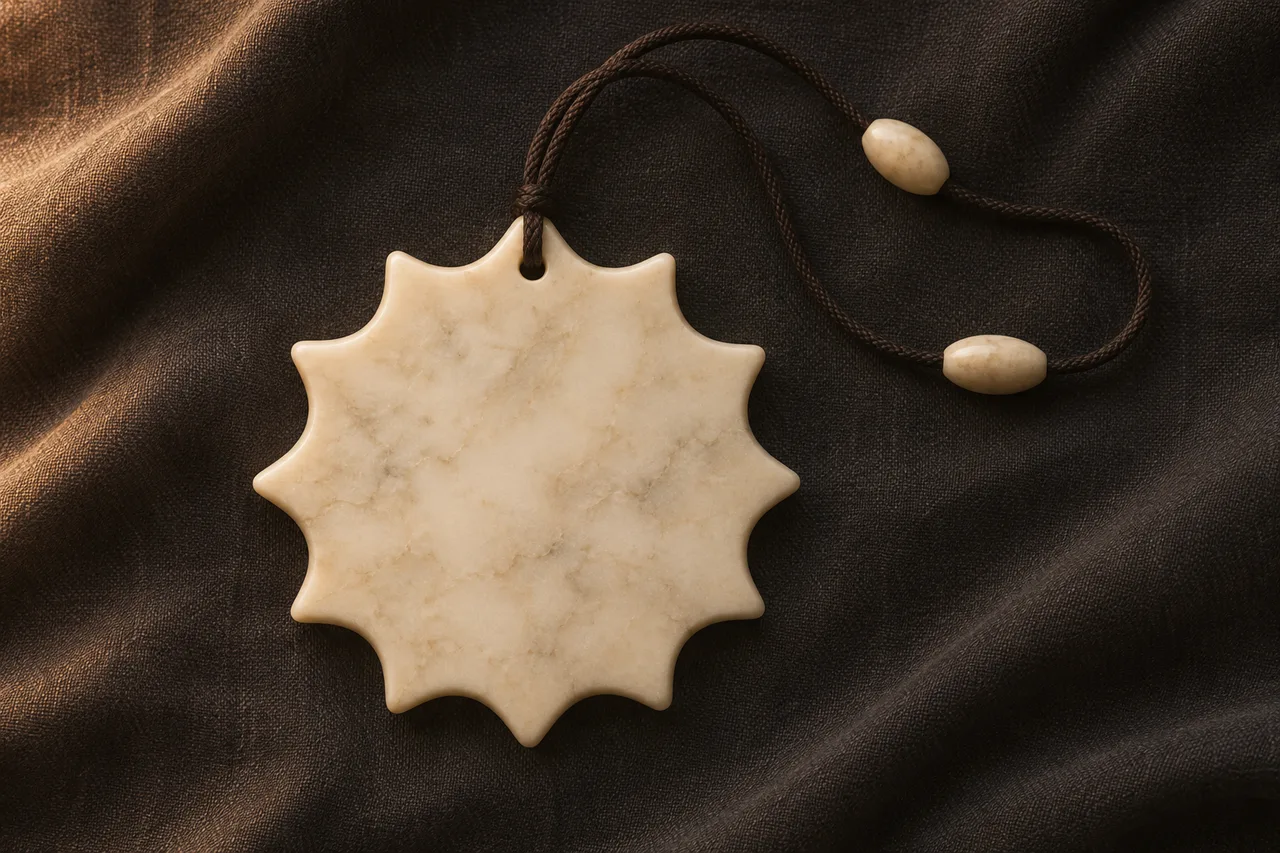
A pale stone, twelve points, a cord: the outline offers a quiet invitation to look closer. A National Museum of World Cultures catalogue entry reproduced by Art Boulevard describes a marble pendant accompanied by two small opaque stones on its cord. Its name is teslim taşı, translated as “stone of surrender,” and it belongs to the dress of dervishes of the Bektaşi Sufi order. These few details bring the object into focus: stone and string, an individual wearer, a religious tradition. Museum catalogue record
There is pleasure in the shape before its meaning is known. The repeated points give the eye somewhere to linger; the cord suggests the closeness of an object worn against the body. Learning its name adds another dimension to that first encounter. “Surrender” gives this piece of adornment an inward emphasis, inviting us to consider what an object might mean to the person who wears it.
A form with a devotional meaning
The twelve points represent the Twelve Imams. In the TDV İslâm Ansiklopedisi account of Bektaşilik, devotion to the Twelve Imams occupies an important place in the order as it took shape under Balım Sultan. The same account traces a long formation beginning in the thirteenth century, developing around traditions associated with Hacı Bektaş Veli, and reaching a more consolidated organization in the early sixteenth century. The pendant belongs within that layered religious history. TDV İslâm Ansiklopedisi
The museum record gives the object a place in a person’s entry into the order: a spiritual leader known as a baba presented the pendant to a follower after initiation. It also records that both married and unmarried dervishes wore it, and that pendants passed from one baba to another. The exchange makes the relationship between adornment and belonging especially tangible. A pendant passed from a religious guide to a new member carried a meaning that its outline alone could only begin to suggest. Museum catalogue record
That context changes the experience of looking. The twelve points can still be admired for their rhythm, but the pattern also holds a specific dedication. Its beauty and its religious meaning occupy the same small space.
Different stones, a shared outline
Marble is one material in this story. The catalogue also names crystal, carnelian and alabaster among the materials used for these pendants. In the marble example, the two additional opaque stones make the cord part of the composition. The description gives us a whole necklace to contemplate, with the pendant at its centre. Museum catalogue record
For alabaster, the catalogue supplies a geographical connection. It describes white and cream-coloured material with reddish-brown markings, names it Hacı Bektaş stone, and records its extraction near the lodge and mausoleum of Hacı Bektaş in Central Anatolia. The material now has a place on the map, close to the religious setting associated with the pendant. Museum catalogue record
Stonework and a livelihood
The town of Hacıbektaş gives the story a craft setting. In a study published in 2013, Dilek Akbulut describes it as a centre where stoneworking developed around religious belief, with skills passed from father to son. Her research included interviews with stoneworkers, souvenir shop owners and Hacıbektaş Museum staff, bringing makers, sellers and museum knowledge into the same account. Dilek Akbulut’s study
Akbulut documented souvenir production alongside work on stone cladding, worktops and gravestones. She also described pressure from imported materials and products on the souvenir trade, with a diminishing number of craftspeople turning towards cladding and gravestone production or other occupations. These observations belong to her 2013 account. They give the history of the craft an economic dimension, where religious associations and the need to earn a living meet. Dilek Akbulut’s study
Against that background, the pendant invites attention to the people and livelihoods behind worked stone. Its small scale offers an approachable way into a much wider story about the place of craft within a town.
The motif above the doorway
At the Hacı Bektaş Veli complex, the form also belongs to architecture. Two teslim taşı motifs appear above a kitchen-corridor doorway’s construction inscription dated 1560–61; another motif appears above the doorway into the main kitchen space. The former lodge opened as an ethnographic museum on 16 August 1964, after restoration between 1957 and 1964. A shape associated with the neck thus has a counterpart within the fabric of the lodge itself. Kültür Portalı museum description
Another museum context is supplied by Turkey’s Ministry of Culture and Tourism: its description of Ankara’s Ethnography Museum lists teslim taşı among nineteenth-century dervish objects in the Hacı Bayram-ı Veli and Sufi Objects Gallery, alongside prayer beads and incense burners. That setting places the pendant within a wider material world of religious life. Ministry museum description
Returning to the pale stone and its cord, the outline now feels more particular. For someone first drawn to it as adornment, there is room to appreciate both the form and the devotion attached to it. The twelve points hold the eye; the history gives that attention somewhere to go.