Story
The Warrior’s Jewel: How the Zihgir Transformed from Battlefield Tool to Royal Statement
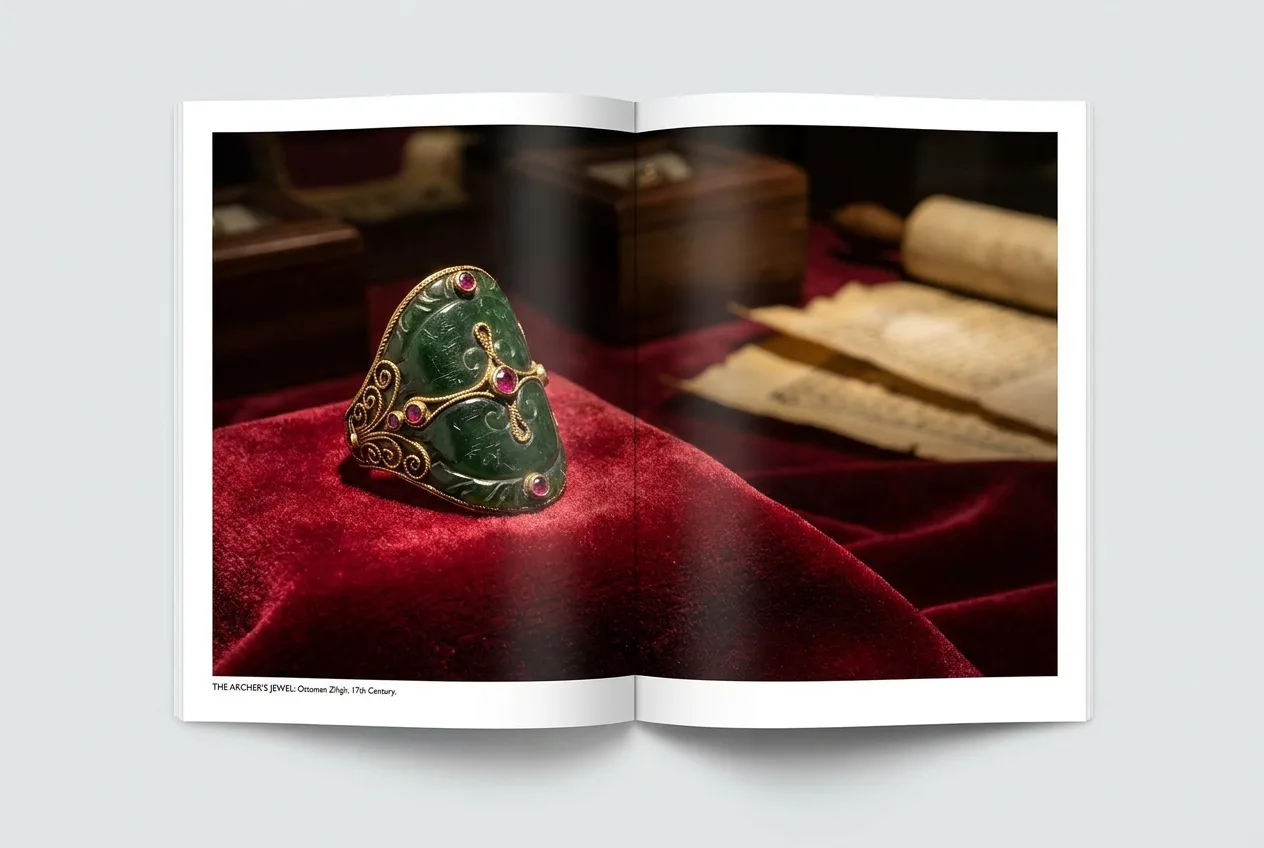
In the vast and storied history of military prowess, few objects are as intimately connected to both martial survival and exquisite artistry as the zihgir. To the untrained eye, it is simply an asymmetrical ring worn on the thumb. Yet, within the context of the Ottoman Empire, this small accessory was the literal pivot point upon which the empire’s legendary archery skills turned. Over the centuries, the zihgir transcended its purely functional origins on the dusty steppes to become a glittering symbol of royal prestige, worn by sultans and high-ranking nobles in the opulent halls of palaces.
The Architecture of the Thumb Draw
The fundamental necessity of the zihgir lies in the unique mechanics of traditional Turkish archery. Unlike the Western tradition, which typically relied on a three-finger draw to pull the bowstring, Eastern archers utilized the “thumb draw.” This technique was developed alongside the short, highly efficient composite bow. In the thumb draw, the immense tension of the bowstring is borne entirely by the thumb, locked in place by the index finger. Without protection, the string would instantly cause severe skin abrasions, calluses, and debilitating joint injuries.
To prevent this, the zihgir was engineered with a highly specific anatomy comprising three distinct structural elements. The first is the palate, known in Turkish as the kaş, which bears the direct, brutal pressure of the drawn string. Next is the ear, a contoured section often fitted with a delicate leather lining on the interior to ensure the ring sat securely against the archer’s skin without slipping during a crucial shot. Finally, the threshold serves as the precise ledge where the string rests just before the release. Together, these elements transformed a simple protective band into a sophisticated mechanism of control.
Materials Born of Purpose
In its earliest and most pragmatic forms, the materials used to craft a zihgir were dictated entirely by the type of archery being practiced. For warfare and short-distance target shooting, archers frequently utilized leather rings. Leather was prized for its elasticity and cushioning properties; its softness interfered less with the instinctive, rapid accuracy required in the heat of battle or while shooting from horseback.
Conversely, when archery flourished into a celebrated competitive sport within the empire, the demands on the ring changed. Flight shooting—the discipline of shooting an arrow over the maximum possible distance—required incredibly hard materials capable of withstanding explosive force. These rings were explicitly fashioned with thick, arched, and acute-angled lips. While buffalo horn was the most widely used material due to its availability and strength, the ultimate prize for a dedicated flight shooter was a ring carved from walrus tusk, widely considered the strongest and most resilient material available.
A Lexicon of Archery and Elegance
The widespread importance of this tool is reflected in the diverse terminology surrounding it. In Ottoman texts, the ring is referred to variously as the zihgir, zingir, zehgir, or şast. Its presence extended across the broader Islamic world, known as the küştibân in Arabic, and the engüştvâne in Persian—a word that translates elegantly to “thimble.”
As the Ottoman Empire solidified its power, archery gradually shifted from being strictly a military endeavor to an institutionalized, aristocratic sport and a symbol of cultural heritage. Along with this shift, the zihgir itself evolved into a marker of honor, status, and nobility. It became fashionable for the elite—even those who never set foot on a battlefield—to wear a zihgir as a testament to their refinement and association with the warrior class.
Craftsmen began to elevate the ring from a tool to a jewel. Ornate zihgirs were commissioned using precious metals like gold and silver, and carved from semi-precious stones such as jade, agate, and jasper. Many were heavily adorned with mother-of-pearl. The exquisite collections housed today in the Topkapı Palace stand as a testament to this era, showcasing rings encrusted with gems and intricate inlays. One beautifully documented surviving example from the 18th century—a Turkish zihgir crafted from silver, gold, jade, and precious gems—measures just 4.1 centimeters in length but carries a substantial weight of exactly 19.8 grams, a heavy reminder of its material wealth.
A Lasting Symbol
The historical footprint of the zihgir is visible not only in museum collections but in the archaeological record and fine art. The discovery of a rare mother-of-pearl inlaid zihgir at Konya’s Gevale Castle provides a tangible link to Anatolia’s archery heritage.
Perhaps the most poignant illustration of the zihgir’s cultural significance, however, is found in a famous portrait of Sultan Mehmed the Conqueror, attributed to the artist Shiblizade Ahmed. In the painting, the Sultan is depicted in a moment of profound, delicate serenity, gently smelling a rose. Yet, resting prominently on his thumb is an archer’s ring—a quiet, brilliant reminder that beneath the refined aesthetics of the Ottoman court beat the heart of a formidable warrior.