Story
The Bee of Ephesus: A City on a Gold Ring
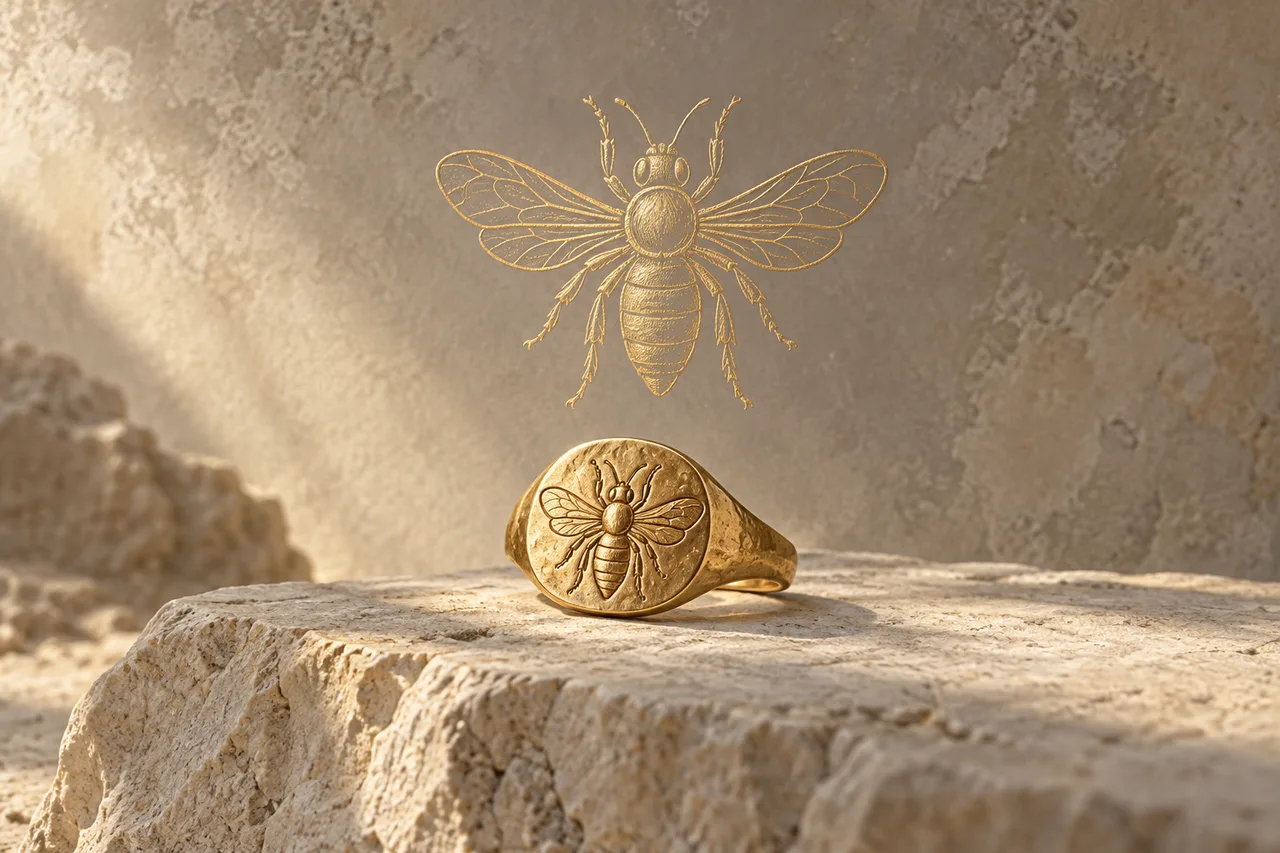
A bee, a little gold and two Greek letters: the decoration seems spare for an object with so much to suggest. On a ring in the J. Paul Getty Museum collection, the insect appears between epsilon and phi, letters that abbreviate Ephesos, the ancient name of Ephesus. The museum identifies the design as a close copy of the city’s coin imagery. A small piece of jewellery thus opens a view onto a much larger place. Getty’s ring record
For someone drawn to jewellery, the pleasure lies in that change of scale. The bee is small enough to belong on a finger, yet its setting among the letters gives it a particular address. Its outline invites attention; the name hidden in the composition gives us a reason to linger.
A city in two centimetres
The Getty dates the gold ring to the third century BCE, classifies it as Greek and records its maker as unknown. Its inventory number is 85.AM.278. The bezel, the decorated face, measures 1.8 × 1.6 centimetres; the hoop measures 1.9 centimetres at its greatest extent. Those dimensions bring the object back from an enlarged museum image to the intimate scale of jewellery. Getty’s ring record
The letters deserve as much attention as the insect. Together, they make the connection with Ephesus explicit. The Getty’s comparison with coins concerns both elements: the bee and the abbreviated city name. Read together, they allow us to see the ornament as a miniature expression of place. The appeal of that reading rests in how little space the design needs.
The same bee in silver
An earlier example appears on a silver tetradrachm, a coin worth four drachmas, also in the Getty collection. Dated to 390–380 BCE and measuring 27 millimetres across, it bears a bee between epsilon and phi inside a dotted border. On the other side, the forepart of a stag turns its head back towards a palm tree. The ring’s central combination of insect and letters is already there in silver. Getty’s tetradrachm record
A later silver drachma in the Australian National University’s Classics Museum repeats the bee between the same letters. Dated to approximately 202–170 BCE, it weighs 3.90 grams and measures 19 millimetres. Its reverse shows a standing stag before a palm tree. ANU’s drachma record
Together with the third-century ring, these coins give us three dated examples of a shared design. They help explain the museum’s comparison: the engraving belongs to a recognisable Ephesian motif. The shift from silver money to gold jewellery is especially engaging. A motif associated with a city becomes something scaled to the hand, while the two letters preserve its geographical connection.
Artemis and her emblem
Ephesus was a Greek city on the western coast of present-day Turkey and an important centre of Artemis worship. The bee, stag and palm were all emblems of the city associated with the goddess. The Getty describes her priestesses as “honey bees”; it also connects the stag with Artemis’s role as protector of wild animals. These associations give the ring’s insect a religious setting as well as a civic one. Getty’s account of the coin imagery
The sanctuary’s reach extended well beyond the city. UNESCO describes the Temple of Artemis as one of the ancient Seven Wonders and notes that it drew pilgrims from around the Mediterranean. That wider setting matters when considering the possible meaning of an ornament bearing the Ephesian bee. UNESCO’s Ephesus entry
Gold adds an earlier chapter to the story. A pendant in the form of a bee’s body, now in the British Museum, dates to about 650–600 BCE and was excavated at the sanctuary of Artemis at Ephesus. Only 1.60 centimetres high, it has a flat back and a suspension loop. Its museum number is 1907,1201.181. Here, the connection between a gold bee ornament and the sanctuary includes a recorded findspot. British Museum’s pendant record
A souvenir, perhaps
The Getty notes that other rings and gems with the same design survive and suggests that they may have been souvenirs from Artemis’s sanctuary. That possibility is the most intimate part of the ring’s story. If the interpretation is right, the ornament could have joined personal adornment to the memory of a sacred place. The museum presents this as a suggestion, leaving the ancient wearer’s particular reasons open. Getty’s interpretation
The pendant’s date takes the story several centuries earlier, while its findspot anchors that particular ornament to the sanctuary. The ring’s relationship to the place is approached through its imagery and the museum’s comparison with related pieces. Seen together, the objects bring a distant sanctuary into focus at the scale of jewellery.
For a jewellery lover today, the attraction may lie in the closeness of those two scales: a city with a celebrated sanctuary, and a bee on a face less than two centimetres wide. The engraving offers a modest point of contact with that larger history. Gold catches the eye; the little insect, with its two accompanying letters, holds the attention.