Story
Silver on Black: Erzurum’s Oltu-Stone Beads
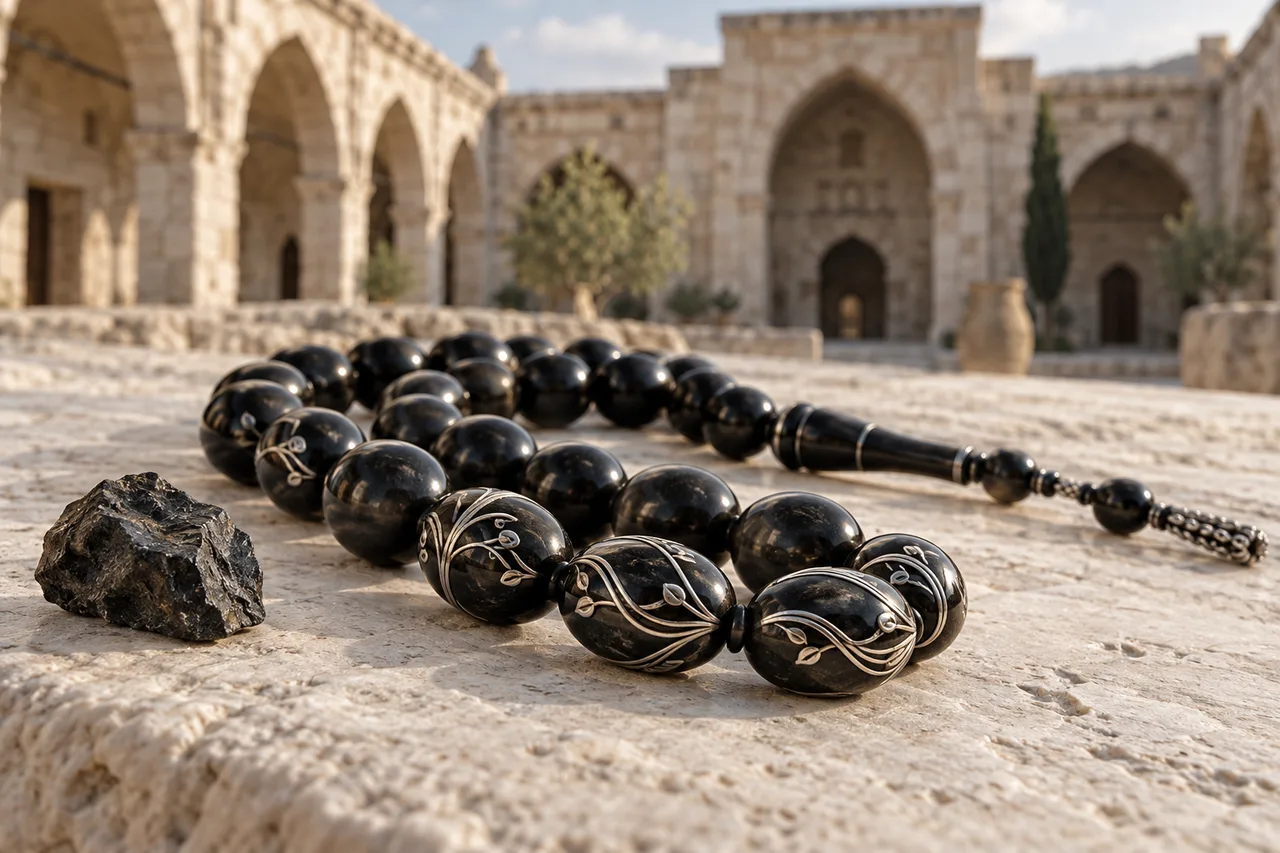
Black stone gives a silver line room to shine. Across the rounded surface of a bead, a small curve can become a whole landscape for the eye. Silver-inlaid Oltu-stone prayer beads invite that close attention; their decoration is documented in the work of Erzurum maker Kadir Çelebi. The attraction begins with contrast, then opens into a story about material, devotion and place. Anadolu Agency
A place held in a name
Oltu stone takes its name from the Oltu district of Erzurum, where its deposits are principally found. A 2021 doctoral thesis at Middle East Technical University identifies tespih, or prayer and worry beads, as its main manufactured product, alongside other ornamental goods. A strand therefore offers a particularly direct introduction to the material. METU thesis
Turkey’s Culture Portal records Oltu stone under geographical-indication registration 192 and gives the alternative name siyah kehribar, “black amber.” Its description is appealingly tactile: the stone has slight veining and a velvety feel. Those details give the imagination something beyond a smooth black silhouette—a surface with its own quiet character. Culture Portal
The name carries a geological complication. The 2021 thesis describes fossilized organic material derived from trees; a 2025 study of Olur–Tortum material rejects a fossil-wood origin and identifies carbon intermediate between amorphous carbon and graphite. The familiar name contains a more complicated scientific story, with different published explanations. METU thesis, Geological Bulletin of Turkey
There is also a striking detail in the Culture Portal’s account of workshop practice: craftspeople rebury unworked stone until it is needed, preventing it from hardening through exposure to air. Even before a pattern appears, the material requires attention. That interval underground belongs to the object’s story as much as its finished surface. Culture Portal
The rhythm of a strand
The repeated shape of the beads has a devotional purpose. In Islamic practice, prayer beads are used for dhikr, the repeated recitation of phrases glorifying God, and strands commonly contain 99 beads. This context lends the sequence of individual beads a meaning beyond its visual rhythm. Anadolu Agency
For a reader first drawn to the decoration, that purpose changes the encounter. The strand can be appreciated bead by bead, with the eye returning to the same rounded form and discovering another small variation in a silver line. Repetition becomes part of its beauty. Understanding its devotional use also leaves room for an owner’s relationship with an object whose appearance initially caught their attention.
The Konya Ethnography Museum also displays Oltu beads alongside prayer beads made from amber, agate and mother-of-pearl. That company offers another way to consider the black stone: within a shared object type, different materials create different visual possibilities. Turkish Museums
A maker’s line in silver
In an interview published on 12 September 2021, Kadir Çelebi described placing silver wire into patterns cut into Oltu beads. The metal follows a design within the stone’s surface. Seen as decoration, the effect resembles drawing: a bright line is given definition by the black around it. Anadolu Agency
Çelebi, known as Nakkaş Kadir, spoke of finding motifs in objects around him, including a ram’s horn. He said he could complete only two or three strands a month. One particularly demanding tespih, decorated with a spider’s web and a pigeon’s nest, had taken 48 days. Those details give the idea of painstaking work a human scale: a small object can occupy a large stretch of someone’s working life. Anadolu Agency
His reported repertoire also included 24-carat gold, diamonds, rubies and emeralds. The report presents these materials as part of his own repertoire. For a prospective owner, such distinctions make the individual piece more interesting. The stone’s name introduces the material, while the particular design introduces a maker’s choices. Anadolu Agency
The courtyard around the beads
The trade in Oltu goods has an architectural setting in Erzurum’s Rüstem Pasha Caravanserai, also called Taşhan. Built in 1561 by order of Rüstem Pasha, grand vizier to Suleiman the Magnificent, it has two storeys and 32 rooms arranged around a rectangular courtyard. The scale shifts from the curve of a bead to the space of a substantial stone building. Culture Portal
The Culture Portal describes Taşhan as a place where Oltu goods are manufactured and sold, including prayer beads, rings and necklaces. Here, the material’s association with Erzurum acquires a setting in which objects are made and offered to buyers. Culture Portal
Together, these details enrich the pleasure of looking: the feel of the stone, the repeated bead, the maker’s silver line and the courtyard surrounding the trade. A prospective purchase can hold all those associations. Even for someone simply curious about an unfamiliar material, there is an invitation to linger over a small object and notice how much of a place it can bring into view.