Story
Raised Red: A Garden on an İznik Dish
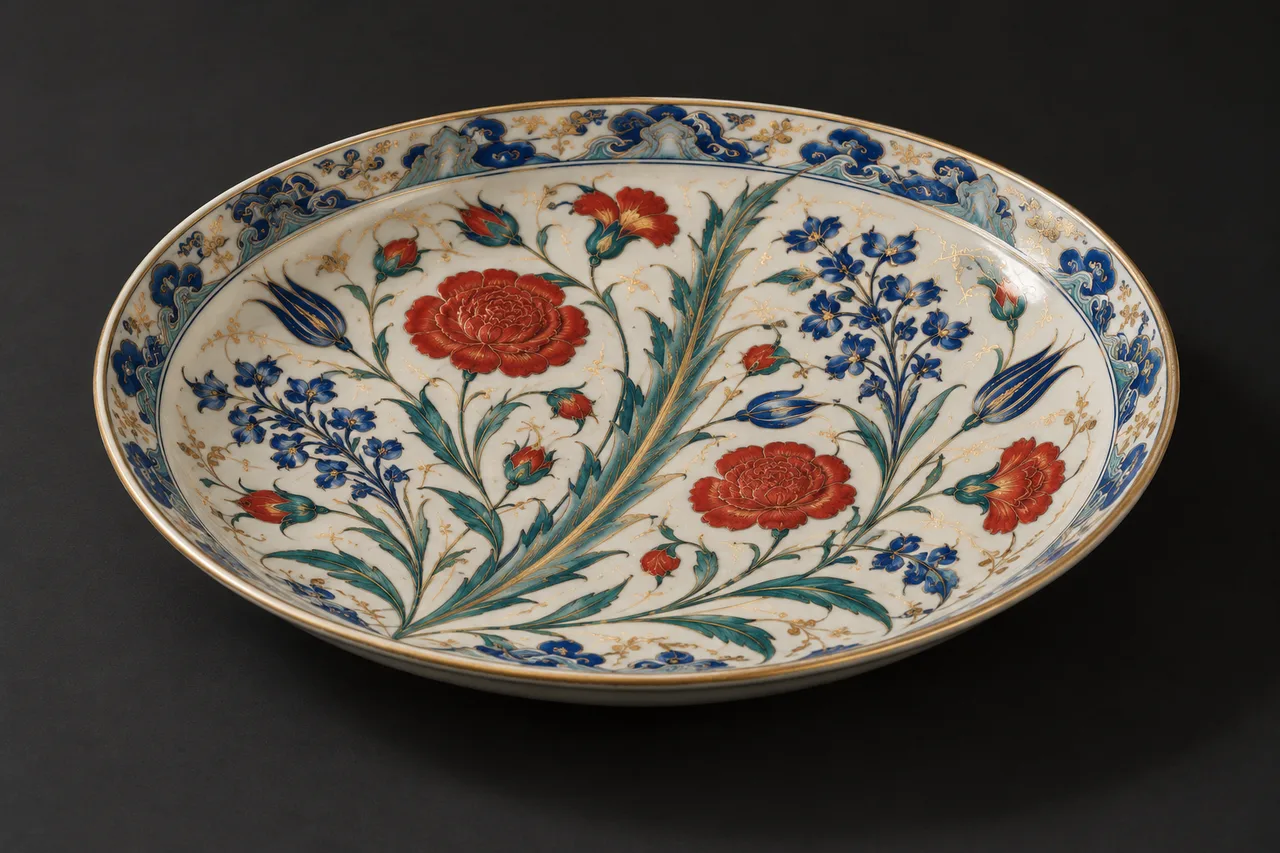
The red roses are the first invitation. On a dish made in İznik around 1590, they share the floral design with blue hyacinths and a sweeping central saz leaf. Gold brings another note of richness to the flowers. The Cleveland Museum of Art’s Gilded Dish with Flowers and Leaves measures 29.8 centimetres across and 6.6 centimetres high: a generous space for a garden to unfold. Cleveland Museum of Art
For anyone drawn to the colour and fine detail of jewellery, this ceramic object offers a familiar pleasure. The eye moves between the whole arrangement and the small accents that make it worth lingering over. A rose draws attention to the red; a gleam of gold holds it somewhere else. The delight lies in those shifts of scale, from a dish full of flowers to a particular passage of colour.
A colour with a little height
The red has a physical presence. The Ashmolean describes İznik potters’ use of an iron-rich slip that remained slightly raised on the surface. Red had been the most difficult colour to achieve, and its eventual place in the palette brought texture as well as intensity. The relief was slight, giving this colour a different material character from a purely flat patch of decoration. Ashmolean Museum
Cleveland records the dish as fritware with red slip, underglaze decoration and overglaze gilding. Those terms describe an intriguing arrangement: the painted design lies beneath the glaze, while the gold sits above it. Colour and gold occupy different levels of the same surface. For a reader accustomed to noticing the relationship between a jewel’s colour and its setting, that layered relationship has an immediate appeal. Cleveland Museum of Art
The museum also notes that such gilding rarely survives. Its presence gives this particular dish an extra claim on our attention. There is pleasure in following a floral composition that still brings its red, blue and glittering gold together. Cleveland Museum of Art
A palette gathered over time
This richness emerged through a changing repertoire of colour. From the late fifteenth century, İznik, about 100 kilometres south of Istanbul, became the principal production centre for a refined ceramic ware serving both the Ottoman court and the market. Its potters worked with a pure white frit body. Early vessels were decorated in blue on white. Ashmolean Museum
Turquoise had joined the palette by the 1520s, alongside a lighter blue. Towards the middle of the century came greens ranging from sage to olive, together with purple. Bolder floral compositions accompanied that expansion. In the century’s second half, blue, black, emerald green and thick red became İznik’s hallmark combination. The roses on the Cleveland dish belong within this wider story of colour gaining new possibilities. Ashmolean Museum
Garden flowers, arranged for the eye
As the palette changed, floral designs moved towards a more naturalistic repertoire that included tulips, roses, carnations and hyacinths. The Courtauld connects these four principal flowers with the style named after Kara Memi, chief painter at Süleyman the Magnificent’s court. Recognisable garden flowers gave the decoration a new closeness to the living garden. Ashmolean Museum, The Courtauld
On the Cleveland dish, the central saz leaf divides the composition, with red roses and blue hyacinths contributing their distinct colours. The leaf’s sweeping movement gives the floral gathering a strong visual direction. Knowing a flower’s name is only part of the pleasure; there is also the way its shape participates in the whole. Cleveland Museum of Art
Flowers circulated across many kinds of Ottoman objects. The Courtauld discusses their presence on prayer books, kaftans and imperial tents, among other surfaces, and considers their cultural, literary and spiritual associations. That wider setting lends depth to the painted garden while leaving the immediate enjoyment of colour and rhythm open to every viewer. The Courtauld
Waves at the edge
Around the Cleveland dish, the rim carries a simplified rock-and-wave design adopted from Chinese ceramics. The museum notes that Chinese ceramics were abundant in Istanbul’s Topkapı Palace. At the edge of this floral composition, another decorative tradition enters the picture: a border with its own history, framing the garden. Cleveland Museum of Art
A British Museum dish dated approximately 1570–1600 offers a revealing companion. Its cobalt blue and apple green accompany thick pinkish bole-red, with forms outlined in greyish black. Around its rim, a continuous, undulating half-palmette scroll sits against a raised pinkish red ground. Here red becomes part of the border’s very field, showing another role for the colour within İznik decoration. British Museum
Returning to the gilded dish, the eye has more to enjoy: the weight of a red rose within the design, the sweep of the leaf, the interruption of a gold accent. For a lover of finely worked objects, that is an appealing kind of abundance. There is always another small detail within the larger garden.