Story
Peter and Theodote’s Ring: A Wish for Harmony
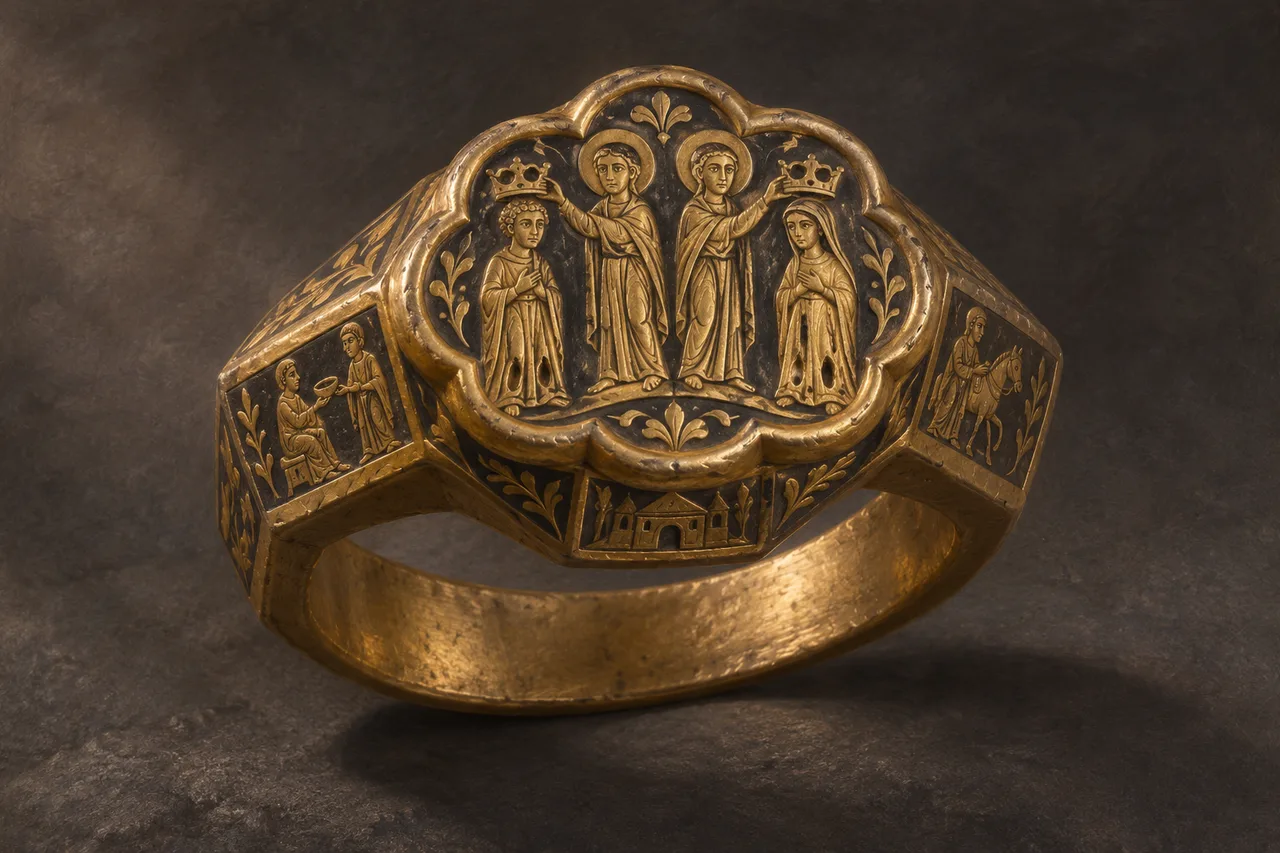
At first, this is a story of gold and dark detail. Then two names bring it close: Peter and Theodote. A prayer on their marriage ring asks for divine help, and suddenly the ornament feels less distant. Its beauty invites attention; its words offer a reason to linger. Dumbarton Oaks identifies the people named in the prayer as the wedding couple. Dumbarton Oaks.
The octagonal ring belongs to that collection, with accession number BZ.1947.15. The Metropolitan Museum dates it to the seventh century and records its materials as gold and niello. Its proposed place of manufacture appears as “Constantinople(?)”: an explicitly tentative attribution. For readers interested in Turkey’s Byzantine heritage, that possible connection adds another reason to pause over this personal object. The Metropolitan Museum of Art.
A blessing with two names
On the ring’s face, a bride and groom receive crowns from two central, haloed figures. One is Christ; the other is identified as Mary, or possibly Ecclesia, the personification of the Church. That alternative remains part of the museum’s interpretation. The scene can be read as an image of the couple beneath sacred protection, their marriage given a place within a religious picture. Dumbarton Oaks.
Words gather around this image. Below it, an inscription invokes harmony. A prayer around the bezel, the ring’s decorated face, names Peter and Theodote and asks for divine assistance. The narrow edges of the hoop carry two passages from John 14:27 concerning Christ’s gift of peace. Dumbarton Oaks.
Read together, the surviving words suggest harmony between two people, help for them both, and peace around their shared life. The emotional pull lies in the openness of those wishes. A name makes the prayer particular; the desire for a peaceful life together leaves room for a reader’s own associations. It is easy to linger over that balance of the personal and the familiar.
Seven scenes around the hoop
The sides carry a further sequence of images. Seven scenes follow the life of Christ: the Annunciation, Visitation, Nativity, Presentation in the Temple, Baptism, Crucifixion, and his appearance in a garden after the Resurrection. Dumbarton Oaks describes them as arranged in chronological order on the hoop’s facets. Dumbarton Oaks.
The effect, read alongside the crowning scene, is of a personal blessing held within a larger sacred narrative. Each episode gives the eye somewhere else to rest. The face introduces a marriage; the surrounding scenes extend the religious world in which its wishes are expressed. This is where the ring becomes especially absorbing as an object of adornment: its story has more than one centre of attention.
For a reader today, that density can feel surprisingly intimate. The scale of a ring brings an expansive subject close to the body. Here, the smallness of the format becomes part of the emotional experience of looking.
Gold defined by darkness
Niello supplies a material counterpoint to the gold. As Susan La Niece explains in her historical and technical survey, it is a black material containing one or more metal sulphides. In recessed decoration, it creates a strong contrast with gold or silver. That definition helps explain the visual language of dark detail against warm metal. The Antiquaries Journal.
For someone drawn to the appearance of jewellery, this contrast offers its own pleasure. The dark passages give the eye something to follow within the gold. Material and image become difficult to separate: the ornament’s appeal resides in their relationship.
There is also a more uncertain detail. Hollows in the bodies of the bride and groom suggest, according to Dumbarton Oaks, that gemstones may originally have occupied them. The museum presents this as an interpretation. The figures may once have held jewels: the suggestion makes these tiny bodies particularly arresting, even as it leaves their original appearance partly unresolved. Dumbarton Oaks.
Concord beyond one couple
A related gold marriage ring in the Louvre, AC 924, dates to 600–700 and is attributed to the eastern Mediterranean. Its inscription OMONOIA calls for concord between spouses. Its construction gives that comparison a tangible dimension: a gold strip forms the band and is soldered to the face, while the engraved figures and inscriptions are filled with niello. Here too, a wish for married life takes shape through words, images and contrasting materials. Louvre.
Another ring, Walters Art Museum 45.15, dates to the sixth–seventh century. It carries eight scenes from Christ’s life, including the Ascension on its flat upper face. The Walters explains that such scenes were credited with protective powers. That attributed power gives the decoration a devotional meaning, offering a useful comparison for the sacred imagery surrounding Peter and Theodote’s marriage scene. Walters Art Museum.
For a reader considering what makes a ring personally meaningful, these objects offer something to dwell on. Gold supplies the setting for the story; the remembered wishes give it emotional weight. With Peter and Theodote, the detail that lingers may be the pairing of their names with harmony and peace: a shared future imagined within the compass of a ring.