Story
Nelson’s Çelenk: A Jewel Made to Move
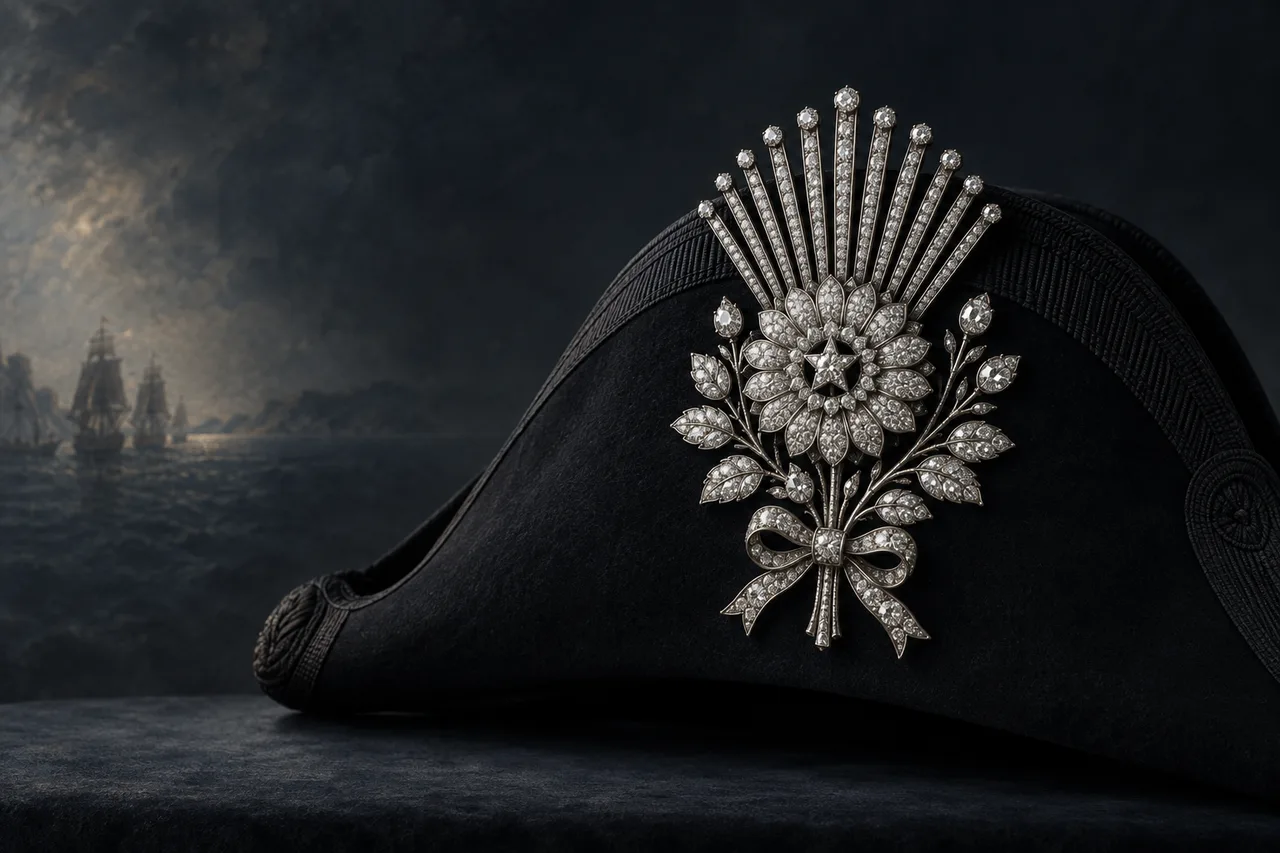
A jewel that responds to a turn of the head has a particular intimacy: its wearer becomes part of the design. The diamond çelenk that Sultan Selim III gave Horatio Nelson after the Battle of the Nile in 1798 had rays that trembled with movement. A published account of the jewel also describes a diamond star turned by clockwork. Even before its later disappearance enters the story, this was an ornament with an extraordinary sense of animation. Royal Museums Greenwich, Fondation Napoléon
A gift in the language of the court
Ottoman turban ornaments provide a setting for understanding the gift. Sultans wore ornamental feathers secured in gold holders decorated with precious stones, placing them at the centre of their turbans as symbols of authority. They sometimes bestowed holders on officials as marks of privilege. Jewellery could therefore make a distinction visible: a beautiful object also expressed the standing of its wearer. Museum With No Frontiers
Surviving holders in Istanbul’s Museum of Turkish and Islamic Arts give that courtly language colour and shape. One seventeenth-century example has a tulip-shaped ornament above a flower with gold leaves, diamonds and rubies, set against green enamel with a turquoise-coloured border. The tulip, the gold leaves and the coloured ground give a vivid point of reference for imagining Nelson’s floral jewel within this courtly world. Museum With No Frontiers
The BADA catalogue of a surviving presentation drawing places the delivery of Nelson’s gift in Naples on 13 December 1798. Kelim Effendi presented the jewel and an Ottoman robe of honour on Selim III’s behalf, in tribute to the victory at the Nile. Seen against the tradition of bestowed head ornaments, the gift can be read as a diplomatic gesture with a richly visual vocabulary: honour conveyed through something a recipient could wear. BADA presentation drawing catalogue
A flower with two kinds of movement
Greenwich’s record of the later replica helps us picture the design: a central flower of sixteen petals, accompanied by leaves and buds. A bow gathers its stalk, while thirteen rays rise above it. The publisher’s account of Martyn Downer’s book, reproduced by Fondation Napoléon, links those thirteen diamond rays to French ships captured or destroyed at the Nile. The floral details invite close attention; the radiating upper part gives the whole design a more expansive outline. Royal Museums Greenwich, Fondation Napoléon
Two separate effects animated that outline. Greenwich records that the original rays vibrated as the wearer moved. The book description adds the clockwork rotation of a central diamond star and records that Nelson wore the çelenk on his hat. A turn of the head and a mechanism within the jewel thus contributed different kinds of movement. Imagining both together changes the way we picture its sparkle: the ornament was designed to be seen in motion. Royal Museums Greenwich, Fondation Napoléon
What the images preserve
One surviving record brings us back to the presentation itself. BADA catalogues the drawing as Turkish School, 1798, in ink and watercolour on toned paper, and states that it accompanied the gift. Its interest lies partly in the change of medium: a jewel whose appeal included movement becomes an arrangement of marks and colour on a sheet. The drawing offers another way of approaching the design, with its own place in the gift’s history. BADA presentation drawing catalogue
A portrait adds a revealing imperfection. An unknown artist drew Nelson from life in Palermo in early 1799, using charcoal and red chalk; the portrait was given to his close companion Thomas Masterman Hardy. The new çelenk appears among Nelson’s honours, but with only seven spokes. Greenwich explicitly identifies this as an error. That small discrepancy matters to anyone drawn to the jewel’s appearance: even a portrait made from life cannot simply be treated as an exact record of every ornament it contains. Royal Museums Greenwich portrait record
Disappearance and a second life
The account reproduced by Fondation Napoléon follows the çelenk through inheritance by Nelson’s family after Trafalgar, an auction sale in 1895 and its eventual arrival at the National Maritime Museum in Greenwich. There, in 1951, it was stolen. The theft gives the earlier images a particular poignancy: they let us examine aspects of an object whose own story has been interrupted. Fondation Napoléon
The Greenwich object numbered JEW0368 belongs to a later chapter. It is a replica in metal and glass paste stones, catalogued as made around 1970 for the film Bequest to the Nation, and presented to the museum by the film’s production company. Its date and materials are essential to understanding what we are seeing. This is a cinematic re-creation with a history of its own. Royal Museums Greenwich
Together, the drawing, the imperfect portrait and the film replica leave several ways to imagine the lost jewel. The detail that lingers is movement: a flower, a bow, a fan of rays, and the possibility that a small turn of the wearer’s head could bring the whole ornament to life.