Story
Gold for the Divan: A Garden of Carnations from Bursa
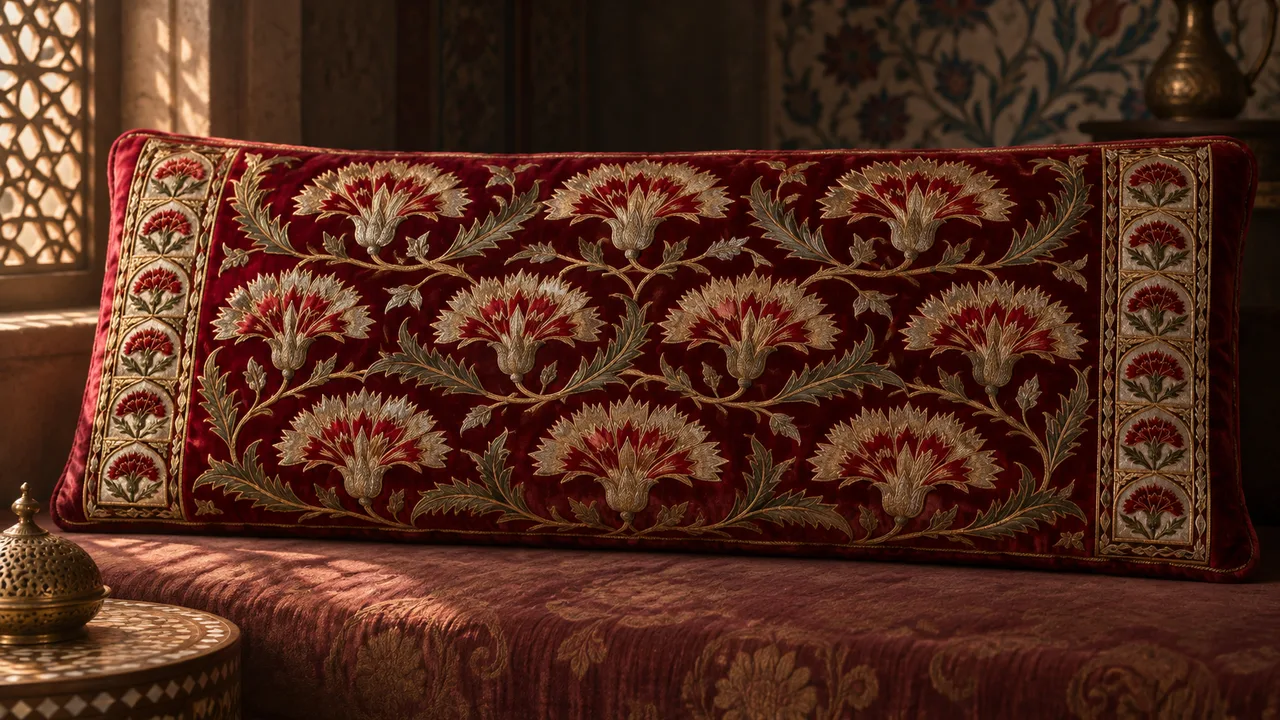
Gold and silver have an unexpected address in this story: a cushion. On a velvet cover in the Cleveland Museum of Art, precious metal belongs to the same composition as silk and flowers. For someone whose eye is usually caught by a ring or a pendant, the attraction feels familiar in this new setting. The museum describes the brocaded velvet as silk with gilded and silver metal threads, a combination that brings the idea of adornment into a furnishing. Cleveland Museum of Art
The cover comes from Bursa, Turkey, and dates to the late 1500s. At 128.9 by 66.7 centimetres, it gives its flowers a generous field. Cleveland identifies the designs at its two ends as the features that mark it out as a cushion cover for a royal divan, or sofa, used at the Ottoman court. That connection gives the textile an intimate scale within courtly life: here, magnificence belongs to an object made for a place to sit. Cleveland Museum of Art
A garden with a measured rhythm
Carnations fill the main pattern in three staggered rows. Their sawtooth petals and serrated leaves are the distinguishing details named in the museum’s description. Those sharp contours give the flowers a graphic presence. To a modern eye, the arrangement can feel like a garden brought into order, with each blossom contributing to a larger rhythm. The floral subject is easy to recognize, while the repetition gives the whole surface a sense of deliberation and poise. Cleveland Museum of Art
At each end, six niches worked in gold and silver contain individual carnations in green and red cut velvet. These smaller compartments offer a second way of presenting the flower: each carnation has a space of its own, held within a metallic frame. Read alongside the staggered rows, the end panels make the design feel complete. There is pleasure in that change of emphasis, from the company of many flowers to the attention granted to a single bloom. Cleveland Museum of Art
The richness of the surface
For a jewelry lover, the compelling detail may be the relationship between the materials. Silk, velvet and metallic thread share one object; the imagination moves between softness and gleam. The thought of a cushion makes that meeting especially engaging. There is something quietly extravagant about giving a furnishing the visual attention one might give a personal ornament. Here, the garden offers a way to enjoy precious materials as part of an entire surface, with the flowers carrying the eye from one area to another.
A related cushion cover at the Los Angeles County Museum of Art gives this encounter a more precise material context. Made in Bursa around 1600, it combines cut and voided silk velvet with a satin ground of silk and cotton and supplementary metallic threads forming the pattern. The catalogue identifies the textile as çatma. Its description helps convey the complexity gathered under the apparently simple name “cushion cover.” Its date also places another Bursa example close to the Cleveland textile, giving the floral cover a companion from the same place and roughly the same period. LACMA
Bursa and the language of comfort
The wider setting comes into focus through the Weltmuseum Wien’s collection entry, published by Museum With No Frontiers. It describes Bursa as a centre of silk velvet weaving from the fifteenth through the seventeenth century and notes the particular appeal of silk velvet cushion covers to wealthy Ottomans. The entry uses the terms yastık for the pillow cover and çatma for its silk velour. Against that background, Cleveland’s courtly furnishing belongs to a broader story of costly cloth and the pleasure taken in an interior. Museum With No Frontiers / Weltmuseum Wien
The Vienna cover adds another voice to that story. Dated to the late sixteenth or early seventeenth century and attributed probably to Bursa, it carries Persian lettering in cartouches, with alternating inverted inscriptions expressing wishes for good luck and prosperity. The thought is an appealing companion to Cleveland’s carnations: a furnishing can invite attention through words as well as flowers. In this comparison, the inscriptions bring a human warmth to the discussion of luxurious materials, making room for a wish within the ornament. Museum With No Frontiers / Weltmuseum Wien
A furnishing that holds the gaze
The appeal of Bursa’s silk velvets with gold and silver threads also reached Europe, according to the Vienna entry. In 1891, historic Bursa silk velvet brocades were among the most important objects displayed at the Austrian Commercial Museum’s first international exhibition of oriental carpets. That exhibition offers a further setting for appreciating such textiles: cloth associated with furnishings could also command attention as an exhibition object. Material and design become the reason to linger, inviting the kind of close attention that a small, precious ornament might receive. Museum With No Frontiers / Weltmuseum Wien
Returning to the Cleveland cover, its appeal rests in the way the whole and the detail sustain each other. The garden has a rhythm; each framed flower has its own small presence. For a reader drawn to jewelry, it offers an expanded idea of adornment, extending the fascination of gold and silver into the space around the body. The lasting pleasure is in that meeting: the intimacy suggested by a cushion, the richness of its materials, and a carnation given enough attention to become the centre of a world.