Story
Croesus’s Lion and Bull: The Value Within the Metal
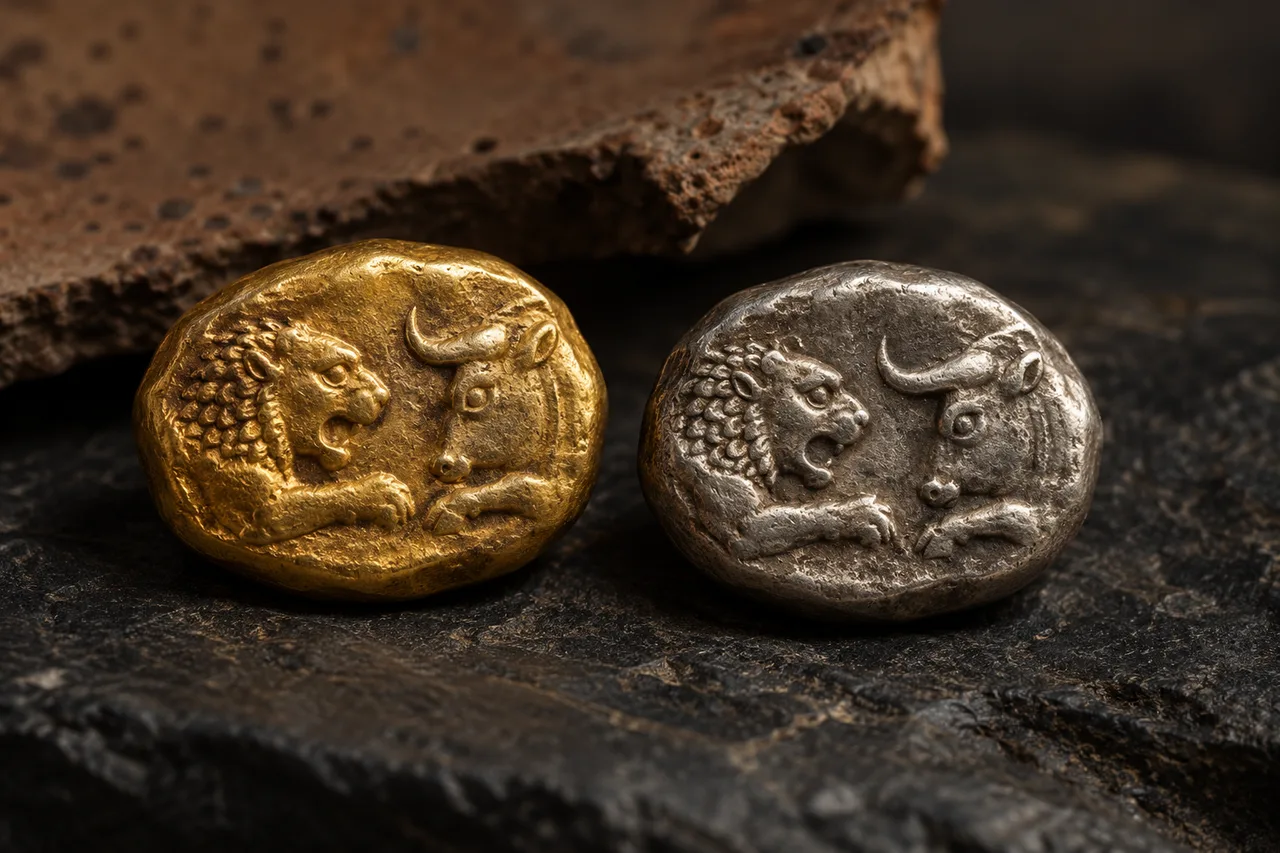
A lion faces a bull across a small field of metal. Their foreparts fill the front of the gold and silver coins associated with Croesus, king of Lydia; the reverse carries the blunt impressions of punches. The coins are thick and rounded, giving the little encounter a sculptural presence. One gold example in the British Museum weighs 8.003 grams: a precise, modest measure for an object attached to a king famous for his wealth. British Museum coin record, Sardis coinage study.
For a reader drawn to jewellery, the attraction can begin with that meeting of substance and image. The more closely we consider the object, the more its beauty becomes entangled with a practical question: what makes a piece of precious metal trustworthy?
Before the lion met the bull
Sardis was Croesus’s royal capital. Earlier Lydian royal coins had been made from electrum, an alloy of gold and silver that can occur naturally or be made artificially. Their familiar emblem was a lion’s head in profile. Some carry the Lydian inscription WALWET, which many scholars associate with King Alyattes. The proposed identification adds a possible royal name to the animal image. British Museum coin record, Pactolus North excavation guide, Sardis coinage study.
Electrum presented a difficulty hidden inside the material. Its proportions of gold and silver could vary, and added silver could reduce the gold content further. A piece’s weight alone therefore could not establish its value. The early stamped coins offered a solution: units already weighed and guaranteed by an issuing authority could be counted in payment, reducing the need to assess each separate piece of metal. The image carried a promise alongside its visual appeal. Sardis coinage study.
Two metals, one design
Around the middle of the sixth century BCE, Croesus replaced the electrum currency with separate issues of pure gold and pure silver. The gold coins became known as Croeseids. This distinction matters: the reform created money in each metal, giving gold and silver separate identities within the currency. Sardis coinage study.
Both metals carried the encounter between lion and bull. The motif itself was sufficient to identify the coins, without an accompanying inscription. Its precise meaning is less secure. John H. Kroll’s study considers a royal badge and a possible reference to the two metals among the interpretations. The animals remain arresting even when their message cannot be pinned down. Their appearance invites attention without requiring a definitive symbolic explanation. Sardis coinage study.
A particularly tangible clue to the reform’s date emerged in 2002. Beneath debris from Sardis’s city wall, destroyed during the Persian capture in the mid-540s BCE, excavators found two small coins: a gold one-twelfth stater and a silver one-twelfth stater. Their archaeological setting supports the existence of the new coinage before the conquest. Two little pieces of metal help anchor a much larger historical change. Sardis coinage study.
The work behind purity
Near the Pactolus stream, outside the city walls, refining installations operated during the first half of the sixth century BCE. Excavated in 1968 and 1969 under Andrew Ramage’s supervision, the remains include small ovens, pottery fragments and shallow hearths. These are the physical traces that bring the separation of precious metals into focus. Pactolus North excavation guide, Sardis refining study.
The reconstruction of cementation, the process used to separate gold, involves thin electrum sheets, ceramic vessels, salt and clay or brick dust. Silver was also worth recovering from the materials that absorbed it. That recovery involved smelting with lead and cupellation, a treatment that isolated the silver. Excavators exposed as many as 200 shallow bowl hearths, along with bellows nozzles and an iron blowpipe tip. Together, these remains make purity feel less abstract: it depended on material knowledge and repeated work. Sardis refining study.
A river with an unfinished story
The familiar account connects Lydian electrum directly with the Pactolus. Nicholas Cahill’s addition to the excavation team’s refining essay complicates that picture: analyses of natural gold sampled from streams around Sardis found virtually no silver. Those results challenge the assumption that the local stream supplied the alloy used for the coins. They leave the source of that electrum open to investigation. Sardis refining study.
The essay suggests possibilities, including electrum from mines in the Troad and the separation of obsolete electrum coins or other objects at Pactolus North. These remain hypotheses. The surviving installations establish that refining took place, while the precise origins and previous lives of the material are less certain. Sardis refining study.
The animal design had a life beyond Croesus, too: Persian rulers continued producing lion-and-bull coins after his reign. British Museum coin record. Today, their appeal can hold both kinds of attention—the pleasure of a compact relief and the curiosity stirred by an unfinished history. The lion and bull give the eye something definite to rest on; the metal still has questions to answer.