Story
Coral at the Table: Ottoman Sherbet Spoons
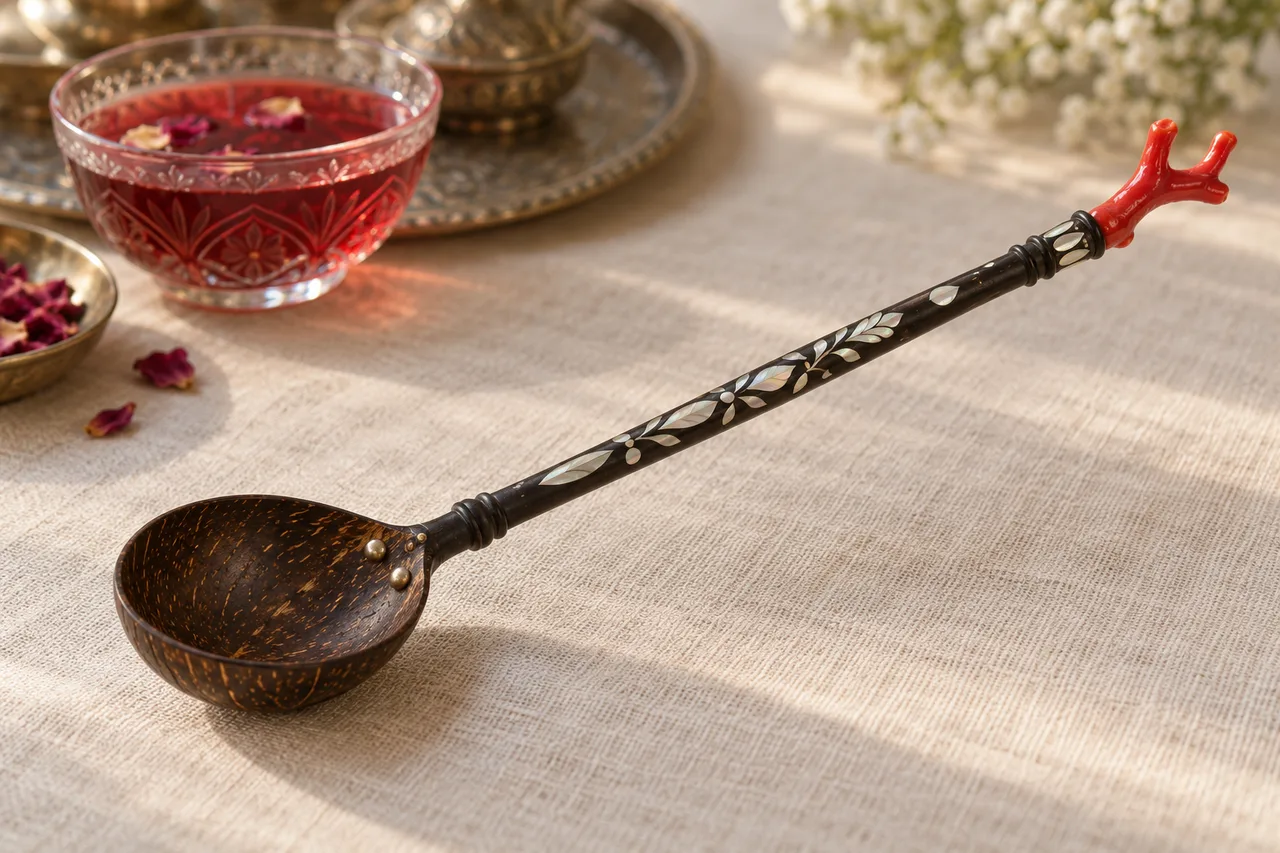
The coral catches the eye first. At the end of an Istanbul sherbet spoon in the Museum of International Folk Art, a naturally forked coral branch extends from an ebony handle. Mother-of-pearl inlay decorates the handle, while carved coconut shell forms the bowl. Together, these materials give an everyday shape an unexpectedly elaborate presence. Museum of International Folk Art
For someone drawn to jewellery, this is an inviting object. The eye moves from the branching tip to the inlay, then down towards the bowl. Each part offers a different pleasure, yet the whole remains recognisably a spoon: an object whose beauty belongs close to the hand.
A sweet drink and a shared meal
The word behind the utensil deserves a moment of attention. Ottoman Turkish şerbet referred to a sweet drink of diluted fruit syrup or juice. The familiar English word carries that history, even though it can now suggest a frozen dessert. Here, the drink is the starting point for understanding the name. American Heritage Dictionary
The wider dining setting helps bring the spoon into focus. Türkiye’s Ministry of Culture and Tourism describes Ottoman palace meals served from shared central dishes, with spoons varying in shape and size according to the food. In that account, the spoon is part of the organisation of a meal, its form connected to what was being served. Ministry account of Ottoman kitchen utensils
The same source cites the writer M. Baudier describing the ruler’s porcelain or coconut-shell spoon placed in a special open box. It is a small detail with considerable visual appeal: one utensil, given a space of its own. For a jewellery lover, that sense of an object being individually framed feels immediately familiar. Ministry account
A branch of coral
The Istanbul spoon dates to the middle of the nineteenth century and measures approximately 25.4 centimetres in length. Its coconut-shell bowl is riveted to the ebony handle; the mother-of-pearl is inlaid, and the forked coral is inserted at the handle’s end. The museum records it as A.1990.49.2. Museum of International Folk Art
Those details reward an unhurried look. There is a visual rhythm to the sequence: the bowl’s rounded form, the length of the handle, the branching finish. The coral provides an irregular accent within a clearly directed shape. Seen this way, the spoon has some of the compositional interest of a jewel, with attention passing between a main form and its smallest details.
A spoon at the Metropolitan Museum of Art, attributed to Turkey and dated to the eighteenth–nineteenth century, combines tortoiseshell, ivory, brass and coral. Its catalogue lists glass too, with a question mark that leaves the identification open. The Met collection record
The brilliance of a dining utensil
An especially elaborate Turkish pair, dated to the eighteenth–nineteenth century and catalogued by Sotheby’s, brings the comparison with jewellery into sharper focus. Each spoon has a teardrop-shaped mother-of-pearl bowl and a cylindrical carved coral handle. Floral and leafy carving extends across the coral and part of the mother-of-pearl, while diamond-inlaid terminals take the form of aigrettes, or plume ornaments. Sotheby’s, lot 316
Here, the decoration offers several scales of enjoyment: the outline of the whole spoon, the carved surface, and the small flourish at its end. The catalogue describes the pleasure of such utensils as extending across sight, touch and taste, and identifies an almost identical pair in the Topkapı Palace Museum, inventory numbers 2/2497 and 2/2498. The condition report also records repaired breaks in both spoons, with a replacement piece of mother-of-pearl in one. Alongside the decorative description, these details give the pair a history of damage and repair. Sotheby’s, lot 316
A whole company of spoons
A different Sotheby’s catalogue opens a much broader view: 190 nineteenth-century Ottoman sherbet spoons associated with the Güvençer factory, housed in three wooden cases. Some still retained their original factory wrapping. The group included both spoons carved from one piece and composite examples with bowls attached to handles by small metal pins. Sotheby’s, lot 413
The same collection offered long curved or tapering handles, deep oval or circular bowls, bud-shaped finials and coral tips, including branching examples. These variations make the group compelling to imagine together: a repeated, familiar shape continually altered by its proportions and finishing details. The surviving wrapping adds another point of interest, preserving part of the collection’s material history alongside the utensils themselves. Sotheby’s, lot 413
Returning to the single fork of coral, its appeal seems more intimate. A spoon leaves little room for a grand gesture, so a curve, an inlay or a carved tip carries particular weight. For the reader who loves beautiful objects, that concentration is the attraction: a whole composition held within something made for a meal.