Story
Carved from Sea Foam: Meerschaum’s Journey to Vienna
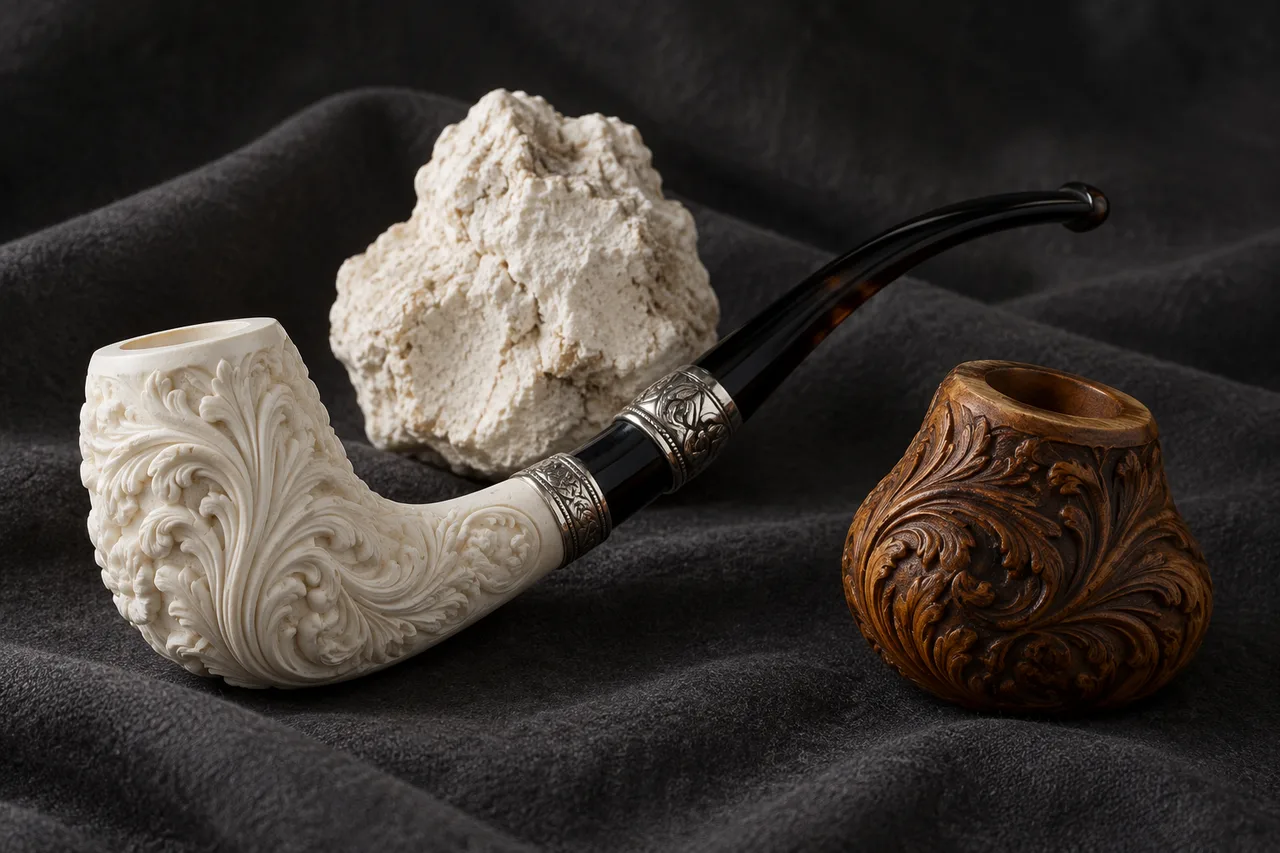
A cream-white pipe bowl and one turned rich brown offer two strikingly different impressions of meerschaum. The contrast belongs to the material itself: its absorbency causes pipes to change colour gradually, eventually acquiring a deep brown tone. For someone drawn to carved objects, that changing surface offers another reason to look closely. Ministry of Culture and Tourism
There is a larger journey behind the small object, too. It begins with nodules underground near Eskişehir and reaches the workshops of Vienna through the trade in raw stone. Following that journey brings the mineral, the work of carving and the finished object into the same frame. Craft inventory, Aysel Kaya’s study
A sea name, an earthly beginning
The German word Meerschaum means “sea foam.” In Turkish, the material is called lületaşı; the provincial craft inventory identifies it with sepiolite. The maritime name is evocative, but the substance is hydrous magnesium silicate, a mineral rather than the fossilized remains of sea creatures. Its white and near-white shades give the name a pleasing visual echo. Craft inventory, Ministry of Culture and Tourism
Around Eskişehir, the stone occurs in individual nodules. The inventory names extraction villages including Sepetçi, Karahöyük and Kozlubel, approximately 40–50 kilometres from the city centre. Its account of traditional mining describes vertical shafts and horizontal tunnels following the layers that contain the nodules, with much depending on human labour and experience. Behind the pale carving lies this less visible work of finding and bringing out the stone. Craft inventory
Freshly extracted meerschaum is damp and soft, allowing fine carving. As it dries, it becomes very light yet durable. The inventory describes a microscopic, sponge-like structure: a useful detail for understanding how a material can combine delicate workmanship with such lightness. The finished object gives little outward indication of how different the stone was when it first emerged from the ground. Craft inventory
Raw stone on the road to Vienna
Museum With No Frontiers places meerschaum’s high standing in pipe manufacture in the late eighteenth century and names Vienna and Paris as celebrated centres in the nineteenth. This gives the carved pipe a place within a wider European history of decorative objects, while leaving its material connection to Anatolia firmly in view. Museum With No Frontiers
That connection is documented in Aysel Kaya’s 2023 study of 34 travelogues written in German, English and Turkish between 1833 and 1963. The study traces raw meerschaum transported to Vienna, where it was processed and sold as pipe bowls and cigar and cigarette mouthpieces. These accounts reveal a trade linking the place where the stone was extracted with another place where it acquired its finished form. Aysel Kaya’s study
Read through that history, “Viennese” and “from Eskişehir” describe different chapters of the same material journey. The workshop city and the mineral’s source both matter. For a reader interested in the life of an object, its origin becomes a richer idea than a single place name.
When resemblance tells a different story
Meerschaum pipes also had cheaper reproductions. One unusually clear example belongs to Madrid’s Cerralbo Museum: a French pipe-shaped object dated 1865–1900, made from moulded resin. It takes the form of a young man’s head and is described as purely decorative, with no practical smoking function. The museum record connects it to a patented French production method that reproduced meerschaum pipes at lower cost. Museum With No Frontiers
The distinction adds interest to the object. Here, the head’s modelling belongs to the history of moulded resin, while the appearance it sought to reproduce belongs to meerschaum. For a prospective buyer fascinated by carved stone, the episode makes the material itself part of the appeal: a familiar shape can carry a very different account of how it was made.
Colour supplies another strand of the genuine mineral’s story. The ministry attributes a meerschaum pipe’s gradual browning to absorbency. The pleasure of looking can include both the quiet clarity of a pale carving and the warmth of a pipe whose surface has turned brown. The same material offers two quite different visual impressions. Ministry of Culture and Tourism
The story gathered in Eskişehir
The city also has a public home for the craft. Odunpazarı Municipality opened the Meerschaum Museum in the Kurşunlu Complex in 2008. The provincial account describes approximately 400 works by 60 artists, with the collection assembled through purchases from festivals, craft competitions and exhibitions held since 1998. Museum record
Alongside the pipe’s European history, the 2009 craft inventory presents meerschaum working as both an occupation and an art in Eskişehir. It records production for decoration and accessories, and workshops developing new models. The museum and the inventory together widen the view beyond a single celebrated object type. Craft inventory
A carving can be enjoyed for the way its details hold the eye. Knowing this history adds the ground beneath Eskişehir, the journey to Vienna and the city’s gathered works to that pleasure. The small object becomes a meeting point for material, workmanship and place.