Story
A Letter in Silver: An Envelope from Van
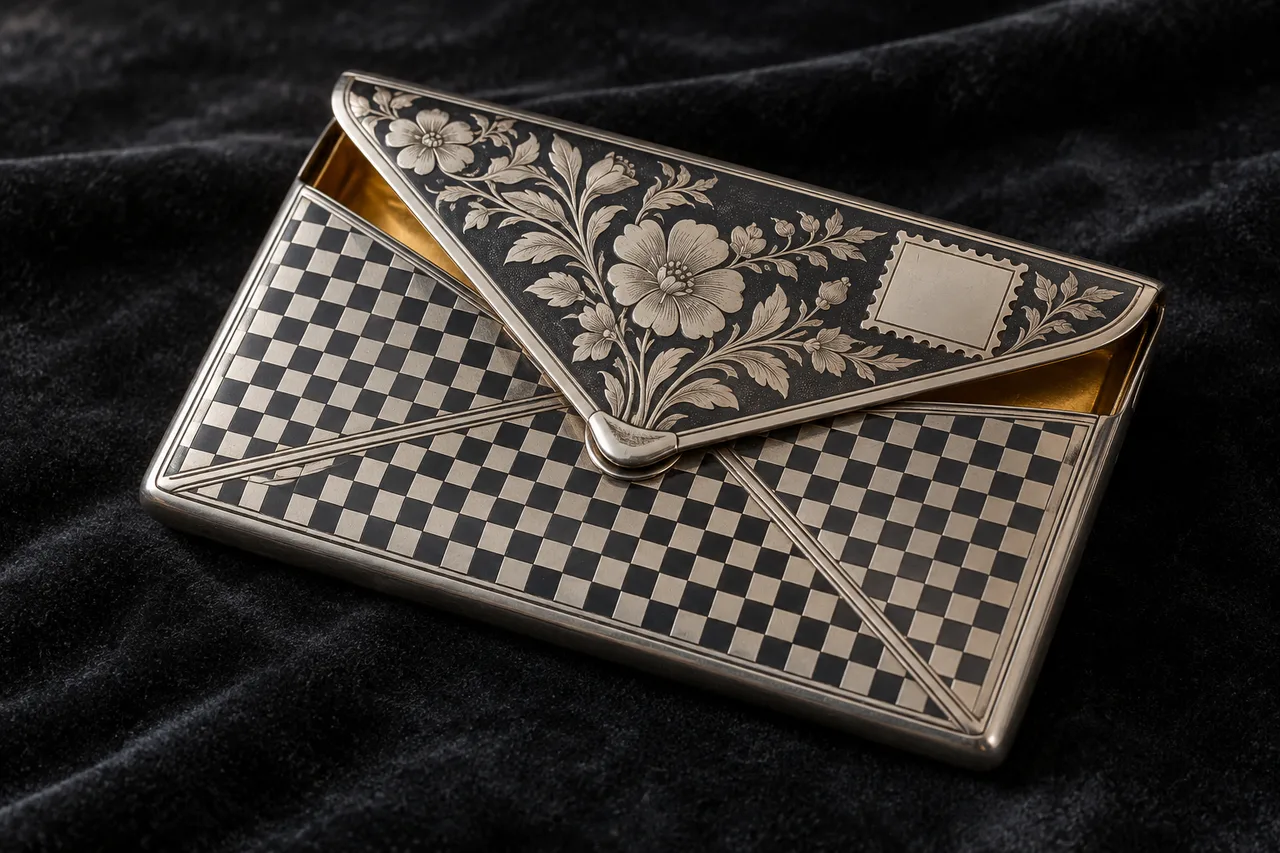
An envelope asks to be opened. Rendered in silver, it also asks to be kept. That small shift gives a cigarette case from Van its particular charm: an ordinary form associated with correspondence becomes a precious object for the pocket. Christie’s dates the silver-and-niello case to around 1905 and records an Armenian maker’s mark. Measuring just 9.2 centimetres long, it offers a compact meeting of ornament, material, and the suggestion of a message. Christie’s catalogue
An address to the imagination
The catalogue describes an envelope-shaped case with a checkered ground. On the front are a depiction of a Turkish one-piastre postage stamp and a Van postmark, transcribed as 20.07.(1)905. A floral spray accompanies a label bearing the word “Souvenir.” Inside, the silver case is gilded. These details give its small surface several distinct points of interest, from the form of the postal mark to the softer outline of the flowers. Christie’s catalogue
Together, they invite the eye to read the object as well as look at it. The stamp and postmark suggest the passage of a letter; the souvenir label introduces the idea of remembrance. Those are associations offered by the design. A particular journey, sender, or recipient remains outside the catalogue’s description.
The flowers add another register to the postal imagery. Their presence makes the composition feel personal, as though the formal signs of correspondence have acquired a small flourish of affection. Across this tiny “envelope,” the geometric ground supplies a visual rhythm, while the floral spray gives the gaze somewhere to pause.
Where the black line lives
Niello gives that surface its dark voice. The Museum of Fine Arts, Boston’s CAMEO reference describes it as a black metallic material combining sulfur with copper, silver, or lead. It occupies engraved lines in precious metal; heating the material within those incisions produces the dark inlay. That connection between line and material gives the decoration its particular presence: the black belongs within the drawn pattern. CAMEO: Niello
For the viewer, the pleasure lies in the exchange between brightness and darkness. The pale metal makes the pattern legible; the black gives the silver edges definition. A checkered ground can consequently feel both orderly and lively, its repeated divisions holding attention even before the eye settles on a recognizable motif.
For Van’s savat work, the Turkish Culture Portal describes a mixture of copper, lead, silver, and sulfur, and records the use of 900-fineness silver. These are details of the local practice described by that source; the case’s own catalogue entry specifies silver without stating its fineness. Turkish Culture Portal Christie’s catalogue
Van and Armenian silverwork
The Armenian maker’s mark places this object within a broader story of craftsmanship in Ottoman Van. In his account of Armenian metalwork, art historian Dickran Kouymjian identifies Van as a centre where black-and-silver niello was popular. He situates it within the substantial production of silver belts, buckles, earrings, purses, and communion boxes during the eighteenth and especially nineteenth centuries. Jewelry and small personal objects belong together in this account. Fresno State: Metalwork and Engraving Christie’s catalogue
Another measure of the city’s craft activity comes from the Turkish Culture Portal, which reports 120 savat workshops in Van before the First World War. The figure gives scale to a tradition encountered here through a single pocket object. It sets the case within a wider picture of the city’s craft activity. Turkish Culture Portal
Museum records bring the discussion back to things made for personal use. The Ararat-Eskijian Museum lists nineteenth-century silver-niello cigarette boxes from Van for both women and men, bearing Armenian inscriptions and symbols. Its collection provides a useful setting for this envelope-shaped case: decorated pocket objects form part of the material history represented there. Ararat-Eskijian Museum: Jewelry Collection
The promise of “Souvenir”
For someone drawn to jewelry, the appeal is easy to recognize. Attention moves between the overall silhouette and the smallest detail, between a material’s brightness and the marks that give it character. This case invites the same close, unhurried looking. Its compact scale makes the composition feel intimate, almost like a message addressed to whoever chooses to examine it.
The gilded interior adds a further pleasure to the design. Against the black-and-silver exterior, an imagined opening introduces a warmer field of colour. The envelope shape has prepared us for a revelation; the precious surface inside provides one. The catalogue’s brief mention of gilding allows that inward turn to become part of how we picture the object. Christie’s catalogue
“Souvenir” leaves room for a personal response. We can read the word as an invitation to remember a place, a person, or a moment, without assigning the case an invented biography. Its enduring attraction, for a present-day viewer, may lie in that openness: a little silver envelope whose message is carried by its form.