Story
A Book on a Chain
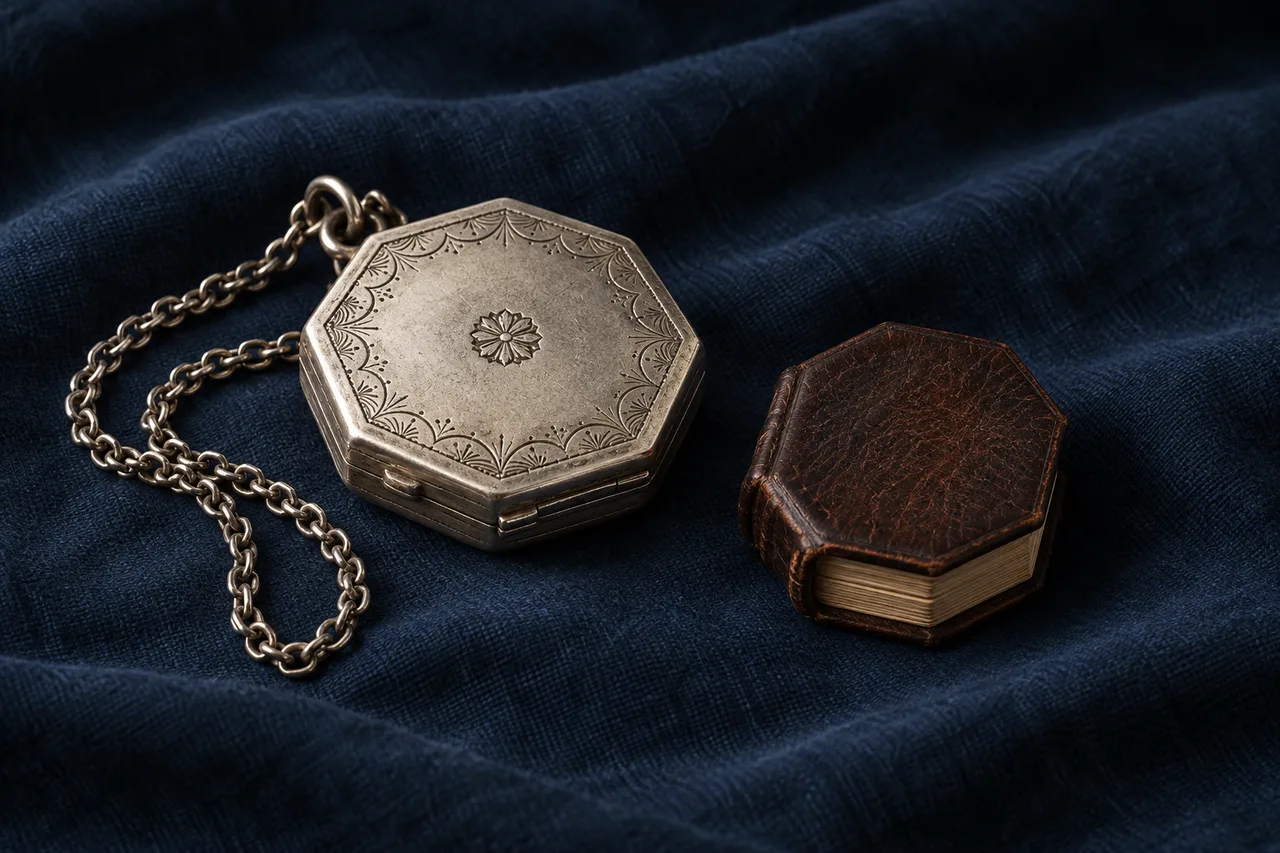
At pendant scale, a book becomes a startling object. Its octagonal outline has the presence of a jewel, while its chain brings the written word into the space usually occupied by an ornament. Miniature octagonal Qur’ans, often preserved in silver cases, could be worn around the neck, close to the heart. LACMA describes them as intimate objects whose owners associated that closeness to the body with protection. LACMA: Miniature Qur’an in Silver Case with Chain
The Ottoman world forms an important setting for their story. LACMA traces their popularity across the empire during the early modern period, alongside their appearance in India, Iran and sub-Saharan Africa; production continued into the twentieth century. The Smithsonian also notes that miniature Qur’ans and prayer scrolls became particularly popular in Turkey and Iran after the sixteenth century. Together, these accounts place the tiny book within a broad culture of carrying sacred words. LACMA · Smithsonian: Amulet case and scroll
A silver exterior, a book within
A revealing example survives at LACMA: a miniature Qur’an with a silver case and chain, catalogued as an Egyptian work that may date to the sixteenth century. Both qualifications matter. It offers a comparison for the Ottoman story while retaining its own geographical attribution and uncertain date. The catalogue records a width of 7.6 centimetres for the object and lists silver, leather, ink, opaque watercolor and gold on paper among its materials. LACMA
That material list brings two kinds of craftsmanship into the same small space. Silver belongs to the case; leather and decorated paper belong to the book it contains. Seen together, they invite attention to the relationship between an exterior made to be carried and an interior holding a manuscript. For a reader drawn to jewelry, the fascination lies partly in that change of scale: an entire book enters the familiar world of a pendant.
The case has an incised scalloped border framing a small rosette. LACMA notes that owners could commission lavish cases befitting their status. Here, the relatively simple decoration leads the museum to suggest an owner of more modest standing than the court. Yet the manuscript’s illumination echoes the broader luxury book production of its period. The museum also identifies the remarkable craftsmanship of miniaturization as part of these books’ appeal. Restraint in the silverwork leaves plenty to admire in the ensemble. LACMA
Near the heart, beside a banner
The chain gives the object another dimension. LACMA explains that its length allowed the encased Qur’an to be attached to a battle standard. This use supplied the most familiar name for the type: sancak, or “banner,” Qur’an. The same kind of miniature book could occupy the intimate space beside a wearer’s heart and the public setting of a military banner. LACMA
Those settings lend different emotional weight to the little case. Around the neck, its significance centers on the individual carrying it. With a banner, the book enters a setting associated with war. The chain is the visual connection between those possibilities, giving an object of manuscript culture the mobility we associate with personal adornment.
Its protective meaning belonged to religious belief. LACMA explains that miniature Qur’ans were understood to ward off evil or ill will, with the divine word and proximity to the body central to their talismanic role. The museum also allows for devotional reading, perhaps deepened by the concentration needed to follow such a small text. Reading, carrying and trusting in protection could all form part of an owner’s relationship with the book. LACMA
Another shape for a shared hope
A related object at the Smithsonian offers a different meeting of metal and sacred writing. Made in Iran during the Qajar period, in the late eighteenth or early nineteenth century, it is a hexagonal tubular case with silver over copper alloy. It retains its original prayer scroll. The case measures 7.6 centimetres in length; the scroll extends to 68 centimetres. Its thin parchment was unusual in an Iranian context where paper then predominated. Smithsonian
Three small loops suggest that the tube was intended to hang horizontally as a pendant. On its exterior, engraved inscription panels alternate with stylized plant motifs. Within, prayers in black ink are accompanied by larger red and blue invocations. Although the writing is legible at this scale, the Smithsonian explains that the prayers were intended to work together as a talisman. Smithsonian
The scroll case gives the octagonal book a revealing companion. Each brings sacred writing into a metal enclosure that can be worn; each connects careful workmanship with the hope of protection. For someone drawn to silver today, that relationship offers a particular kind of beauty. The chain, the border and the small central ornament are the visible beginning of an object whose meaning also rests in what it holds.